


On-location work is where a lot of studios find out exactly how big the gap is between their studio operation and their field operation. In the studio, everything's predictable — same power outlets, same backdrops, same bathroom down the hall. On location, you're at the mercy of a building manager who "forgot" you were coming, a permit office that takes 12 business days instead of the 5 they promised, and a second shooter whose car battery dies at 6:40am.
Studios that handle location shoots well aren't more talented. They just treat the two weeks before the shoot as the actual job. What follows is the on-location shoot checklist that holds up under pressure — permit and insurance timing, scouting details people forget, and the contingency roles that keep a bad morning from turning into a refund conversation.
Start with the timeline, because everything else fails when this slips
The most common way a location shoot goes sideways isn't creative. It's paperwork that got started too late. A permit request submitted 4 days out that needed 10. A certificate of insurance (COI) the venue required, requested the afternoon before the shoot, when the insurance office is already closed.
Permits and COIs aren't hard — they're just slow, and the slowness is outside your control. Municipal film permit offices run on their own schedule. Venues route COI requests through a facilities or legal contact who checks email twice a week. You can't compress those timelines by being stressed about them. You can only start earlier.
| Days before shoot | Task | Why this timing |
|---|---|---|
| 21+ | Confirm location, get written permission or booking | Owner/manager availability is the real bottleneck |
| 14 | Submit permit application (if public/municipal) | Most city offices quote 5–10 business days |
| 14 | Request COI from your insurer with venue's exact wording | Additional insured language often needs an edit |
| 10 | Scout the actual location in person or via detailed video | Late scouting = surprises with no time to fix |
| 7 | Confirm COI received by venue, get written acknowledgment | "We never got it" is the classic day-of excuse |
| 5 | Lock crew, assign contingency roles | People flake; you need buffer to backfill |
| 3 | Weather check + reschedule decision deadline (outdoor) | Deciding at 5am is deciding too late |
| 1 | Gear check, load list, call sheet distributed | Everyone knows where to be and what they carry |
The dates aren't sacred. A private residence shoot skips the municipal permit entirely. A corporate lobby might need three weeks of lead time because their legal team reviews every COI. Adjust the timeline to your riskiest dependency, not your comfort level.
The mistake studios keep repeating: treating the timeline as a checklist they hope to hit instead of a set of hard deadlines with someone's name attached. If nobody owns "COI confirmed received by day 7," it becomes "COI confirmed received on the drive over."
Permit and insurance verification: confirm receipt, not just sending
There's a real difference between "I sent it" and "they have it and accepted it." Studios get burned on that gap constantly.
Never miss a shoot or client detail again.
TryPixly helps you book, confirm, and manage every photography session seamlessly.
- Unified session and client management
- Automated client reminders
- Team calendar & resource scheduling
No credit card required
You emailed the permit application. Did the office confirm it's complete, or is it sitting in a queue waiting on a missing signature? You sent the COI to the venue's booking contact. Did that contact forward it to the person actually working the door on shoot day — and does the COI name the correct entity as additional insured, with the correct address?
A COI that lists the property management company but not the individual building LLC the venue's lease actually requires is worthless at the door. It looks right. It's wrong. And you find out at 7am with a client and two subjects standing next to you.
Build verification in as its own step:
-
Permit get a permit number or written confirmation of approval, not a "we received your application" auto-reply
-
COI get a reply from the venue explicitly stating the certificate is accepted and on file
-
Additional insured wording paste the venue's exact required language into your insurer request — don't paraphrase it
-
Parking/loading permits separate from the shoot permit in many cities, and separately slow
-
Contact for shoot day name and cell of the person who unlocks the door, not the person who booked it
That last one saves more shoots than anything else on this list. The person who signed your booking agreement three weeks ago is often not the person on-site. Get the on-site contact's direct number before the day, and confirm they actually know your crew is coming.
The scouting details people skip and regret
Most scouting reports capture the pretty stuff — light quality, backdrops, angles. Then the shoot happens and every problem is logistical, not creative. Where do we plug in? Is there a working bathroom? Can the van get within carrying distance of the entrance, or is it a 200-foot haul through a courtyard?
A proper scout treats the location as an operational environment, not just a set. Walk it at roughly the same time of day you'll shoot, because a lobby flooded with natural light at 2pm can be a cave at 9am.
-
Power — number and location of working outlets, whether they trip under load, whether you need a generator or extension runs
-
Access — closest vehicle drop, elevator vs stairs, freight elevator hours, any loading dock booking required
-
Timing conflicts — cleaning crews, other bookings, foot traffic patterns, when the space is actually empty
-
Light through the day — how windows behave at your shoot time, not at scout time
-
Backup interior space — for outdoor shoots, the exact fallback room and whether it's included in your booking
-
Bathroom + changing area — non-negotiable for family and headshot sessions with wardrobe changes
-
Ambient noise — HVAC cycles, nearby construction, PA systems in retail or corporate spaces
-
Cell signal / wifi — matters if you tether, upload previews, or need to reach the client mid-shoot
-
Ceiling height and obstructions — for lighting setups, sprinkler heads, low fixtures
Photograph everything, including the boring stuff. A photo of the outlet locations and the loading route is worth more on shoot day than another hero shot of the window light.
Contingency roles: assign the failures before they happen
Every location shoot has predictable failure points. Someone will be late. Gear will malfunction. The venue contact won't answer. The weather will turn. What separates a studio that absorbs these problems from one that unravels is whether those situations already have an owner assigned in advance.
Contingency roles aren't about hiring more people. On a two-person shoot, one person can hold three contingency roles. The point is that when something breaks, nobody's standing around asking "so what do we do?" The answer already has a name next to it.
-
Point of contact (POC) — the single person who calls the venue, handles access issues, and talks to the client if something changes. Only one voice to the outside world prevents mixed messages.
-
Gear backup owner — knows the redundancy plan
which spare body, which backup lighting, what happens if the primary strobe dies. Also owns the load-out list so nothing gets left behind.
-
Weather/reschedule decision-maker — has the authority to pull the trigger on the plan-B interior space or the reschedule, using the pre-set deadline. Not a committee. One person, one deadline.
-
Crew backfill owner — has the phone numbers of two on-call shooters or assistants and the authority to call them if someone no-shows.
Pair every contingency role with a trigger and a threshold.
One pattern worth borrowing: pair every contingency role with a trigger and a threshold. "If the venue contact doesn't answer by 15 minutes before call time, POC escalates to the building's main line and the emergency contact." A clear trigger removes the hesitation that costs you twenty minutes of daylight.
A real scenario: the shoot that almost cost a refund
A three-person portrait studio booked an outdoor family session at a public botanical garden — the kind of shoot that runs $600–$900 for them. They'd shot there before, so they assumed the permit process was casual. It wasn't. The garden had changed management and now required a photography permit with 7 business days lead time, plus a COI naming the new operating entity.
They submitted the permit 4 days out. Denied for lateness. No permit, no shoot, and a client who'd booked around a visiting grandparent's one weekend in town.
They scrambled to a backup park, but the location had harsh midday light and no shade, and the gallery came back weak. The client asked for a partial refund, and the studio ate roughly $300 plus a reshoot to keep the relationship.
The fix wasn't complicated. They built a standing pre-shoot timeline template for every location type — private, public, corporate — with permit and COI deadlines pre-loaded and a named owner for each step. The following season, location shoots stopped generating fire drills. Not because they got lucky, but because the paperwork started on the right day every time, instead of whenever someone remembered.
When a full location protocol is overkill
Not every off-site shoot needs this much machinery. A headshot session at a client's private office, with a contact you already trust and no municipal permit involved, doesn't warrant a 21-day timeline. Forcing heavy process onto low-risk shoots just trains your team to ignore the checklist when it actually matters.
Scale the protocol to the risk. Public or municipal locations, corporate buildings with legal review, and anything outdoors and weather-dependent get the full timeline. A repeat private residence with an established client gets the light version — scout photos, gear list, one contingency owner, done. The judgment is knowing which shoot is which before you commit to a date, not after.
Making the checklist actually get used
A checklist that lives in someone's head or in a buried Google Doc doesn't survive a busy season. Studios that keep this discipline turn each timeline step into an assigned task with a due date and an owner — so "submit COI request by day 14" shows up as an actual reminder to an actual person, not a good intention that gets buried under client emails.
This is where a workflow or job-management platform earns its keep. Templating the pre-shoot timeline once means every new location booking auto-generates the permit deadline, the COI verification step, the scouting task, and the contingency-role assignments. Automated reminders nudge the right person before the deadline, not after it's blown. The value isn't the software being clever — it's that the boring, slow, easy-to-forget steps stop depending on someone's memory during your busiest weeks.
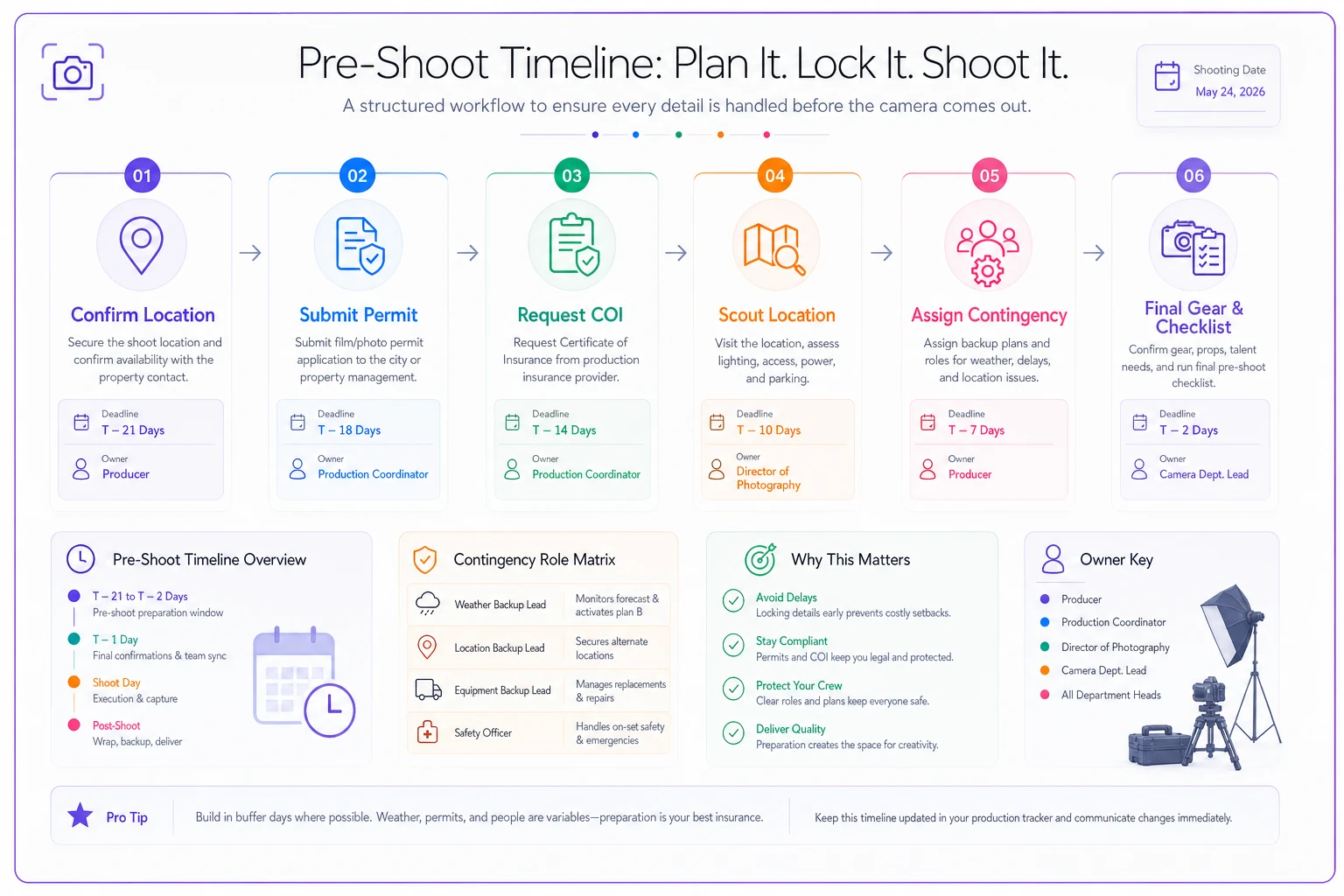
Here's a simple visual workflow for the pre-shoot timeline.
Whatever tool you use, the principle holds: a location shoot is won or lost in the two weeks before it. Get the permit and insurance timing on a real calendar, scout the location as an operational space and not just a pretty backdrop, and give every likely failure a name before you leave the studio. Do that consistently, and on-location work becomes a reliable part of your revenue instead of the thing that keeps you up the night before.
Whatever tool you use, the principle holds: a location shoot is won or lost in the two weeks before it. Get the permit and insurance timing on a real calendar, scout the location as an operational space and not just a pretty backdrop, and give every likely failure a name before you leave the studio. Do that consistently, and on-location work becomes a reliable part of your revenue instead of the thing that keeps you up the night before.
Ready to elevate your studio’s workflow?
Join 500+ studios using TryPixly to save time, reduce scheduling conflicts, and deliver exceptional client experiences.