



I spent three months mapping workflow breakdowns across photography studios, and what actually killed client relationships wasn't missed deadlines — it was the handoff gaps nobody measured. A studio in Denver was delivering galleries 14 days late on average, but when we traced the actual workflow, the real issue was a 4-day black hole between shooting and retouching where files just… sat. Nobody's fault specifically. Just no gate.
The photography studio operations playbook most businesses need isn't about faster editing or better photographers. It's about building measurable checkpoints between workflow stages where accountability transfers cleanly and nothing disappears into operational limbo.
Why traditional deadline tracking misses the actual problem
Studios usually track two things: booking date and delivery date. Maybe shoot date if they're organized. But the failures happen in the spaces between — those unmarked handoff zones where one person's responsibility ends and another's theoretically begins.
A portrait studio handling 80-100 sessions monthly found that their 21-day average delivery broke down like this: 2 days for shooting prep, same-day shoot, 6 days sitting before retouching started, 8 days in retouching, 3 days waiting for quality review, 2 days for final packaging and delivery. The actual work took roughly 13 days. The handoff gaps ate 8 of them.
Those gaps compound with volume. At 30 sessions a month, informal handoffs might hold together. People remember what needs doing. At 80+ sessions, you're juggling shoots at every stage simultaneously, and that's where things break. Files get forgotten. Priority gets confused. The newest fire gets attention while older sessions quietly drift past their delivery dates.
What makes this particularly damaging is that clients don't see your internal handoffs. They see the gap between their session and receiving images. Every extra day past expectation chips away at referral probability. One studio tracked this directly: clients receiving galleries within 14 days left reviews at a 47% rate with 4.8 average stars. Clients waiting 21+ days reviewed at a 61% rate but averaged 3.9 stars. More reviews, worse scores. Not a trade you want to make.
Building gates, not just deadlines
The operational fix isn't setting stricter deadlines. It's creating measurable handoff gates with clear ownership transfer. Each gate needs three things: completion criteria, acceptance criteria, and escalation triggers.
Never miss a shoot or client detail again.
TryPixly helps you book, confirm, and manage every photography session seamlessly.
- Unified session and client management
- Automated client reminders
- Team calendar & resource scheduling
No credit card required
Take the pre-shoot to shoot-day handoff. Most studios assume this happens automatically — session is booked, photographer shows up, photos get taken. But without a formal gate, you get photographers discovering missing props, unclear client expectations, or double-booked locations on the morning of the shoot.
A functioning pre-shoot gate looks like this:
-
72 hours before session
-
Client questionnaire complete
-
Location confirmed and accessible
-
Equipment list verified against session type
-
Backup photographer identified if needed
-
Client preparation email sent and confirmed received
The key isn't the checklist itself — it's that someone explicitly accepts responsibility at this gate. The scheduler completes the items, the photographer reviews and accepts. If something fails, escalation happens at T-minus 48 hours, not morning-of when nothing can be fixed.
Same logic applies to the shoot-to-retouch handoff. Raw files uploaded is not a handoff. It's a file transfer. A real handoff includes shot count verification, flagged selects if applicable, special instructions documented, and explicit acceptance by the retouching team within a defined window.
Require acceptance to be timestamped so your dashboard can automatically mark gate completion and trigger escalations.
If acceptance is explicit and timeboxed, you avoid the "I didn't know it was ready" syndrome entirely.
The four critical gates every studio needs
After watching dozens of studios struggle with delivery delays, these four gates consistently determine whether a client experience is good or painful.
Gate 1: Inquiry to Booking Confirmation
Timeframe: 24-48 hours Owner transition: Sales/booking coordinator to production scheduler
-
This gate catches misaligned expectations before they become production problems. Package details, specific requests, and unusual requirements get documented here. A family portrait studio started requiring coordinator sign-off on any session with 8+ subjects after discovering these consistently ran over and cascaded delays through their entire day.
-
Acceptance criteria
-
Package details match system pricing
-
Special requests documented and feasibility confirmed
-
Session requirements verified against available resources
-
Deposit processed or payment terms documented
Escalation: No confirmation within 48 hours of inquiry automatically flags for manager review. Too many studios lose bookings here simply because nobody formally owned the conversion step.
Gate 2: Pre-Production to Shoot Ready
Timeframe: 72 hours before session Owner transition: Production scheduler to assigned photographer
-
Most shoot-day disasters trace back to this gate failing. The scheduler has everything prepared on paper, but has the photographer actually reviewed and accepted the setup?
-
Acceptance criteria
-
Photographer confirms equipment availability
-
Location access verified (especially for on-location shoots)
-
Client prep materials sent and delivery confirmed
-
Props or special materials pulled and staged
-
Weather contingency plan established for outdoor sessions
One studio reduced their reschedule rate from 18% to 6% just by requiring photographer acceptance at this gate rather than assuming preparedness.
Gate 3: Shoot Completion to Retouching Start
Timeframe: 24 hours post-shoot Owner transition: Photographer to retouching team
-
This is where most studios hemorrhage time. Files get uploaded whenever the photographer gets around to it and retouching starts whenever someone notices new files. The lag compounds fast with volume.
-
Acceptance criteria
-
All files uploaded to designated folders
-
Culling complete (if photographer-culled workflow)
-
Shot count verified against package requirements
-
Special retouching notes documented
-
Technical issues flagged — soft focus, exposure problems, etc.
-
Priority level assigned based on delivery promise
The retouching team must actively accept the handoff within the timeframe, not just passively receive files. This kills the "I didn't know it was ready" excuse before it starts.
Gate 4: Retouching Complete to Client Delivery
Timeframe: 48 hours from retouch completion Owner transition: Retouching team to delivery coordinator
-
Even when images are ready, delivery delays happen — wrong gallery links, missing prints, incomplete packages. This gate makes sure everything the client expects is actually prepared before anything goes out.
-
Acceptance criteria
-
Image count matches package specifications
-
Print orders queued if included
-
Gallery passwords and access tested
-
Download permissions set correctly
-
Any additional products prepared
-
Delivery communication drafted
Studios often skip formalizing this gate because delivery seems straightforward. But a wedding studio tracked 31% of their client complaints back to delivery issues — wrong gallery access, missing images, incorrect download sizes. All preventable with a proper gate.
Here's a simple visual to help teams understand how gates and ownership transitions flow through a session lifecycle.
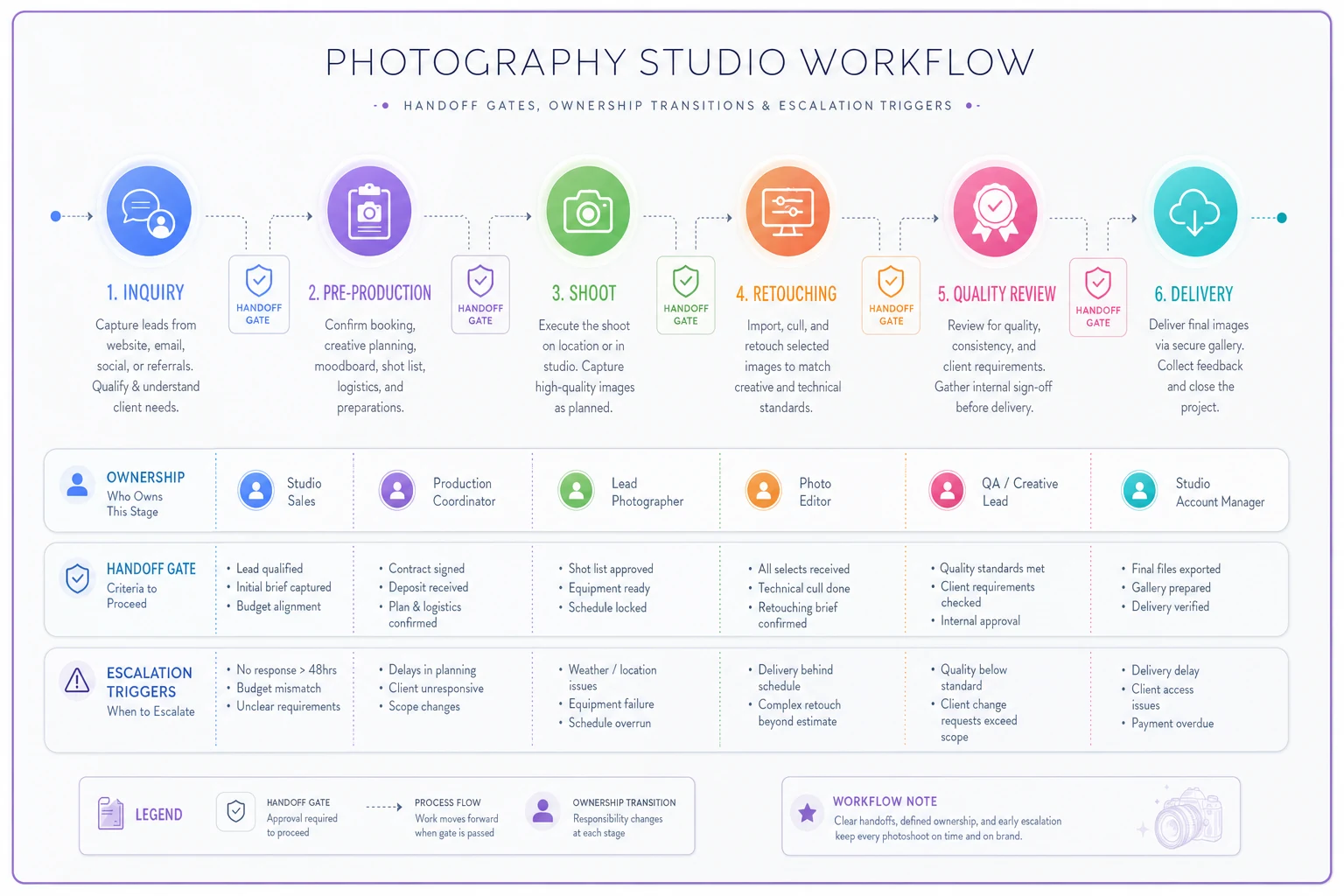
Use this to align teams on who accepts responsibility at each stage and what escalations look like.
Escalation rules that actually trigger
Gates without escalation are just suggestions. Every gate needs automatic triggers that fire when timelines slip.
Standard escalation ladder:
-
T-minus 25% of timeline Automated reminder to owner
-
Timeline expired Automated alert to owner and manager
-
T-plus 50% of timeline Director-level notification with response required
-
T-plus 100% of timeline Client communication triggered with revised timeline
A studio running 100+ sessions monthly implemented this ladder and saw their on-time delivery rate jump from 67% to 89% in eight weeks. Not because people worked faster — because bottlenecks became visible before they became disasters.
The escalation can't be manual. If someone has to remember to check and escalate, it won't happen consistently at volume. The system needs to automatically track gate timestamps and trigger notifications. This is where operational software becomes genuinely useful — spreadsheets can't proactively alert you when handoffs stall. Someone has to notice, and at scale, nobody consistently notices.
Dashboard metrics that prevent surprises
Tracking completion rates tells you what happened. Tracking gate health tells you what's about to happen. That distinction matters a lot for operational planning.
| Metric | What It Tells You |
|---|---|
| Gate completion rate | Percentage completing within timeline |
| Average gate duration | Actual time from start to acceptance |
| Gate failure points | Which acceptance criteria fail most often |
| Escalation frequency | How often each gate triggers escalation |
| Downstream impact | How gate delays affect total delivery time |
A boutique portrait studio started tracking these and discovered their pre-production gate succeeded 94% of the time, but their shoot-to-retouch gate only hit 61%. That single data point let them reassign resources and cut average delivery time by 5 days without changing anything else.
The dashboard should show both current status and trends. Is the shoot-to-retouch gate getting worse over time? Are escalations increasing week over week? These patterns surface systemic issues before they turn into client complaints. A weekly summary helps with planning, but operations managers need to see today's bottlenecks while there's still time to intervene — not in a report next Monday.
Template systems for consistent handoffs
Templates seem basic, but inconsistent handoff communication causes more delays than almost any other factor. Every gate needs standardized templates that clearly communicate what's being handed off, what's expected, and when.
Pre-shoot handoff template example:
-
Session Details
-
Client
[Name]
-
Session type
[Type]
-
Date/time
[DateTime]
-
Location
[Address or Studio Room]
-
Package
[Selected Package]
-
Expected deliverables
[Quantity and type]
-
Preparation Status
-
Client questionnaire
[Complete/Incomplete — Link]
-
Location status
[Confirmed/Pending]
-
Special requests
[Details or "None"]
-
Equipment needs
[List or "Standard"]
-
Props required
[List or "None"]
-
Handoff Acceptance Required By [DateTime]
-
Accept Handoff [Button/Link]
The template forces completeness. You can't hand off without filling every field. The photographer can't claim they didn't know about special requests if they accepted a handoff that listed them explicitly.
Similar templates across each gate create predictability. The retouching team knows exactly what information they'll receive with each new batch — no hunting through email threads or Slack messages for special instructions buried somewhere.
How handoff accountability changes with scale
A 2-photographer studio can manage informal handoffs. Everyone knows what everyone else is doing. But structural problems emerge at predictable volume thresholds.
-
Under 30 sessions/month A single photographer can handle most gates themselves. Handoffs are mostly client-to-studio and studio-to-client.
-
30-60 sessions/month Separation starts. Can't have the same person shooting and retouching everything. First real handoff challenges emerge. This is where most studios start dropping balls — enough volume to need handoffs, but not enough pain yet to formalize them.
-
60-100 sessions/month Multiple photographers, dedicated retouching, possibly separate booking coordination. Informal handoffs completely break down. Without gates, delays and complaints are inevitable.
-
100+ sessions/month Gates aren't optional. Multiple sessions at every stage simultaneously, no individual can mentally track all handoffs. System-based accountability or constant failures — pick one.
The trap is waiting until you're drowning to implement gates. A studio at 40 sessions a month might survive without formal handoffs, but they're establishing habits that will cripple them at 80. Better to build the structure before the volume forces it.
Automation opportunities without losing accountability
Technology can handle tracking and triggering. Humans have to own the handoffs. That balance matters.
-
Gate timer tracking (starts automatically when previous gate closes)
-
Escalation triggering based on timelines
-
Template population with session data
-
Dashboard updates and metric calculation
-
Client communication for timeline updates
Elements that must stay human-controlled:
-
Acceptance of handoff responsibility
-
Quality verification at each gate
-
Decision-making on exceptions
-
Client relationship management during delays
A high-volume corporate headshot studio automated their gate tracking and escalation through integrated operations software and cut management overhead by roughly 60%. But they kept human acceptance requirements at every gate. The system tracked and reminded — people still explicitly accepted responsibility. If anything, that made accountability clearer, not less, because acceptance was logged and visible.
Common gate failures and their fixes
Pre-shoot gate failure: Photographer accepts handoff without actually reviewing the details. Fix: Require specific confirmation of key elements, not just a single "accept" button. Make them confirm location, special requests, and equipment separately.
Shoot-to-retouch black hole: Files uploaded but nobody notified. Fix: Upload isn't handoff. Require active notification with file count and special instructions. Retoucher must acknowledge receipt within the gate timeline.
Quality review bottleneck: Single person reviewing all work creates a massive backup at that gate. Fix: Tiered review based on session value. High-value sessions get detailed review, standard sessions get a spot-check, all reviews must complete within the gate timeline.
Client delivery confusion: Multiple people think someone else is handling delivery. Fix: One designated role owns the delivery gate. Backup assigned, but primary owner is explicit. No shared responsibility.
A wedding photography studio fixed their chronic delivery delays by addressing just these four patterns. Their on-time rate went from around 55% to 82% within two months.
When studios should implement full gate systems
Not every studio needs all four gates immediately. It depends on where the pain actually is.
Start with gates when:
-
Delivery delays exceed 15% of sessions
-
Client complaints about timing are increasing
-
Team members regularly claim "I didn't know it was ready"
-
You're personally tracking handoffs in your head
-
Volume exceeds what one person can mentally track
Start with the most painful gap. Usually that's shoot-to-retouch or retouch-to-delivery. Get one gate working before adding others. A family portrait studio started with just their shoot-to-retouch gate and saw immediate improvement before expanding the system further.
Full four-gate implementation makes sense when you have:
-
Multiple photographers
-
Separate retouching, in-house or outsourced
-
50+ sessions monthly
-
Different session types requiring different workflows
-
Team members who don't overlap shifts
The investment pays off through fewer client complaints, less firefighting, and better team coordination. One studio calculated that reducing their average delivery time by 5 days increased referrals enough to generate 8-10 additional bookings monthly. Gates aren't overhead — they're revenue protection.
Operational excellence through measured handoffs
Studios lose clients in the gaps between work, not during the work itself. Your photographer might nail the session. Your retoucher might produce stunning edits. But if the handoff between them adds a week of dead time, the client only remembers the wait.
Building a photography studio operations playbook around measurable gates changes how work flows through your business. Instead of hoping things move along, you know exactly where every session stands, who owns it right now, and when the next handoff should happen.
The studios thriving at scale aren't necessarily faster at each individual step. They've eliminated the dead zones between steps where sessions sit waiting for someone to notice them. They've made accountability explicit through accepted handoffs rather than assumed through general job descriptions.
This isn't about complex software or revolutionary workflows. It's about acknowledging that handoffs are where most studios fail and building simple gates to ensure clean transfers of responsibility. Add escalation so gates don't get ignored. Add metrics to catch patterns before they become client problems. Add templates to keep handoffs consistent regardless of who's working that week.
Your clients judge you on total time from session to delivery. Your operations should focus on the handoffs that determine whether that's 14 days of active work or 14 days of work padded with 10 days of organizational gaps. That difference determines whether clients refer you enthusiastically or just tolerate the wait.
Studios lose clients in the gaps between work, not during the work itself. Your photographer might nail the session. Your retoucher might produce stunning edits. But if the handoff between them adds a week of dead time, the client only remembers the wait.
Building a photography studio operations playbook around measurable gates changes how work flows through your business. Instead of hoping things move along, you know exactly where every session stands, who owns it right now, and when the next handoff should happen.
The studios thriving at scale aren't necessarily faster at each individual step. They've eliminated the dead zones between steps where sessions sit waiting for someone to notice them. They've made accountability explicit through accepted handoffs rather than assumed through general job descriptions.
This isn't about complex software or revolutionary workflows. It's about acknowledging that handoffs are where most studios fail and building simple gates to ensure clean transfers of responsibility. Add escalation so gates don't get ignored. Add metrics to catch patterns before they become client problems. Add templates to keep handoffs consistent regardless of who's working that week.
Your clients judge you on total time from session to delivery. Your operations should focus on the handoffs that determine whether that's 14 days of active work or 14 days of work padded with 10 days of organizational gaps. That difference determines whether clients refer you enthusiastically or just tolerate the wait.
Ready to elevate your studio’s workflow?
Join 500+ studios using TryPixly to save time, reduce scheduling conflicts, and deliver exceptional client experiences.