



Most photography studios run their calendars like they're still shooting on film—60-minute blocks for everything, 15-minute buffers between sessions, and then wondering why they're exhausted but not profitable.
The problem isn't your energy levels. It's that different session types need completely different time structures, and generic scheduling burns money in ways that are easy to miss.
Why standard time blocks destroy studio profitability
A newborn session operates nothing like corporate headshots. The baby needs feeding breaks, parents need outfit changes, siblings need attention. Meanwhile, corporate clients show up, shoot for 12 minutes, and leave. But most studios book them both in the same 60-minute slots.
This creates two expensive problems. First, you're giving away 48 minutes of profitable time on those headshots. Second, you're cramming newborn sessions into windows that guarantee stress and rushed results.
The real damage shows up in your monthly numbers. Studios typically lose 8 to 12 hours of bookable time per week just from poor slot allocation. At $150–$300 per session, that's somewhere between $4,800 and $14,400 monthly in lost revenue potential.
Breaking down actual session timing
After tracking hundreds of sessions across different studio types, clear patterns emerge that most scheduling templates completely miss.
Never miss a shoot or client detail again.
TryPixly helps you book, confirm, and manage every photography session seamlessly.
- Unified session and client management
- Automated client reminders
- Team calendar & resource scheduling
No credit card required
Newborn sessions average 2.5 to 3 hours of actual studio time, but the work distribution looks nothing like other sessions:
-
Setup and prep
25–35 minutes
-
Active shooting
45–60 minutes (broken into 3–4 segments)
-
Feeding/soothing breaks
30–45 minutes
-
Parent outfit changes
15–20 minutes
-
Breakdown and reset
20 minutes
Newborn sessions naturally segment into bursts. Trying to power through creates stressed babies and disappointed parents. That's just the reality of the session type.
Multi-family sessions follow a completely different rhythm:
-
Pre-session coordination
15 minutes
-
Individual family units
20 minutes each
-
Full group combinations
25–30 minutes
-
Transition time between groupings
5 minutes per change
-
Final shots and wrap
10 minutes
A three-family session realistically needs 90–105 minutes of studio time, plus another 20 minutes of buffer for late arrivals—which happens in roughly 40% of multi-family bookings.
Corporate headshots move like an assembly line:
-
Setup (if not pre-staged)
10 minutes
-
Per person shooting
8–12 minutes
-
Image review and selection
3–5 minutes per person
-
Breakdown
5 minutes
The mistake studios make is booking individual headshots in hour blocks when the actual work takes 20 minutes total.
The hidden costs of wrong buffer times
Buffer time between sessions can feel like wasted space on your calendar, but the wrong buffer strategy costs more than no buffers at all.
Too little buffer creates cascade failures. One session runs 10 minutes over, the next client waits in the lobby getting frustrated, you rush their session to catch up, quality drops, and suddenly you're dealing with reshoots and refunds.
Too much buffer means turning away bookings. Studios often default to 30-minute buffers between everything, which sounds professional but blocks out 2–3 additional sessions per day.
Different session types need different buffer strategies.
Newborn sessions need 30–45 minute buffers afterward. Not just for cleanup—these sessions frequently run over. Parents dealing with a crying baby don't care about your next appointment.
Corporate headshots need almost no buffer—maybe 10 minutes to reset lighting and review the schedule. These clients show up on time, know what they want, and leave quickly.
Multi-family sessions need front-loaded buffers. Put 20 minutes before the session to handle coordination calls and late arrivals, but only 15 minutes after, since these rarely run over once everyone's assembled.
Building session-specific scheduling templates
Generic calendar software treats all appointments equally, which is why so many studios struggle with time management despite using "professional" booking tools.
Here's what actually works:
Newborn Session Template
-
Booking slot 3 hours
-
Actual session time 2.5 hours
-
Buffer after 30 minutes
-
Best scheduling Morning start (9 AM or 10 AM)
-
Never schedule Back-to-back newborns
-
Weekly limit 3–4 maximum
The morning preference isn't arbitrary. Newborns tend to be calmer earlier in the day, and parents are less frazzled. Afternoon newborn sessions have noticeably more disruptions and tend to run longer on average.
Corporate Headshot Template
-
Individual booking slot 30 minutes
-
Actual session time 15–20 minutes
-
Buffer after 10 minutes
-
Best scheduling Stacked blocks (book 4–6 consecutively)
-
Efficiency trick Pre-stage lighting the night before
-
Weekly optimization Designate specific headshot half-days
Stacking headshots transforms profitability. Instead of scattered 30-minute bookings throughout the week, concentrate them into dedicated blocks. This reduces setup and breakdown time and can significantly increase your effective hourly rate for this session type.
Multi-Family Template
-
Booking slot 2 hours
-
Actual session time 90 minutes
-
Buffer before 20 minutes
-
Buffer after 10 minutes
-
Coordination requirement Pre-session planning call (day before)
-
Payment rule All families pay separately before the session
That pre-session call prevents real chaos. Confirming who's included, what they're wearing, and the shot list saves 20–30 minutes of studio confusion.
Stack headshots into dedicated blocks to cut setup and breakdown time.
Here's a simple visual workflow to summarize building templates.
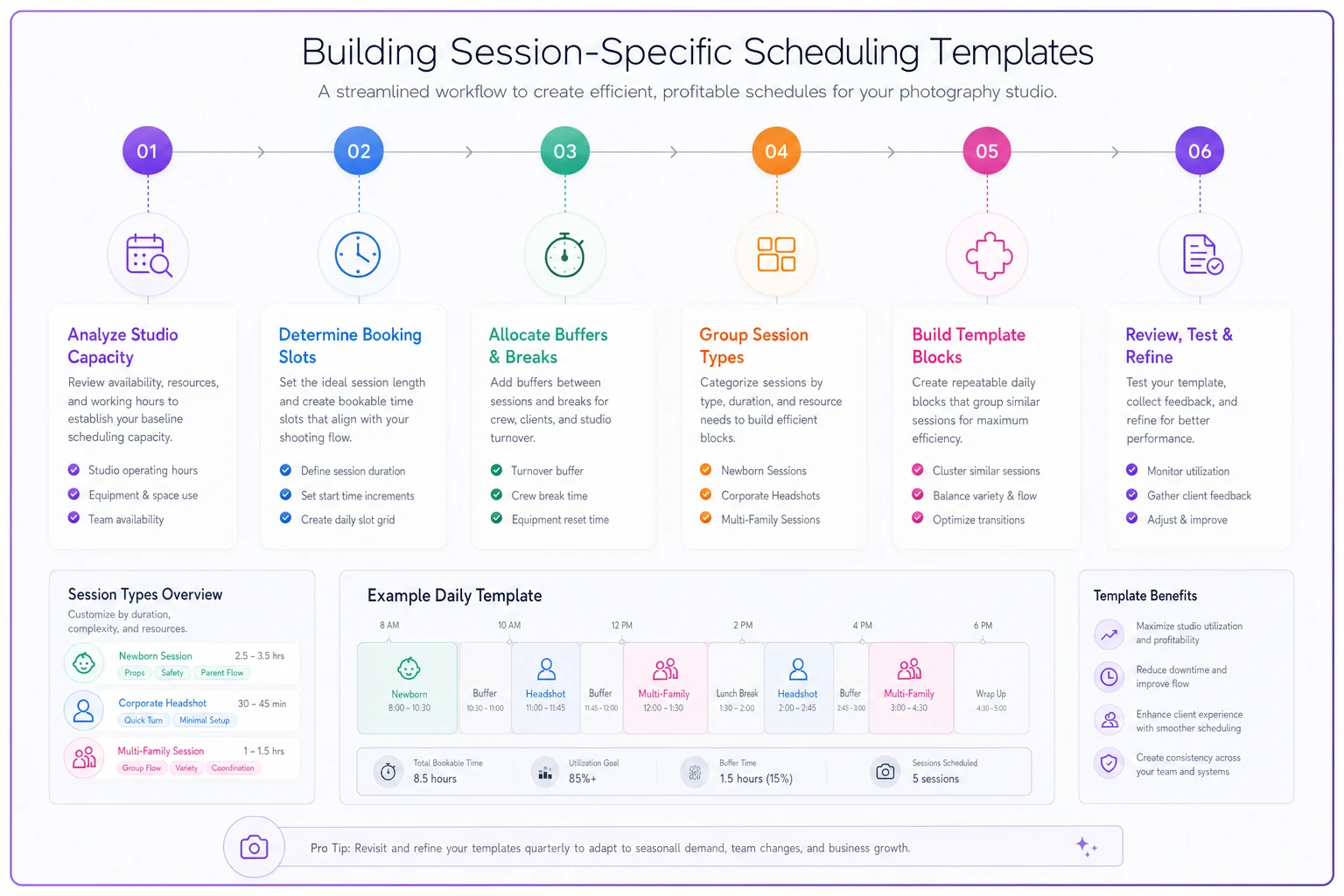
This flow shows how templates, buffers, and stacking fit together.
Real studio transformation: from chaos to profit
A portrait studio was bleeding money despite being fully booked. They ran everything in 60-minute slots with 15-minute buffers—the default their booking software suggested.
Their typical week:
-
35 sessions scheduled
-
8–10 running significantly over
-
3–4 reshoot requests monthly
-
Photographers working 50+ hour weeks
-
Monthly revenue
$22,000–$26,000
After implementing session-specific scheduling:
Week 1–2: Resistance and adjustment. Clients questioned the longer booking slots. Staff worried about fewer daily sessions.
Week 3–4: Patterns emerged. Newborn sessions stopped running over. Corporate clients appreciated the faster turnaround. Multi-family chaos decreased noticeably.
Month 2:
-
28 sessions scheduled (down from 35)
-
Zero sessions running over
-
1 reshoot request (down from 3–4)
-
Photographers working 40-hour weeks
-
Monthly revenue
$28,000
Fewer sessions. More money. Less stress.
The key change was simple: they stopped treating time as a generic resource and started treating it as session-specific inventory.
Sample weekly calendar optimized for throughput
Most studios organize their weeks based on whatever books first. This creates operational chaos and kills profitability potential.
| Day | Schedule |
|---|---|
| Monday | 9 AM – 12 PM: Newborn session (one only) 1 PM – 3 PM: Admin/editing block 3 PM – 5 PM: Multi-family session |
| Tuesday | 9 AM – 1 PM: Corporate headshot block (8–10 clients) 2 PM – 5 PM: Standard portrait sessions (3 x 45-minute slots) |
| Wednesday | 9 AM – 12 PM: Newborn session 1 PM – 2 PM: Lunch/reset 2 PM – 4 PM: Multi-family session 4:30 PM – 5:30 PM: Single portrait session |
| Thursday | 9 AM – 11 AM: Mini-session block (6 x 20-minute slots) 12 PM – 3 PM: Newborn session 3:30 PM – 5 PM: Overflow/makeup time |
| Friday | 9 AM – 1 PM: Corporate headshot block 2 PM – 4 PM: Multi-family session |
| Saturday | 9 AM – 12 PM: High-demand slots (premium pricing) 1 PM – 3 PM: Standard sessions |
This structure creates natural rhythms. Photographers know what kind of energy each day requires. Equipment stays configured longer. Clients get better service because you're not constantly switching mental gears between completely different session types.
Common scheduling mistakes that seem logical but aren't
The "maximize availability" trap: Opening every hour for any session type feels client-friendly but creates operational problems. A newborn at 3 PM followed by headshots at 4 PM almost always fails.
The "equal spacing" error: Same buffer between every session ignores how different they actually are. A family portrait needs different recovery time than corporate work.
The "accommodation spiral": Letting clients book outside your structure "just this once" trains them to ignore your systems. That 6 PM newborn session will destroy your next morning's energy.
The false efficiency of back-to-back similar sessions: Three consecutive newborn sessions sounds efficient but ignores photographer fatigue. Quality on the third session drops noticeably.
When to break your own rules (and when not to)
Rigid rules create their own problems, but random exceptions destroy systems entirely.
Break rules for:
-
Clients spending over $2,000 per session
-
Genuine medical scheduling constraints
-
Weather-dependent outdoor sessions
-
Travel sessions requiring location coordination
Never break rules for:
-
"I can only come at 6 PM" for standard sessions
-
Back-to-back newborn bookings
-
Removing buffers to squeeze in extra sessions
-
Discount seekers demanding premium time slots
The difference is strategic flexibility versus operational chaos.
Time-motion optimization for multi-photographer studios
When you run multiple photographers, scheduling complexity multiplies. The same principles apply—just with additional coordination layers.
Photographer-specific templates: Not all photographers work at the same pace. Track actual session times per photographer and adjust their templates accordingly. Your veteran might handle headshots in 12 minutes while a newer hire needs 20.
Shared resource scheduling: If photographers share equipment or spaces, build hard breaks between their sessions. Overlapping sessions that both need the main studio create expensive delays.
Rotation patterns: Alternate high-energy sessions (newborns, large families) with lower-intensity work (headshots, single portraits) across your team. This prevents burnout and maintains quality throughout the week.
Converting better scheduling into higher profits
Proper session scheduling rules aren't just about organization—they directly affect profitability.
-
15–25% revenue increase from better slot utilization
-
Around 30% reduction in overtime hours
-
Significantly fewer reshoot requests
-
Improved photographer retention
-
Higher client satisfaction scores
The math is simple. If you're losing 10 hours weekly to poor scheduling and those hours could generate $200 each, that's $2,000 per week—or close to $96,000 annually—in lost revenue.
Building enforcement into your booking system
Rules mean nothing if your booking system ignores them. Most photography studios struggle here because standard booking software doesn't account for session-type complexity.
Manual enforcement burns time and creates errors. Someone forgets that Tuesday afternoon is headshot-only. The online booking system lets a client schedule a newborn at 4 PM Friday.
This is where operational software with built-in workflow rules becomes useful. Instead of hoping everyone remembers the guidelines, the system enforces them automatically. AI-assisted scheduling can identify patterns, flag optimization opportunities, and prevent booking conflicts before they happen—without you having to babysit the calendar.
Studios using this kind of scheduling automation report significantly less time spent on calendar management and far fewer booking errors. The software handles the complexity while you focus on actually shooting.
Measuring and adjusting your time allocations
Your initial time estimates will be wrong. That's expected. The key is building measurement into your operations.
Track these metrics weekly:
-
Actual session duration versus scheduled
-
Buffer usage rate (how often you need it)
-
Overtime incidents
-
Client wait times
-
Photographer feedback on pacing
After four weeks, patterns become clear. Maybe your newborn sessions average 2:45, not 3:00. Perhaps corporate headshots only need 8 minutes once the workflow is dialed in. Adjust accordingly.
Small refinements compound. Saving 10 minutes per session across 30 weekly bookings creates 5 hours of additional bookable time.
The competitive advantage of superior scheduling
Most studios compete on quality, price, or style. Operational discipline through smart scheduling creates a different kind of advantage—one that's harder to copy.
When you consistently deliver sessions on time, clients notice. When photographers aren't exhausted, quality improves. When buffers prevent chaos, referrals increase.
One studio reported that simply publishing their session-specific booking policies on their website increased conversion rates by around 18%. Clients appreciated the transparency and it signaled professionalism before they even picked up the phone.
Proper scheduling isn't just an internal operations issue. It's a marketable differentiator that clients actually value.
Time structure as profit architecture
Session scheduling rules for photography studios aren't generic—they need to be as specific as the sessions themselves. A newborn session needs different time architecture than corporate headshots, and pretending otherwise burns money and energy.
Start by tracking your actual session times for two weeks. Identify patterns. Build templates around what's actually happening, not what you assumed when you set up your booking software. Then enforce those templates consistently.
Within 30 days, you'll see measurable improvements in revenue, photographer satisfaction, and client experience. Within 90 days, the whole operation runs differently—smoother, more profitable, and a lot less chaotic.
Keep forcing different session types into generic time blocks and accept the chaos, or build time structures that match operational reality. The math points pretty clearly in one direction.
Start by tracking your actual session times for two weeks. Identify patterns. Build templates around what's actually happening, not what you assumed when you set up your booking software. Then enforce those templates consistently.
Within 30 days, you'll see measurable improvements in revenue, photographer satisfaction, and client experience. Within 90 days, the whole operation runs differently—smoother, more profitable, and a lot less chaotic.
Keep forcing different session types into generic time blocks and accept the chaos, or build time structures that match operational reality. The math points pretty clearly in one direction.
Ready to elevate your studio’s workflow?
Join 500+ studios using TryPixly to save time, reduce scheduling conflicts, and deliver exceptional client experiences.