



Two months ago, a portrait studio in Denver showed me something that genuinely made my stomach drop. They had 47 no-shows in October. Not cancellations—straight no-shows. Zero notice. Each session slot worth $450–850 gone. That's roughly $28,000 in lost revenue from empty studio time they couldn't backfill.
The owner pulled up their booking confirmation email. Generic template. No deposit. One reminder 24 hours before. Classic setup for disappointment.
What stuck with me wasn't just the lost revenue. It was watching their photographer sit there, fully prepped, lights up, waiting for clients who never showed. The waste compounded—assistant scheduled, equipment reserved, post-production time blocked. All for nothing.
Most photography no-show policy guides will tell you to charge deposits. Sure. But they skip the part about the tradeoff nobody warns you about: higher deposits reduce no-shows but also tank booking rates. Lower deposits keep conversions healthy but leave you exposed. The answer isn't picking a number that feels right. It's building a testing framework to find your actual balance.
Why standard deposit policies fail studios
Traditional deposit structures break down because they treat every session the same. A $50 deposit on a $350 family portrait carries completely different psychological weight than that same $50 against a $2,500 wedding package.
-
Fixed percentage (25% across everything)
-
Fixed dollar amount ($100 for all sessions)
-
No deposit, strict cancellation terms on paper
Each fails differently. Fixed percentages produce awkward deposit amounts that create friction in the booking flow. Fixed amounts become meaningless at the high end. No-deposit policies—well, October in Denver tells that story.
The booking environment has shifted too. A few years ago, clients booked photographers the way they booked dentists—deliberately, with some planning involved. Now they book like OpenTable reservations. Quick decision, low commitment, easy to ghost.
One studio owner put it plainly: "Clients book three photographers for the same weekend, pay whoever asks for a deposit last, then pick their favorite the week before." The deposit isn't just about financial commitment anymore. It's about where you land in their decision timeline.
Dynamic deposit sizing by session value and lead time
What actually moves the needle is variable deposits built around two factors most studios ignore.
Never miss a shoot or client detail again.
TryPixly helps you book, confirm, and manage every photography session seamlessly.
- Unified session and client management
- Automated client reminders
- Team calendar & resource scheduling
No credit card required
Session value brackets:
-
Under $500
20–30% deposit
-
$500–1,500
Fixed $200–350 deposit
-
$1,500–3,000
15–20% deposit
-
Over $3,000
Fixed $500–750 deposit
Notice the switch between percentages and fixed amounts at certain brackets. This prevents awkward deposit numbers while keeping psychological weight intact. A $73 deposit on a $365 session feels arbitrary. A $75 deposit feels like someone thought about it.
Lead time adjustments:
-
Same week booking
+50% to standard deposit
-
Next 2 weeks
Standard deposit
-
3–6 weeks out
Standard deposit
-
Beyond 6 weeks
–25% from standard deposit
Last-minute bookers no-show at higher rates. They're usually shopping multiple options or making impulsive decisions that can reverse just as fast. The increased deposit filters out casual browsers. Serious last-minute clients will pay it without pushback.
Long-term bookings deserve different treatment. Someone reserving their holiday card session in July is demonstrating planning and intent. A reduced deposit acknowledges that without eliminating accountability entirely.
Confirmation cadence that reduces ghost rates
The deposit captures initial commitment. The confirmation sequence is what maintains it.
The 7-3-1 confirmation framework:
Seven days before: preparation email, not a reminder
-
Pinterest board for outfit inspiration
-
Parking instructions with photos
-
Session flow timeline
-
Request for specific shot preferences
This email reengages without nagging. Clients respond because you're asking for input, not just confirming attendance.
Three days before: logistics check
-
Weather contingency if outdoor
-
Final headcount for groups
-
Reminder of session inclusions
-
Direct phone number for day-of questions
One day before: simple SMS
"Hey [Name]! Excited for tomorrow's session at 2pm. Studio's at 123 Main St. Reply YES to confirm you're all set!"
That reply matters more than it seems. The act of typing YES creates a small but real micro-commitment. Studios using reply-required SMS report around 23% fewer day-of cancellations compared to notification-only messages.
Use reply-required SMS for the 1-day message; asking for a YES creates a micro-commitment.
Each message provides something useful while reinforcing commitment. You're not pestering—you're preparing them.
Email and SMS templates that actually get responses
Generic confirmations get ignored. Specific, useful messages get engaged with.
7-day email template:
Subject: Your [Session Type] prep guide + quick question "Hi [Name], Getting everything ready for your [family portrait session] next Tuesday! The studio looks great and the lighting setup for [number] people is already planned out. Quick thing—attaching our style guide that shows what photographs best in our studio lighting. Jewel tones and textured fabrics really pop; pure white can wash out under our setup. Two questions:"
-
Any specific groupings you want beyond the full family shots?
-
Are kids doing okay with 2pm timing, or should we shift earlier?
[Link to Pinterest board] [Parking map attached] See you Tuesday! [Your name]"
3-day email template:
Subject: Tuesday's session—weather update + arrival info "Hi [Name], Weather's looking [perfect/questionable] for Tuesday. [If outdoor: I have solid indoor backup options if needed—we can make that call morning of.] Quick confirmations:"
-
Arriving with [4] people, correct?
-
2pm start (please arrive 10 min early for setup)
-
Package includes [X digital images]
Text me at [phone] if anything comes up before Tuesday! [Signature]"
1-day SMS template:
"[Name], excited for tomorrow's 2pm session! Address: [location]. Parking in back lot. Reply YES if you're all set, or call [number] if anything changed!"
Each message provides something useful while reinforcing commitment. You're not pestering—you're preparing them.
A/B testing framework for conversion vs attendance optimization
Testing deposit structures takes discipline. Studios often change multiple things at once, then can't figure out what actually worked.
Clean testing structure:
Month 1 baseline: run your current deposit structure without touching anything. Track booking rate, no-show rate, and cancellation timing.
Month 2–3 test period: split test ONE variable only. Alternate between your current setup (A) and the new structure (B) on a daily or weekly basis depending on your volume.
Don't test during seasonal peaks or valleys. December data tells you almost nothing about February behavior.
Variables worth testing, one at a time:
-
Deposit percentage (20% vs 30%)
-
SMS vs email confirmation
-
Payment timing (immediate vs 48-hr window)
-
Refund policy communication
-
Confirmation response requirement
Track both sides of the equation throughout. A 40% deposit might wipe out no-shows, but if it cuts your booking rate in half you're worse off overall. For most session types, the sweet spot tends to sit somewhere between 20–30%, though premium services can push higher without much conversion damage.
The conversion vs attendance tradeoff table
Real numbers from studio testing over roughly six months:
| Deposit Level | Booking Rate | No-Show Rate | Effective Revenue |
|---|---|---|---|
| No deposit | 94% | 12% | 82.7% of potential |
| 10% deposit | 91% | 8% | 83.7% of potential |
| 20% deposit | 86% | 4% | 82.6% of potential |
| 30% deposit | 79% | 2% | 77.4% of potential |
| 50% deposit | 68% | 0.5% | 67.7% of potential |
The surprising outcome: 10% deposits performed best for overall revenue despite having higher no-shows. Booking rates stayed strong while no-shows dropped by a third. Most studios assume higher deposits equal better business, but the math doesn't support that for standard portrait work.
| Session Type | Optimal Deposit | Booking Impact | No-Show Impact |
|---|---|---|---|
| Mini sessions | $25–35 flat | -3% | -62% no-shows |
| Family portraits | 15–20% | -8% | -71% no-shows |
| Newborn | 25–30% | -5% | -83% no-shows |
| Weddings | $500–750 flat | -2% | -94% no-shows |
| Corporate headshots | Net 30 invoice | +12% | -45% no-shows |
Corporate clients behave differently from everyone else. They resist deposits but rarely no-show when properly invoiced. The formal purchase order process creates organizational commitment that a personal credit card charge simply doesn't replicate.
Session-specific thresholds that make sense
Mini sessions need completely different handling than weddings. That's obvious. Yet a surprising number of studios run one deposit policy across everything.
Mini sessions (under $200):
-
$25–35 flat deposit
-
Non-refundable but transferable once
-
SMS-only confirmations
-
Book-to-shoot window
2 weeks max
Quick sessions attract casual buyers. Heavy deposits kill conversions at this price point. Light touch keeps them engaged without overwhelming them with process. The transfer option reduces hostile cancellations while still maintaining some accountability.
Premium portrait sessions ($500–1,500):
-
20% deposit for bookings 3+ weeks out
-
30% deposit for under 3 weeks
-
Refundable minus $50 until the 72-hr mark
-
Email + SMS confirmation sequence
-
Response required on final confirmation
These clients invest emotionally before they invest financially. They're planning outfits, coordinating schedules, building anticipation. The deposit structure should respect that process while protecting your calendar.
Event and wedding coverage ($2,000+):
-
Flat $500–750 deposit regardless of package size
-
Additional 25% due 30 days before
-
Non-refundable after initial 14 days
-
Monthly check-ins starting 3 months out
-
Vendor team group SMS one week before
Large events rarely fully cancel—they reschedule. Staged payments maintain cash flow while regular touchpoints keep the relationship warm. The vendor group text creates coordination and social accountability that individual reminders can't replicate.
Specific test variations worth running
Beyond basic deposit amounts, a few variations consistently surprise studios.
Payment timing flexibility:
Option A: Immediate payment required. Option B: 48-hour payment window with held slot.
The 48-hour window increased bookings by around 18% for one studio. Clients who needed spousal approval or expense authorization could commit without friction. No-shows only ticked up about 2% despite the delayed financial commitment—a worthwhile trade.
Deposit framing:
Option A: "$75 deposit to secure your session." Option B: "$75 session retainer (applied to your total)."
"Retainer" tested roughly 8% better for conversion with no change in no-shows. "Deposit" implies money potentially forfeited. "Retainer" implies credit toward a purchase you're already making.
Cancellation policy visibility:
Option A: Clear policy on the booking page. Option B: Policy only in the confirmation email. Option C: Policy requires checkbox acknowledgment.
Option A performed worst for conversions but best for attendance. Clients who book despite seeing a strict policy upfront rarely cancel. The checkbox option balanced both metrics most effectively.
Confirmation response mechanism:
-
Option A
No response needed.
-
Option B
Email reply requested.
-
Option C
SMS reply required.
-
Option D
Confirm via booking portal.
SMS replies dominated—roughly 67% response rate versus 31% for email and 19% for portal confirmation. The friction should be minimal but present.
Balancing strict policies with client experience
The strictest policies aren't always the most profitable. One wedding photographer with an iron-clad no-refund policy told me it generated exactly three things: fewer bookings, hostile reviews, and exhausting payment disputes.
Smart strictness targets the right behavior. You want to filter out casual ghosting, not punish people dealing with genuine emergencies.
The 72-48-24 ladder:
-
72+ hours notice
Full deposit refund or transfer
-
48–72 hours
Deposit transfers to a future session
-
24–48 hours
50% of deposit retained
-
Under 24 hours
Full deposit retained
This acknowledges reality. Kids get sick, work explodes, things happen. The graduated structure encourages early communication without feeling punitive.
One studio added an interesting twist: instead of forfeiting the deposit entirely, it converts to product credit. Clients who cancelled last-minute often ended up spending more on prints and albums than the original session would have cost. The studio preserved revenue and kept the relationship intact.
"We understand unexpected situations arise. For medical emergencies or family crises, provide documentation within 48 hours and we'll work together on a fair resolution."
One studio added that paragraph to their policy and said it eliminated around 90% of hostile disputes. Nearly nobody actually invoked it—the gesture alone built enough trust to prevent adversarial cancellations in the first place.
Real implementation roadmap
Changing deposit policies mid-stream creates chaos. Here's a tested rollout approach.
Visual rollout of the 12-week plan:
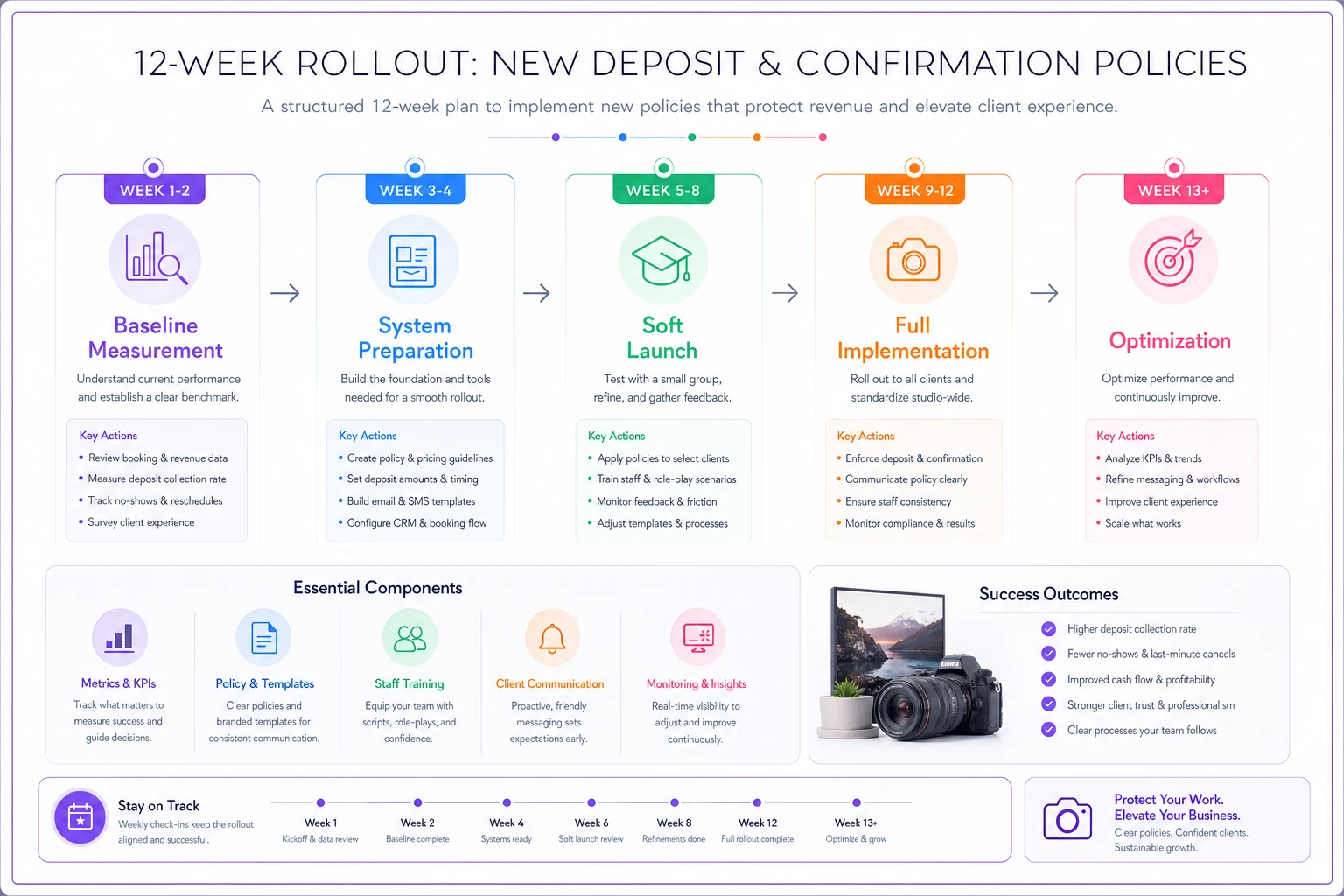
Week 1–2: Baseline measurement
-
Booking conversion rate
-
No-show percentage
-
Cancellation timing distribution
-
Revenue per booking slot
-
Client complaint and dispute rate
Week 3–4: System preparation
-
Update booking software with new deposit rules
-
Create email and SMS templates
-
Brief any staff on policy changes
-
Prepare FAQ for common client questions
-
Set up tracking spreadsheet
Week 5–8: Soft launch
-
New bookings only. Existing bookings keep original terms.
-
Start with your highest-value session type.
-
Monitor early booking and no-show signals closely.
Week 9–12: Full implementation
-
All new bookings follow the new structure.
-
Monitor weekly
Booking rate changes, No-show rate changes, Client feedback patterns, Staff burden changes
Week 13+: Optimization
-
Deposit amount
-
Confirmation cadence
-
Payment flexibility
-
Cancellation terms
-
Messaging language
Each test needs 50+ bookings for statistical relevance. Low-volume studios might need two or three months per test to get there.
Automation opportunities that compound results
Manual confirmation sequences break down at scale. A studio booking 60 sessions a month can't personally SMS everyone three times each. This is where AI-powered operational software starts earning its keep—triggered sequences based on booking behavior, client type, and session value can replace the repetitive coordination work without stripping out the personal feel.
Set up sequences that adapt to who's booking:
-
First-time clients get extra preparation content
-
Repeat clients skip the parking instructions they already know
-
Premium sessions receive a more attentive communication cadence
-
Mini sessions stay lightweight
The key distinction: automate the timing and delivery, not the entire message. Templates should be roughly 80% consistent with 20% personalization. Adding one personal line to an automated message takes five seconds and makes a noticeable difference.
Track response patterns to optimize timing. One studio found their clients responded to SMS at 6pm at three times the rate of 10am messages. A simple timing adjustment improved confirmation rates by about 22%.
The payment flow matters too. Requiring separate payment steps after booking kills completions. Integrated booking and deposit collection in a single flow improved completion rates by around 31% for most studios. Don't make clients work to pay you.
It's also worth building conditional logic around client behavior. Someone who pays their deposit immediately needs different handling than someone who uses the full 48-hour window. Quick payers are committed—don't over-communicate with them. Delayed payers benefit from a gentle nudge to stay engaged. Most booking platforms support this kind of branching now, and it's worth setting up even if it takes an afternoon.
Conclusion: your testing starting point
The photography no-show policy that works isn't the strictest one. It isn't the most lenient either. It's the most tested.
Start here:
-
Measure your current no-show rate for one month
-
Implement the 7-3-1 confirmation sequence
-
Test a 20% deposit for standard sessions
-
Require SMS confirmation replies
-
Track both bookings and attendance throughout
Resist changing everything at once. The studios seeing real improvement didn't stumble onto a magic policy—they found their specific balance through methodical testing.
The Denver studio? After three months of testing, they landed on 25% deposits combined with the 7-3-1 sequence. No-shows dropped to 3%. Bookings only decreased by 4%. That's roughly $26,000 in recovered revenue with minimal friction added to the booking experience.
Your optimal structure is somewhere inside the testing framework above. The only real mistake is not starting.
Ready to elevate your studio’s workflow?
Join 500+ studios using TryPixly to save time, reduce scheduling conflicts, and deliver exceptional client experiences.