


Most photography studios handle their first three photographers pretty smoothly. Everyone knows their role, clients get consistent work, and the owner can still personally oversee quality. Then somewhere between photographer four and seven, things start getting weird.
The Hidden Complexity That Breaks Studios at Seven Photographers
Suddenly you're dealing with inconsistent editing styles across shoots. Your senior photographer edits darker and moodier than your newest hire who loves that bright and airy look. Clients who rebook get confused when their family portraits look nothing like what they got last year. Your Google reviews start mentioning "inconsistency" and you can't quite pinpoint where things went sideways.
The problem isn't the photographers themselves. It's that multi-photographer studio management requires operational structure that most studios never build until after they're already in crisis mode.
The Quality Drift Nobody Talks About
Quality drift happens slowly, then suddenly. One photographer starts adding their own creative touches to standard portrait sessions. Another changes the posing flow because "it works better for me." Someone else adjusts the lighting setup slightly. Each change seems minor, even positive. Six months later, you're essentially running three different photography businesses under one brand.
Never miss a shoot or client detail again.
TryPixly helps you book, confirm, and manage every photography session seamlessly.
- Unified session and client management
- Automated client reminders
- Team calendar & resource scheduling
No credit card required
There's a wedding photography studio that expanded from two to eight photographers over eighteen months. They were booking around $180k per month in weddings — crushing it from a revenue perspective. But their rebooking rate for anniversary shoots dropped from 65% to below 30%. When they audited their work, photographers were delivering wildly different styles despite using the same preset packs and equipment.
The owner said something that stuck: "We thought talent was enough. We hired great photographers and figured they'd naturally align with our style." That assumption cost them roughly $90k in lost anniversary session revenue that year, plus reputation damage that took two years to rebuild.
Building a Role Matrix That Actually Works
A role matrix isn't just a fancy org chart. It's your operational bible for who does what, when they do it, and what happens when they can't. Most studios create some basic job descriptions and call it done. That's like giving someone a recipe title without the ingredients.
-
Primary responsibilities — Not just "shoot weddings" but the exact workflow from initial client contact through final delivery. Does this photographer handle their own editing? Do they communicate directly with clients about albums? Who manages timeline coordination with vendors?
-
Authority boundaries — Can they offer discounts? Approve rush delivery? Change shooting locations? Add extra coverage hours on the fly? These decisions happen constantly and without clear boundaries, you get chaos or paralysis.
-
Quality standards — Specific, measurable standards. Not "maintain brand style" but "shadows lifted to -15 to -25, highlights between -30 to -40, whites at +10 to +15." If someone can't measure it, they can't maintain it.
-
Substitution triggers — When exactly does someone else step in? Is it just sick days or also equipment failures, family emergencies, double bookings? Who makes that call?
One portrait studio had nine photographers but no clear substitution protocol. When their lead newborn photographer got COVID, three different photographers covered her sessions that week. Each used different posing techniques, different editing approaches, different client communication styles. Parents who'd specifically booked based on her portfolio were getting completely different results. Two requested full refunds, three left negative reviews.
The Substitution Protocol That Prevents Disasters
Most studios handle photographer substitutions like emergency triage — scrambling to find anyone available when someone calls in sick. That reactive approach practically guarantees inconsistent client experiences.
-
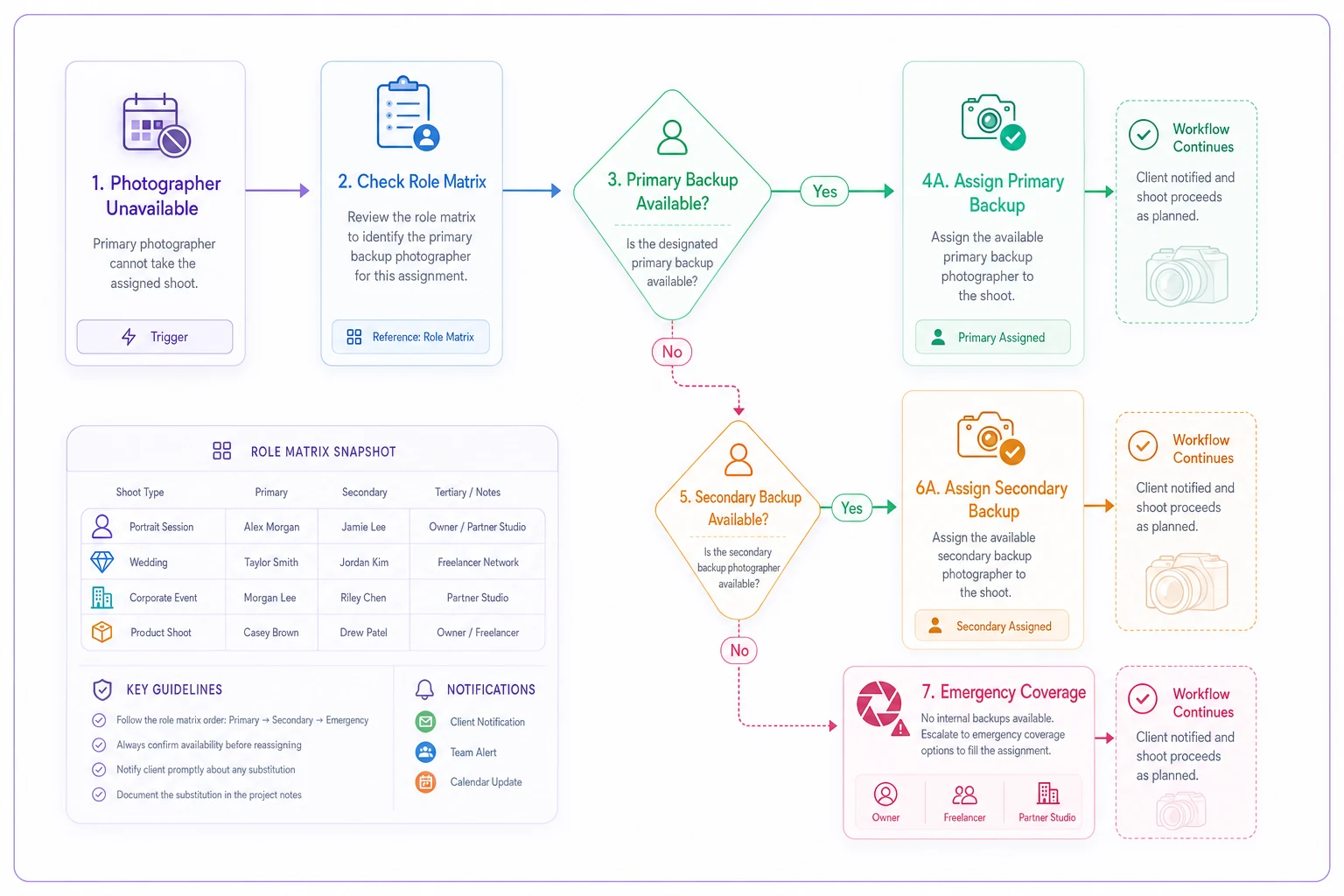
Primary backup — Someone already trained in that specific shooting style and workflow. They've shadowed multiple sessions, edited in that style, understand the client communication approach.
-
Secondary backup — Usually someone at a similar skill level who can step in with minimal notice. They might not perfectly match the style but can deliver acceptable results.
-
Emergency coverage — This might be the owner, a freelancer on retainer, or even a partnership with another studio. You hope to never use it, but it exists.
Where most studios mess up is forgetting about the non-shooting responsibilities. When your family portrait specialist is out, who handles their scheduled consultation calls? Their album design reviews? Their vendor relationships?
A studio in Denver had great shooting coverage but nobody picked up the admin tasks when photographers were absent. One week, their lead wedding photographer was on vacation, shoots were covered fine, but nobody responded to three venues asking about upcoming timeline coordination. One wedding almost started two hours late because nobody confirmed the revised schedule with the DJ and caterer. The bride's one-star review specifically mentioned "complete lack of communication from the photo team."
Calibration Sessions Most Studios Skip
You can write all the standards documents you want. Without regular calibration sessions, every photographer will gradually drift toward their personal style. It's not rebellion — it's just human nature.
Calibration sessions aren't just about reviewing photos together. They're operational alignment meetings where you actively sync everyone's approach. What actually works:
Live editing sessions — Everyone edits the same raw files simultaneously, then compares results. You'll be surprised how differently people interpret "warm and romantic" or "clean and modern." One studio found their photographers' interpretation of "properly exposed" varied by almost two full stops.
Schedule calibration sessions at consistent intervals (e.g., biweekly) and keep the agenda tight so they stay practical, not preachy.
Shoot shadowing — Photographers observe each other's sessions, not to judge but to understand workflow variations. That "small" difference in how someone poses families might be exactly why their sessions run 30 minutes longer than everyone else's.
Client scenario workshops — Work through challenging situations together. What do you say when a bride wants to skip family formals? When a toddler won't cooperate? When someone shows up in clothes that clash with the location? Without alignment on these moments, each photographer invents their own answers.
Standard revision discussions — Your standards should evolve, but they should evolve together. When someone discovers a better technique or workflow, it gets discussed, tested, and either rejected or adopted by everyone.
One high-volume senior portrait studio runs calibration sessions every two weeks during busy season. Seems excessive until you realize they're processing 400+ sessions per month across seven photographers. Those sessions caught a gradual shift where three photographers had started overexposing backgrounds because it was "trending on Instagram." Left unchecked, half their portfolio would have looked different from their marketed style within two months.
Client-Facing Consistency Rules Nobody Writes Down
Internal consistency means nothing if clients are experiencing different service levels. Most multi-photographer studios have some brand guidelines but miss the operational touchpoints that actually matter to clients.
-
Communication templates — Not just email templates, but actual conversation frameworks. How do you explain rescheduling? What's your response to requests for raw files? How do you handle complaints about weather? Without this, each photographer develops their own approach and clients notice.
-
Boundary scripts — Every photographer needs the exact words for common boundary situations. "I'd love to accommodate that, but our insurance requires..." or "To maintain our schedule for other clients..." These scripts prevent both pushovers and harsh rejections.
-
Problem escalation paths — When should a photographer handle something themselves versus escalating to management? One studio had a photographer give a full refund on-site because a client complained about lighting. Another photographer in the same studio would have never offered more than a reshoot. Guess which clients left reviews about "inconsistent policies."
-
Presentation standards — How images are shown, in what order, on which platforms. One studio discovered half their photographers were sending full galleries immediately while others were sending sneak peeks first. Clients were literally comparing notes in Facebook groups about their different experiences.
A boutique wedding studio in Austin documented every client touchpoint after losing a major vendor partnership. The vendor complained that every photographer seemed to represent a "different company." Now they have 47 specific consistency standards, from how to answer the phone to how to package final deliveries. Seems like overkill until you realize they've grown their average client value by $1,400 simply because clients trust their consistency enough to book additional services.
The Audit Checklist That Catches Drift Early
You can't fix what you don't measure. Most studios only realize they have consistency problems when clients complain or bookings drop. By then you're doing damage control, not prevention.
| Audit Area | What to Look For | Red Flag |
|---|---|---|
| Style consistency | Pull 5 random images per photographer, compare side by side | Client can tell which photographer shot it |
| Communication review | Read client emails and texts per photographer | Brand voice variations, response time gaps |
| Workflow timing | Track time for standard tasks like editing 50 images | Range wider than 2–3x across the team |
| Client feedback patterns | Look for patterns by photographer, not just overall scores | One photographer repeatedly flagged for same issue |
| Deviation documentation | Track every protocol deviation | Same deviation appearing across multiple photographers |
This shouldn't take more than a few hours per month, but skipping it means you're always reacting instead of preventing.
Style consistency — Put five random images from each photographer's recent work side by side. Could a client tell they're from the same studio? Look beyond editing — check posing styles, composition patterns, lighting approaches.
Communication review — Read through client emails and texts from each photographer. Are they maintaining brand voice? Using approved language? Following response time standards?
Workflow timing — Track how long each photographer takes for standard tasks. Editing 50 images shouldn't range from 2 hours to 8 hours across your team. Those variations usually mean someone's either cutting corners or adding unnecessary steps.
Client feedback patterns — Don't just track overall satisfaction. Look for patterns by photographer. If one person consistently gets comments about "rushing" while another gets "made us feel so comfortable," you've found a training opportunity.
Deviation documentation — Track every time someone deviates from standard protocol. Not to punish, but to understand why. Sometimes that deviation is actually an improvement worth adopting.
The Technology Layer That Holds It Together
This is where operational software makes a real difference in maintaining standards across multiple photographers. You're not replacing human judgment — you're creating systems that make consistency automatic rather than effortful.
Modern studio management platforms can enforce workflows, flag deviations, and maintain quality standards without turning your photographers into robots. The right platform tracks who's following protocols, alerts managers to consistency issues, and gives you real-time visibility across your entire team.
Some studios resist adding technology because they think it'll make everything feel corporate or impersonal. It tends to work the other way. When operational consistency is handled by the system, photographers can focus on what actually matters — creating great images and connecting with clients. They're not mentally juggling which email template to use or whether they're following the correct workflow.
AI-assisted communication tools specifically help with maintaining consistency at scale. Instead of each photographer writing their own responses from scratch, AI-powered templates keep everyone aligned on brand voice while still leaving room to personalize for specific situations. One studio saw their response time drop from around 3 hours to under 15 minutes while actually improving client satisfaction scores.
Making This Work in Your Studio
Studios that successfully scale past seven photographers don't just hire talent and hope for alignment. They build operational infrastructure that makes consistency systematic rather than personality-dependent.
The substitution workflow below shows how a well-structured studio routes coverage decisions before anyone's in a panic:
Start with the role matrix. Don't overthink it — document what your best photographer does and make that the standard. Then build your substitution protocol. You'll need it sooner than you expect, and building it in the middle of a crisis never goes well.
Run your first calibration session soon. Don't wait for the perfect agenda. Get everyone in a room with some raw files and start comparing approaches. You'll learn more in two hours than you would in six months of hoping everyone stays aligned on their own.
The client-facing consistency rules feel tedious to create but they prevent the exact problems that damage studio reputations. Almost every negative review about "inconsistency" or "different from what we expected" traces back to missing operational standards.
Photography is a creative business, but at scale it's also an operational one. The studios thriving with ten-plus photographers aren't necessarily more talented. They've figured out that operational structure is what enables creative consistency, not what kills it. Without systems, you're not running one photography studio — you're running as many mini-studios as you have photographers, all under one increasingly confused brand.
The difference between a multi-photographer studio that scales successfully and one that implodes around photographer number seven isn't talent, marketing, or even leadership. It's whether you build the operational backbone before you need it or after it's already breaking.
Ready to elevate your studio’s workflow?
Join 500+ studios using TryPixly to save time, reduce scheduling conflicts, and deliver exceptional client experiences.