

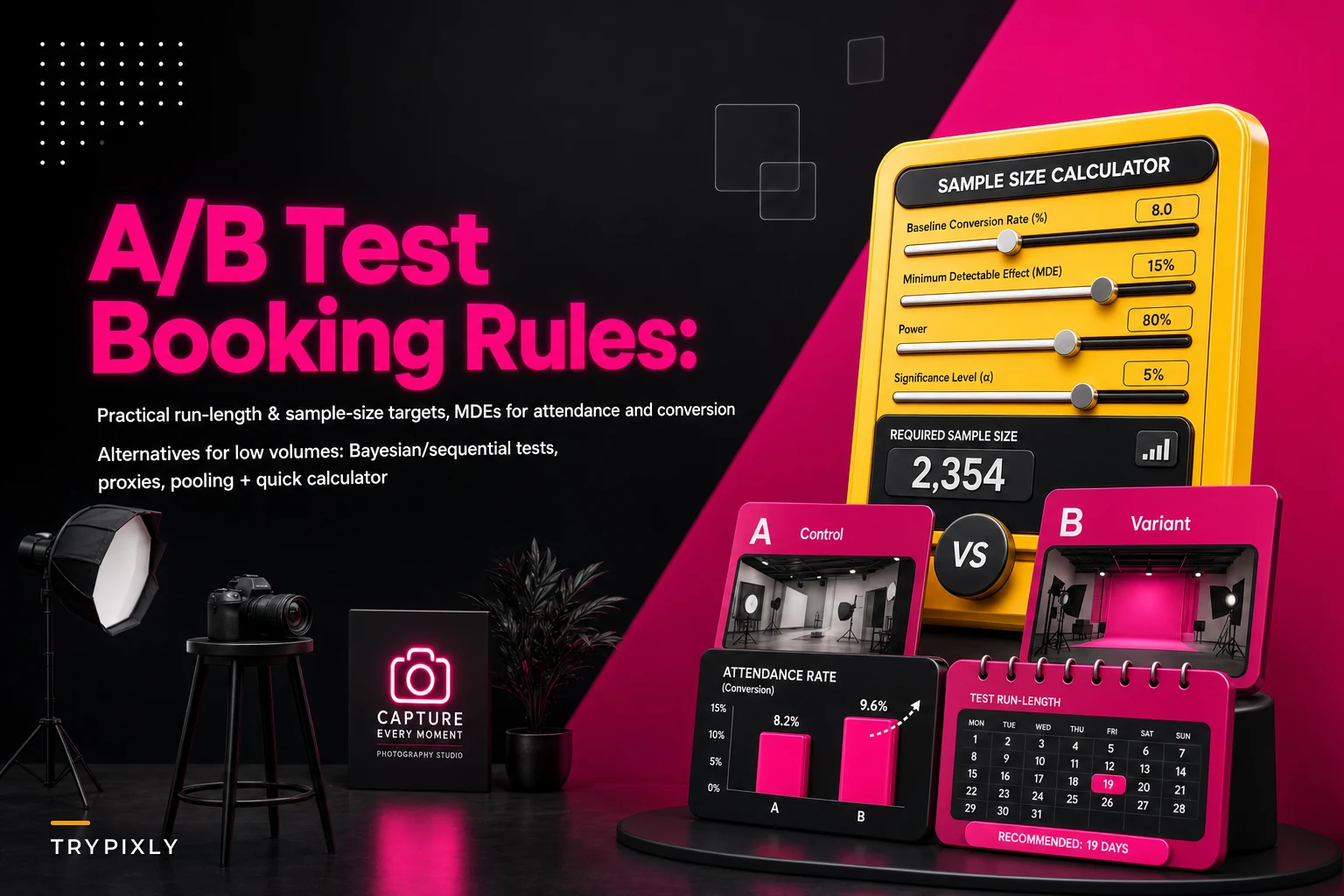

Most studio owners who try to "test" a new deposit rule do something like this: they switch to a 50% deposit for a month, no-shows look a little better, and they declare victory. Then two months later no-shows creep back up and nobody knows whether the deposit actually did anything or whether they just got lucky with a good booking stretch.
That's not a test. That's a vibe.
The hard truth about A/B testing no-show policies at studio scale is that you have very little data to work with. A busy salon chain running thousands of bookings a month can split-test in two weeks. You're booking maybe 20 sessions a week, your baseline no-show rate is single digits, and the change you're hoping to detect is small. That combination is statistically brutal — and almost nobody tells you that before you start.
This piece is about doing it honestly anyway. How long to run things, what sample size you actually need, how to pick a detectable effect you can realistically measure, and what to do instead when the math says "you'll be waiting 14 months." If you haven't already set up a policy worth testing, start with the groundwork in our testable cancellation and deposit policy guide — this article assumes you already have a policy and want to know whether it's working.
The sample-size problem nobody warns you about
Let's get the uncomfortable number out of the way first.
Say your current no-show rate is 8%. You introduce a deposit and you're hoping it drops no-shows to 5% — that's a solid, meaningful improvement. To detect a drop from 8% to 5% with standard confidence (95%) and reasonable power (80%), you need roughly 900 bookings per group. Two groups, so about 1,800 bookings total.
If you book 25 sessions a week, that's 72 weeks. Almost a year and a half.
And a 3-point drop is a big effect. If you're hoping to catch something subtler — say 8% down to 7% — the required sample balloons to tens of thousands of bookings. For most studios, that test will literally never finish before the policy becomes irrelevant.
This is the core tension. The improvements worth chasing are often small, and small effects need enormous samples. The reason so many studio "tests" feel inconclusive is that they were statistically doomed from the start, not poorly executed.
Here's a rough table of what you're up against at an 8% baseline:
| Target no-show rate | Absolute change (MDE) | Approx. bookings per group | Weeks at 25 bookings/wk (one group) |
|---|---|---|---|
| 5% | 3 points | ~900 | ~72 |
| 6% | 2 points | ~1,900 | ~150 |
| 7% | 1 point | ~7,000 | ~560 |
| 4% | 4 points | ~500 | ~40 |
Read that last column again. Even detecting a large 4-point improvement takes close to a year for a single-location studio. Everything else in this article is really about getting around the sample-size wall, not pretending it doesn't exist.
Pick your MDE before anything else
MDE — minimal detectable effect — is the smallest change you care enough about to detect. Most people skip this step, which is exactly why their tests fail. They run a test "to see what happens" without deciding in advance what size of effect would actually change their behavior.
Never miss a shoot or client detail again.
TryPixly helps you book, confirm, and manage every photography session seamlessly.
- Unified session and client management
- Automated client reminders
- Team calendar & resource scheduling
No credit card required
The trick is to set your MDE based on money, not statistics.
Work backwards. If a no-show costs you roughly $180 in lost slot revenue and you book around 1,100 sessions a year, every 1-point reduction in no-shows is worth about $2,000 annually. If a new deposit policy adds friction that costs you a few bookings, you probably don't care about a change smaller than 1.5–2 points — below that, the juice isn't worth the squeeze.
So your MDE isn't "whatever's statistically detectable." It's the smallest improvement that would justify keeping the new policy. For most studios at an 8% baseline, a realistic MDE lands around 2 to 3 points. Anything tighter and you're committing to a test longer than most studios keep the same booking software.
A quick way to set your MDE:
-
Estimate the dollar cost of a single no-show (lost slot + wasted prep + opportunity cost).
-
Multiply by annual bookings to get the value of a 1-point improvement.
-
Decide the minimum annual gain that makes a policy change "worth it."
-
Convert that back to points — that's your MDE floor.
Base your MDE on real booking and revenue numbers from the last 12 months so it's tied to actual dollars.
If you do this honestly, you'll often find your MDE is bigger than you assumed. That's actually good news: bigger MDEs need smaller samples.
Write the hypothesis down, literally
Tests drift when the question is fuzzy. Before touching your booking system, write a one-line hypothesis you can later grade as true or false. Vague goals like "reduce no-shows" let you rationalize any result.
Use a template like this:
> We believe [changing X] will [increase/decrease metric Y] by at least [MDE] for [which bookings]. We'll know we're right if [metric] moves past [threshold] after [sample size] bookings per group.
Worked examples:
-
We believe requiring a 25% deposit will decrease no-shows from 8% to 5% for weekday portrait sessions. We'll know we're right if the deposit group's no-show rate stays below 6% after ~900 bookings per group.
-
We believe adding a 24-hour SMS reminder (on top of the 72-hour email) will cut no-shows by at least 2 points for new clients. We'll measure confirmation-link clicks as an early proxy.
Notice the second example names a proxy metric. That's deliberate, and we'll come back to it — proxies are one of the few real escape hatches from the sample-size trap.
Decision thresholds: decide the rules before you see the data
The fastest way to fool yourself is to check results every day and stop the moment they look good. This is called "peeking," and it quietly inflates your false-positive rate. If you check a running test often enough and stop when it's ahead, you'll "find" improvements that are pure noise maybe 30–40% of the time instead of the 5% you thought you were risking.
Set your stopping rules up front:
-
Fixed-horizon rule Decide the sample size in advance (e.g., 900/group). Do not look at the no-show difference until you hit it. Then compare once.
-
Minimum run length Always run at least 4 full weeks regardless of sample, so you capture weekday/weekend and payday-cycle effects. No-shows have strong weekly rhythms; a 9-day test is almost always misleading.
-
Guardrail metric Pick one thing you refuse to harm — usually total bookings. If the new deposit cuts no-shows but also drops bookings by more than, say, 8%, you kill it regardless of the no-show win.
That guardrail matters more than people expect. The most common failure isn't a deposit that does nothing — it's a deposit that works beautifully on no-shows while quietly scaring off price-sensitive first-timers. If you only measure the thing you hoped to improve, you'll never see the bookings you lost.
When the math is impossible: pragmatic alternatives
Most studios can't hit 900 bookings per group in a reasonable window. Fine. Here are the workarounds that actually hold up, roughly in order of how useful they are for small volume.
1. Sequential or Bayesian testing
A fixed-horizon test wastes information by forcing you to wait. Sequential testing lets you check results repeatedly with the statistics adjusted for peeking — so you can stop early when the evidence is genuinely strong, without inflating false positives.
Bayesian approaches are even friendlier for studio owners to reason about. Instead of a binary "significant / not significant," you get something like "there's an 88% probability the deposit reduces no-shows, and the most likely effect is about 2.4 points." That's a far more natural input for a business decision than a p-value, and it lets you act on partial evidence while being honest about the uncertainty.
When this makes sense: almost always, for low-volume studios. The main cost is that you need a calculator or tool that does the adjustment correctly — doing sequential testing by eyeballing a chart is just peeking with extra steps.
Here's a quick workflow to choose an alternative:
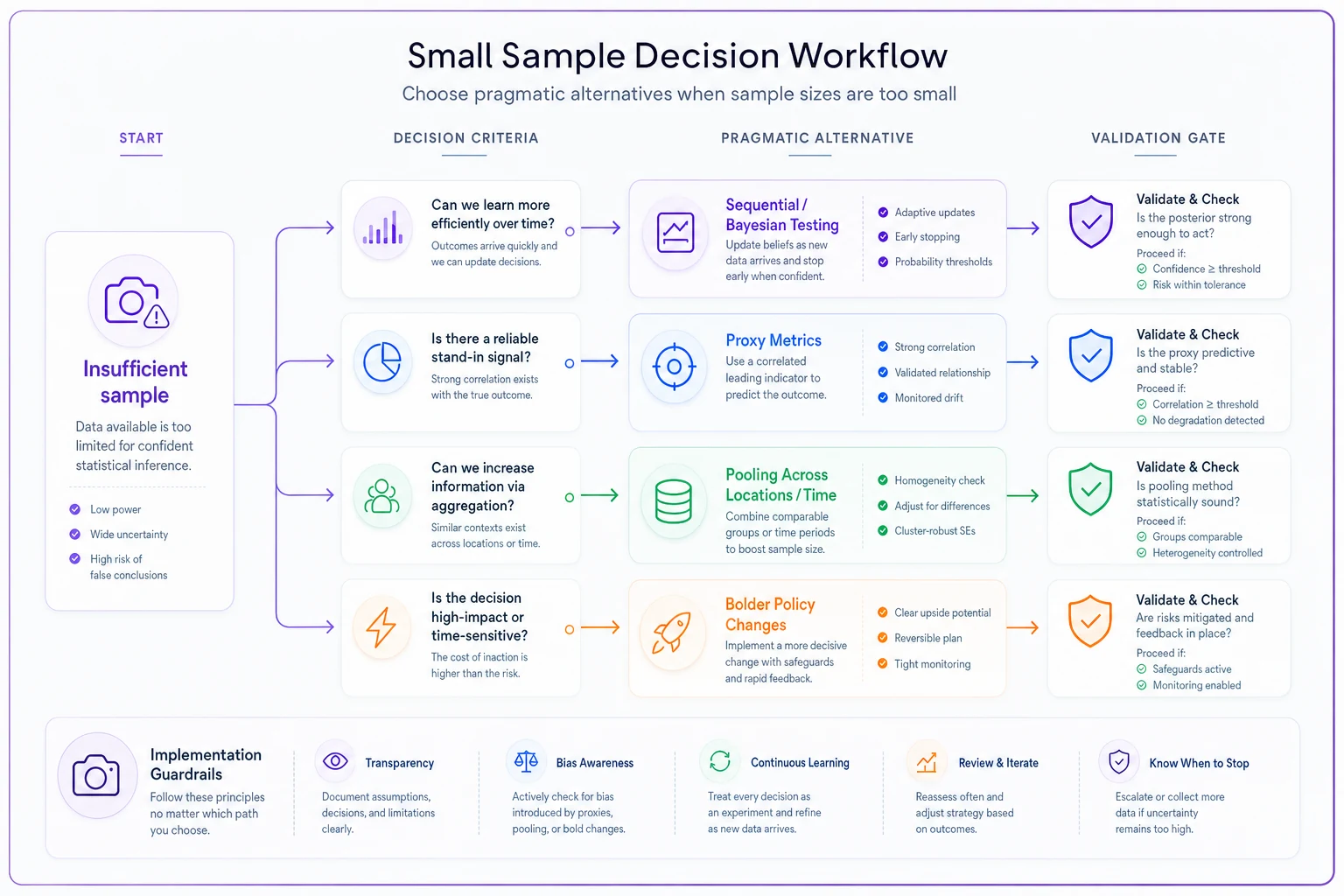
2. Proxy metrics (the real unlock)
No-shows are rare events, which is why they need huge samples. But the behaviors that predict no-shows happen far more often. Confirmation clicks, reminder opens, reschedule requests, deposit-payment completion rates — all of these move faster and need smaller samples to read.
A typical example: instead of waiting a year to prove a 24-hour SMS lowers no-shows, you measure confirmation-link click-through. If the SMS group confirms at 70% vs 45% for email-only, you've got a strong signal in a few weeks, long before the no-show numbers could ever reach significance. You're betting that higher confirmation rates lead to fewer no-shows — which is a defensible bet you can validate slowly in the background.
When this is a bad idea: when your proxy isn't actually linked to the outcome. If you've never checked whether confirmation clicks correlate with showing up, don't treat clicks as a stand-in. Validate the link once on historical data first.
3. Pooling across time or locations
If you run multiple locations or multiple photographers with similar client mixes, you can pool bookings into the same test to reach sample size faster — as long as you randomize within each location rather than making Location A the deposit group and Location B the control. Otherwise you're measuring the location difference, not the policy.
You can also pool across time by running the same test structure for a full season, accepting a longer timeline for a cleaner answer instead of rushing a 3-week version that tells you nothing.
4. Bigger changes, not smaller tests
If you can't shrink the required sample by getting more data, you can shrink it by chasing a bigger effect. A timid 10% deposit might move no-shows by half a point — undetectable. A 50% deposit plus a firm cancellation window might move them 3–4 points — detectable in a fraction of the time. Sometimes the statistically smart move is just to test a bolder policy.
Who should NOT run a formal A/B test
Honest answer: a lot of single-location studios.
If you book under around 15 sessions a week and your no-show baseline is already low — say 4–5% — a rigorous split test will take so long the world will change underneath it. You're better off:
-
Making the policy change studio-wide,
-
Watching the no-show rate as a simple before/after trend over a full season,
-
Using proxy metrics for faster signal,
-
And accepting that your "evidence" is directional, not bulletproof.
That's not a cop-out. For a small studio, a well-reasoned policy change backed by proxy data and a season of before/after tracking is a perfectly rational decision. Pretending you ran a clean RCT when your sample was 60 bookings is worse than admitting you made a judgment call.
A real scenario
A two-photographer portrait studio books around 28 sessions a week, no-show rate hovering near 8%. The owner wanted to test a new $75 flat deposit.
The naive plan was a one-month test. The math killed it immediately: detecting even a 3-point drop needed ~900 bookings per group, roughly 15 months per arm.
Instead they did three things. They set the MDE at 3 points — below that, the deposit's friction wasn't worth it. They switched to a Bayesian sequential approach so they could read partial evidence weekly. And they tracked deposit-completion rate and 48-hour confirmation rate as proxies, since both had correlated with attendance in their past year of records.
By week six, the proxy signal was clear: the deposit group confirmed at a noticeably higher rate, and completed deposits were strongly tied to attendance. The Bayesian estimate put the probability of a real no-show reduction around 85%, with a most-likely effect of roughly 2.5–3 points. Guardrail check: total bookings dipped only slightly, well within tolerance.
They rolled the deposit out studio-wide at that point rather than waiting another year for textbook significance. Over the following two seasons the no-show rate settled into the 5–6% range — close to what the early signal predicted. Not a perfectly clean experiment, but a defensible decision made months earlier than a fixed-horizon test would have allowed.
A quick-start checklist
Before you launch any no-show policy test, make sure you can check every box:
-
- [ ] You've written a one-line hypothesis with a specific MDE
-
- [ ] Your MDE is based on dollar value, not just what's "detectable"
-
- [ ] You've calculated the required sample size and confirmed it's reachable (or chosen a workaround)
-
- [ ] You picked a guardrail metric you refuse to harm
-
- [ ] You set a minimum run length of at least 4 full weeks
-
- [ ] You decided your stopping rule before launch (fixed-horizon or sequential — not "I'll know it when I see it")
-
- [ ] You identified at least one validated proxy metric for faster signal
-
- [ ] If pooling locations, you're randomizing within each location
Before you launch any no-show policy test, make sure you can check every box:
Build the calculator once, reuse it forever
You don't need fancy software to do this math, but you do need to stop doing it by gut. Put together a simple sheet — or grab any decent sample-size calculator — where you plug in your baseline no-show rate, your target rate, and your weekly booking volume, and it spits back required sample size and estimated run length.
The reason this matters: the calculator is what stops you from launching doomed tests. The moment you see "estimated run length: 61 weeks," you'll naturally pivot to a bigger MDE, a proxy metric, or a studio-wide rollout with before/after tracking — which is the right instinct.
Keep it simple. A single reusable sheet with these inputs — baseline, MDE, weekly volume, number of test arms — will prevent most of the bad testing decisions studios make. The studios that test well aren't the ones with the most sophisticated statistics. They're the ones who checked the required sample size before launching, picked an MDE that matched real money, and were honest enough to use proxies and Bayesian signals when a clean RCT was never realistic.
Statistical honesty at studio scale isn't about running the perfect experiment. It's about knowing when the perfect experiment is impossible and choosing the next-best thing on purpose.
Ready to elevate your studio’s workflow?
Join 500+ studios using TryPixly to save time, reduce scheduling conflicts, and deliver exceptional client experiences.