

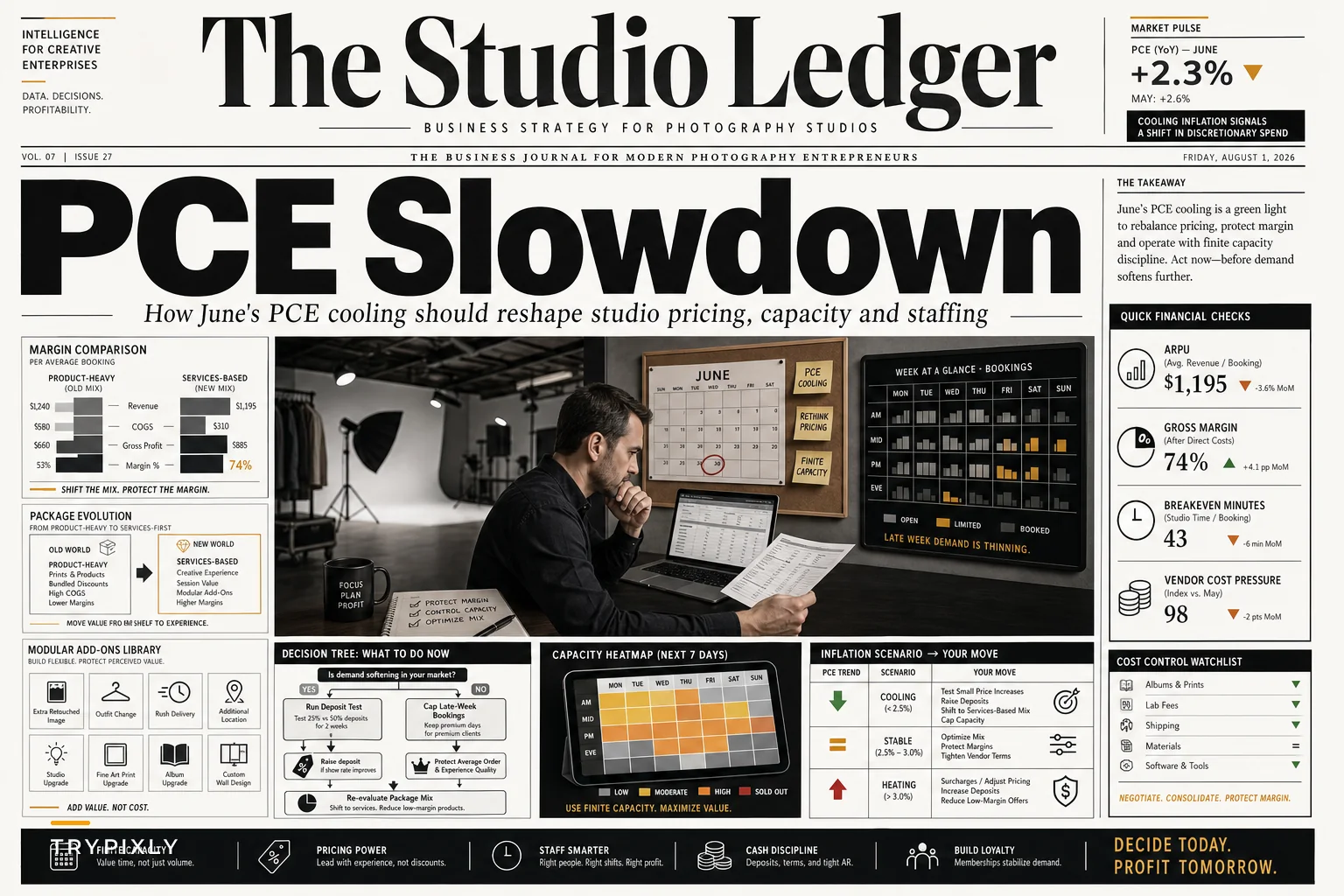

The Fed's preferred inflation metric just threw photography studios a curveball. June's PCE data showed inflation pulling back to 3.7% year-over-year, with core PCE at 3.3%, according to the latest BEA release. Sounds like good news, right? Not exactly. Your studio's cost structure hasn't gotten the memo. Overall inflation is cooling, but your landlord still wants their 8% annual increase. Your lab locked in paper costs through Q4. That freelance retoucher you rely on during wedding season isn't dropping their rates anytime soon. Meanwhile, clients are reading the same headlines and expecting prices to stabilize or drop. The gap between what the inflation metrics say and what your P&L actually shows creates an operational trap most studios won't see coming until Q4 bookings start sliding.
The Three-Speed Economy Hitting Studios Right Now
What makes this PCE slowdown particularly tricky is that different parts of your business face completely different inflation realities. Service costs stay elevated while goods prices moderate. Labor stays tight while equipment gets cheaper.
A portrait studio in Denver ran into this exact scenario recently. They kept 2025 pricing thinking inflation still justified it, while competitors started offering "inflation relief" packages. By the time they noticed the booking slowdown, they'd already lost their entire back-to-school mini-session pipeline to a studio charging 15% less.
The operational challenge isn't just adjusting prices. It's recognizing that your studio now operates in what economists call a "K-shaped recovery" — some costs drop while others stay elevated. Fulfillment might get cheaper while photographer wages stay high. Studio rent holds flat while insurance premiums keep climbing.
Studios that treat inflation as one uniform number miss this entirely. They either overcorrect and slash prices across the board, or they undercorrect and keep everything the same. Both approaches destroy margin.
Why Traditional Pricing Models Break in Transitional Inflation
Most photography studios price based on competitor analysis or a simple cost-plus model — take your costs, add a margin target, done. That works fine when inflation moves predictably in one direction.
Never miss a shoot or client detail again.
TryPixly helps you book, confirm, and manage every photography session seamlessly.
- Unified session and client management
- Automated client reminders
- Team calendar & resource scheduling
No credit card required
Transitional periods like this are a different story. Your pricing model becomes unreliable fast.
Think about what happens when you price a fall wedding package today. You're estimating costs for an event six months out, during a period where Fox Business notes the Fed might cut rates, hold steady, or even raise them if inflation rebounds. Your album vendor could drop prices 10% or raise them 5%. Your second shooter might demand more or accept less depending on how busy the market gets.
Studios that survive this transition don't guess. They build pricing that adapts — not dynamic pricing that changes daily, which is a trust killer in photography — but pricing tiers with built-in flexibility.
A wedding studio in Austin restructured their packages around this reality. Instead of fixed packages at $3,500, $5,000, and $7,500, they moved to base packages at $3,200, $4,600, and $6,800 with modular add-ons priced monthly. The base stays stable for client trust, while add-ons adjust with costs for margin protection. Their average package value actually increased around 8% because clients picked more add-ons when they weren't bundled into intimidating base prices.
Capacity Planning When Demand Signals Conflict
Cooling inflation suggests consumer spending might pick up. But elevated core inflation means the Fed stays cautious. For studios, this creates a capacity planning headache.
Book too much capacity expecting a demand surge and you're stuck paying photographers and assistants to sit idle. Book too little expecting continued softness and you miss profitable sessions during the few busy weeks you actually get.
The mistake studios make constantly: planning capacity based on hope rather than triggers. Staffing up because "inflation is cooling, so bookings should improve" without defining what "improve" actually looks like — or when you'd know you're wrong.
Smarter capacity planning in this environment uses commitment triggers, not forecasts. You define specific metrics that drive capacity changes. When three-week forward bookings hit 70%, you bring on freelance photographers. When they drop below 40%, you reduce assistant hours. When corporate headshot inquiries spike above 12 per week, you open dedicated corporate slots.
One studio implemented this after getting burned by optimistic Q1 projections. They'd hired two additional photographers in January expecting a "return to normal" that never materialized. Now they run a lean core team with clear triggers:
-
Mini-session bookings hit 85% full → add overflow dates
-
Portrait sessions book out 4+ weeks → activate freelance photographer
-
Corporate inquiries exceed handling capacity → dedicate Tuesday/Thursday slots
Use three-week forward bookings as a primary trigger rather than monthly forecasts.
This removed emotion from staffing decisions entirely. No more "feels busy" hiring or "seems slow" layoffs.
Re-Engineering Package Mix for Margin Protection
Package design becomes critical when inflation sends mixed signals. The wrong package mix kills margins even when bookings look healthy.
Traditional wisdom says push clients toward higher packages for better margins. Inflationary transitions flip this logic. Your highest packages often carry the highest hard costs — more prints, longer sessions, extra retouching. If those costs stay elevated while clients resist premium pricing, your "best" packages become margin traps.
A portrait studio discovered this when they analyzed package profitability during the recent inflation spike. Their $1,200 premium package (3-hour session, 40 images, large album) generated less profit than their $650 basic package (1-hour session, 15 images, digital only). Album and print costs had climbed roughly 40% while digital delivery stayed flat.
The fix wasn't eliminating premium packages — it was restructuring them around services rather than products. Their new premium package emphasized exclusive location access, priority scheduling, and extended retouching. Things with minimal variable cost. Product add-ons became separate upsells at current market prices.
Here's a quick visual comparing service-based versus product-heavy package margins across inflation scenarios.
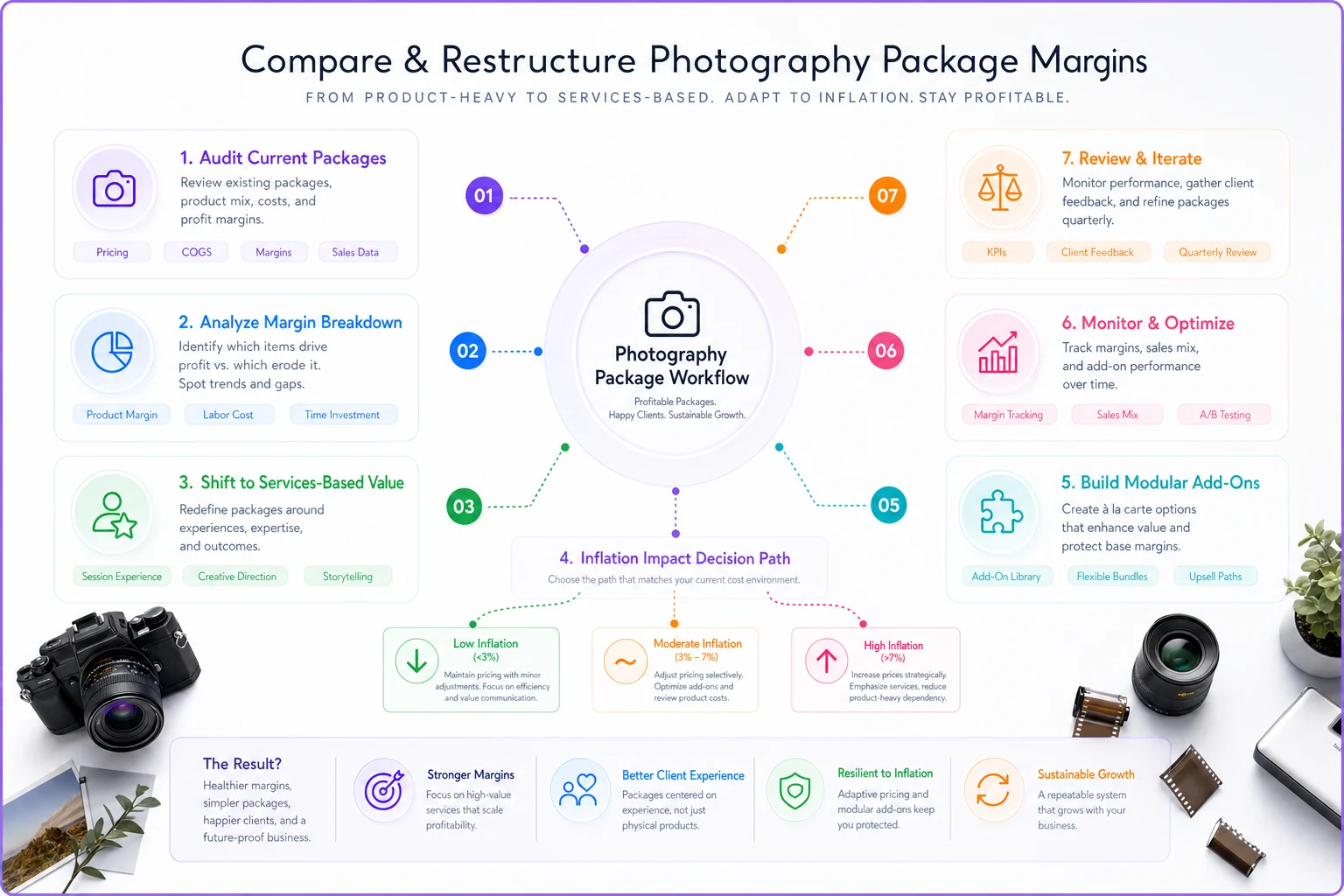
The operational impact of that shift is bigger than it looks. When a client books premium, you're no longer locked into delivering physical products at potentially underwater margins six months later. You maintain pricing power on goods while still offering a premium experience.
Deposit and Payment Terms That Match Economic Reality
Studios typically run standard deposit structures: 50% down, 50% at delivery. Some require full prepayment. Others allow payment plans. These rigid structures don't match an economy in transition.
When inflation cools but stays elevated, clients face a psychological mismatch. They hear "inflation is improving" but still feel stretched. Demanding large upfront deposits feels increasingly out of touch, but eliminating them destroys cash flow.
The operational solve is graduated deposit structures tied to booking windows:
| Booking Window | Required Deposit |
|---|---|
| 8+ months out | 25% |
| 4–7 months out | 40% |
| Less than 60 days | Full prepayment |
This matches client psychology — lower barrier for advance bookings — while protecting studio cash flow as near-term costs become clearer.
What most studios miss: deposit structures affect more than cash flow. They reshape your entire operational calendar. Lower deposits on advance bookings mean more overall volume, but also more cancellations. You need tighter confirmation sequences — 90 days out, 45 days out, 14 days out. Higher deposits on rush bookings mean fewer clients but better quality ones. You can reduce confirmation overhead and focus on delivery.
Vendor Renegotiation in a Mixed Inflation Environment
Your vendors are watching the same PCE numbers. Some will proactively adjust pricing. Others will quietly maintain elevated rates hoping you don't notice. Waiting for vendors to move first guarantees you'll overpay through the transition.
The approach that actually works: segment vendors by inflation exposure and renegotiate accordingly.
High inflation exposure vendors (labor-intensive services):
-
Retouchers
-
Second shooters
-
Album designers
-
Hair/makeup artists
These costs likely stay elevated despite broader inflation cooling. Push for value adds rather than price cuts — faster turnarounds, volume guarantees, exclusive availability windows.
Moderate inflation exposure vendors (mixed goods/services):
-
Labs
-
Album manufacturers
-
Equipment rentals
-
Software subscriptions
These should see some price moderation. Request price reviews with specific data. "PCE shows goods inflation down to 2.8%. Our volume is up 20%. What's the new rate?"
Low inflation exposure vendors (primarily goods):
-
Props
-
Backgrounds
-
Office supplies
-
Packaging materials
Push hard for reductions here. These vendors have likely seen their costs drop but haven't passed savings through.
A commercial photography studio ran this segmentation exercise and recovered roughly $2,200 monthly — not through dramatic confrontations, but through systematic conversations backed by data. Their album vendor couldn't drop prices but added rush delivery at no charge. Their retouching service held rates but included basic skin smoothing that was previously billed separately.
The Membership Model Hedge
When economic signals conflict, recurring revenue becomes operationally valuable. But launching membership programs during inflation transitions requires different tactics than stable periods.
The standard studio membership pitch — "lock in today's prices" — falls flat when clients expect prices to drop. Position memberships around value stability instead.
A family portrait studio shifted their messaging from "beat future price increases" to "predictable family photo budgeting." The membership includes quarterly mini-sessions, an annual full session, and all digital images for $147 monthly. The value prop isn't about inflation anymore. It's about removing decision friction entirely.
They found something interesting: membership conversion increased when they emphasized included services over saved dollars. "Never worry about booking fees, sitting fees, or image fees" outperformed "save $400 annually" by roughly 3:1 in A/B testing.
The operational benefit extends beyond revenue stability. Members book differently than transactional clients — they spread sessions throughout the year instead of clustering in October, they refer more actively, and they're more forgiving about individual session issues because they have upcoming sessions as a natural reset.
Staffing Decisions When Signals Point Different Directions
Cooling PCE suggests labor markets might loosen somewhat. But photography talent remains surprisingly tight. This creates a staffing paradox: you need flexibility for uncertain demand, but reliable talent is still scarce.
Traditional staffing models — either W2 employees or pure freelance — don't fit this reality well. The operational solution is hybrid structures that balance commitment with flexibility.
Instead of hiring full-time photographers, create priority freelancer tiers. Your tier-one freelancers get first scheduling choice and guaranteed minimum monthly bookings. In exchange, they commit availability and maintain your quality standards. Tier-two freelancers fill overflow. This costs marginally more per session than employees but eliminates fixed costs during slow periods.
One multi-photographer studio restructured from four full-time photographers to two full-time plus six tiered freelancers. Photographer costs dropped around 22% while capacity increased 15%. The key was treating freelancers like team members rather than contractors — they attend training, participate in quality reviews, and maintain studio email addresses.
Support staff requires different tactics. Rather than cutting hours when things slow down, cross-train aggressively. Your booking coordinator learns basic retouching. Your retoucher handles customer service. Your studio assistant manages social media. This maintains team stability while improving utilization across the board.
Early Warning Metrics for Demand Shifts
Most studios measure bookings, revenue, and maybe conversion rates. During inflation transitions, these lag indicators arrive too late. By the time bookings drop, the damage is already done.
Leading indicators worth tracking during inflation shifts:
-
Pricing page exit rates increase 15%+ → price resistance building
-
Package comparison time extends 20%+ → decision complexity increasing
-
Contact form starts decline 10%+ → consideration dropping
Inquiry patterns shift:
-
Question focus moves from "when" to "if"
-
Payment plan requests increase
-
Premium package inquiries drop relative to basic
Booking patterns evolve:
-
Advance booking windows shorten
-
Group bookings (families pooling resources) increase
-
Corporate booking volatility spikes
Track these weekly, not monthly. Set simple thresholds that trigger action. When pricing page exits spike, test new package structures. When booking windows compress, adjust capacity planning. When corporate inquiries surge, shift marketing spend.
Protection Through Operational Excellence
Studios that thrive during this inflation transition won't be the ones who guess right about Federal Reserve decisions. They'll be the ones who build operational systems that work regardless of what happens next.
This means connecting traditionally separate systems. Your pricing model informs your capacity planning. Your vendor contracts link to your package structures. Your staffing triggers sync with your booking patterns. That kind of integrated operational thinking is where profitability systems that tie cost-per-slot to package mix become genuinely essential rather than just nice to have.
The PCE slowdown isn't good news or bad news for photography studios — it's complicated news that rewards operational sophistication. Studios that recognize the three-speed economy, adjust package mix for margin protection, and build flexible staffing structures will capture market share while others are still trying to interpret mixed signals.
This PCE print signals a transition, not an ending. Build systems that work at 2% inflation or 5% inflation. Create packages that hold margin whether costs rise or fall. Design staffing that scales up or down without drama. Stop treating inflation as a single number that affects your business uniformly, because it doesn't — your studio operates in multiple inflation realities simultaneously, and the studios that plan around that complexity will be the ones still standing when the dust settles.
Ready to elevate your studio’s workflow?
Join 500+ studios using TryPixly to save time, reduce scheduling conflicts, and deliver exceptional client experiences.