



Most photography studios track revenue wrong. They count bookings, celebrate busy months, then wonder why their bank account doesn't match their calendar. The disconnect is almost always the same: studios rarely calculate true slot profitability—the actual margin after accounting for session time, post-production hours, and overhead allocation.
A studio in Denver showed me their "best month ever" with 82 sessions booked. Revenue hit $31,000. Profit? Around $3,400. Another studio in the same city, same month, booked 44 sessions and cleared $11,200. The difference wasn't pricing or talent. It was understanding which sessions actually made money.
The profitable studio had built what I now call a photography studio profitability system—a set of interconnected metrics and decision rules that connect booking choices to bottom-line impact. Not just revenue per session, but understanding how different session types consume resources differently, and adjusting their booking mix accordingly.
Why traditional studio metrics lie about profitability
Photography studios typically measure success through vanity metrics. Sessions booked. Average sale. Conversion rate. These numbers feel good but hide operational reality.
A newborn session priced at $450 might look more profitable than a $350 headshot package—until you factor in that newborn sessions often run 2–3 hours with parents requesting multiple setups, outfit changes, and feeding breaks. Then add another 3–4 hours of culling and editing hundreds of shots. Your actual hourly rate drops below $50.
That corporate headshot session, though? Twenty minutes to shoot, consistent lighting setups, maybe 30 minutes of post-production total. Hourly rate exceeds $200.
Studios that don't track cost-per-slot make booking decisions based on incomplete data. They chase high-ticket sessions without understanding resource consumption. They discount already-unprofitable services. They wonder why working harder produces diminishing returns.
It compounds when you factor in seasonal patterns. Wedding season brings high-value bookings but also deadline pressure that forces overtime editing costs. Holiday mini-sessions generate volume but demand rapid turnaround that strains operations. Without understanding true slot economics, studios make strategic decisions in the dark.
Building your cost-per-slot foundation
Calculating real cost-per-slot requires mapping actual resource consumption, not guesses. Track three core metrics for every session type over at least a two-week period.
Never miss a shoot or client detail again.
TryPixly helps you book, confirm, and manage every photography session seamlessly.
- Unified session and client management
- Automated client reminders
- Team calendar & resource scheduling
No credit card required
Active session time: Clock starts when the client arrives, stops when they leave. Include setup, breakdown, and transition time between shots.
Post-production hours: Track culling, basic editing, retouching, and delivery prep separately. Different session types have wildly different ratios here.
Overhead allocation: Fixed costs divided by available shooting hours—rent, equipment depreciation, software subscriptions, non-billable staff time.
Here's what typical numbers look like for a mid-size portrait studio:
| Session Type | Session Time | Post Time | Overhead/Hour | Total Cost | Typical Price | True Margin |
|---|---|---|---|---|---|---|
| Newborn | 2.5 hrs | 4 hrs | $42 | $273 | $450 | $177 (39%) |
| Family Portrait | 1.5 hrs | 2.5 hrs | $42 | $168 | $350 | $182 (52%) |
| Headshot | 0.5 hrs | 0.5 hrs | $42 | $42 | $175 | $133 (76%) |
| Mini Session | 0.25 hrs | 0.75 hrs | $42 | $42 | $125 | $83 (66%) |
| Maternity | 1 hr | 3 hrs | $42 | $168 | $395 | $227 (57%) |
Notice how the highest-priced session—newborn at $450—carries the lowest margin percentage. This pattern shows up consistently across studios once they start tracking real numbers.
The compound effect of session mix
Understanding individual slot profitability is step one. The real leverage comes from optimizing your overall session mix—the percentage breakdown of different session types you book each month.
A studio booking primarily newborn and maternity sessions might generate impressive revenue but struggle with profitability. Shifting just 20% of those slots toward higher-margin services like headshots or mini-sessions can meaningfully improve the bottom line without adding work hours.
Consider a studio with 60 monthly slots. Their current mix:
-
35% newborn sessions (21 slots)
-
25% family portraits (15 slots)
-
20% maternity (12 slots)
-
15% mini-sessions (9 slots)
-
5% headshots (3 slots)
Monthly revenue: approximately $21,000. Monthly profit: approximately $9,800.
After adjusting to a more balanced mix:
-
20% newborn sessions (12 slots)
-
20% family portraits (12 slots)
-
15% maternity (9 slots)
-
25% mini-sessions (15 slots)
-
20% headshots (12 slots)
Monthly revenue: approximately $17,500. Monthly profit: approximately $10,400.
Less revenue, more profit—and fewer total working hours since higher-margin sessions are less time-intensive.
Post-production costs: the profit killer nobody talks about
Post-production is the largest hidden cost in most photography studios. Unlike session scheduling, which happens in defined blocks, editing work expands invisibly. A session that "went great" can turn into a 6-hour editing marathon when the client selects 150 images for retouching.
Studios that consistently maintain profitability tend to share a few habits around post-production boundaries.
Define editing tiers upfront. Basic color correction included; advanced retouching priced separately. One studio charges $8 per image for skin smoothing beyond the included 10. That single rule increased their average sale by around $130 while actually reducing total editing time.
Batch similar sessions. Editing five headshots back-to-back takes roughly 2 hours total. Scatter them across the week and it's closer to 3.5 hours—context switching and reopening presets add up fast.
Implement revision limits. Unlimited revisions kill margins. Smart studios offer one round included, then charge $75 per additional round. Clients suddenly get much more specific with their initial feedback.
Batch similar sessions to reduce editing time.
A portrait studio in Austin tracked their editing time before and after implementing these controls. Average post-production per session dropped from 3.8 hours to 2.1 hours. Hourly profit rate increased by roughly 40% without changing prices or booking more sessions.
Weekly decision cadence for margin protection
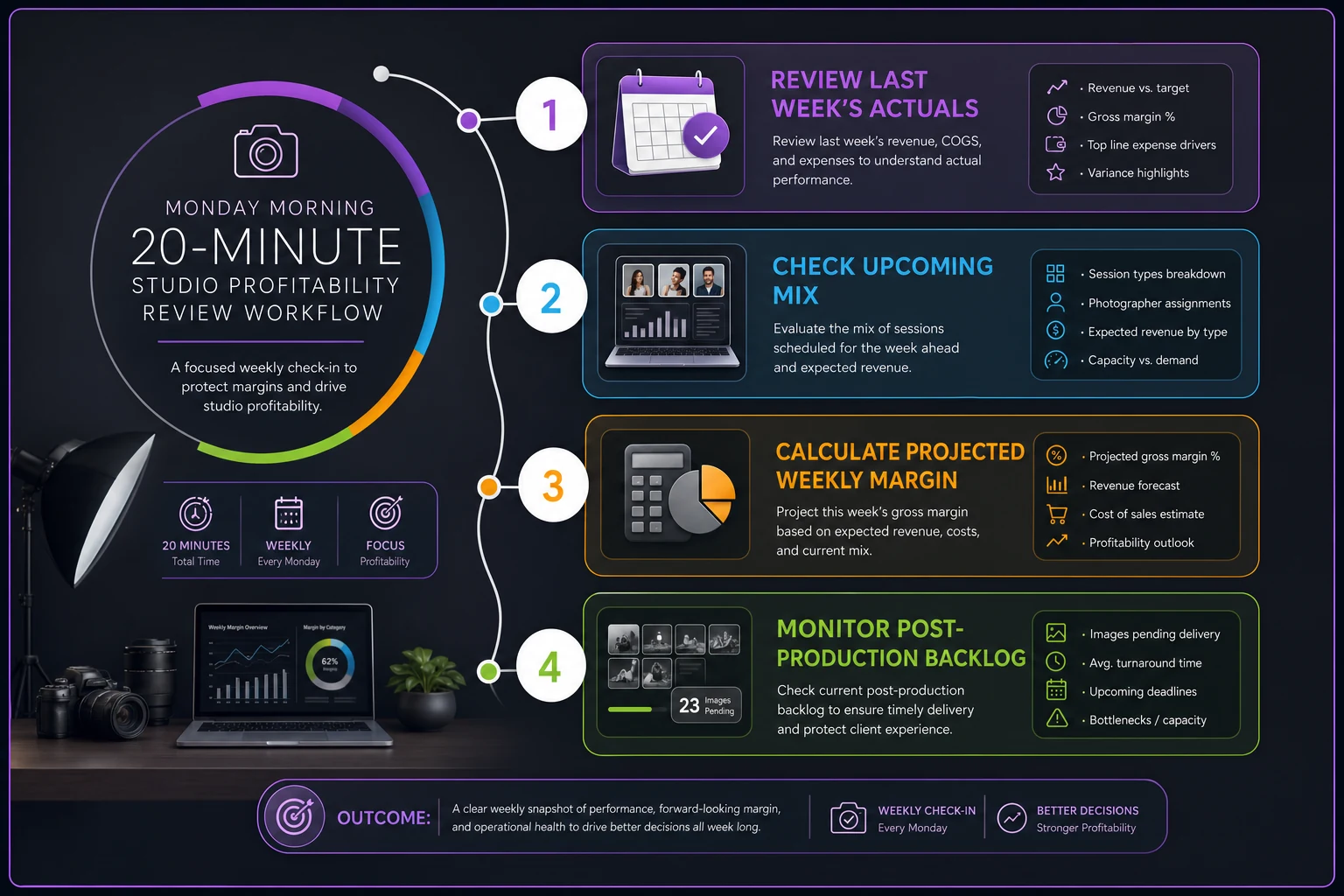
Profitability isn't a quarterly review—it's a weekly discipline. Studios that consistently protect margins tend to follow a Monday morning routine that takes about 20 minutes.
Step 1 — Review last week's actuals. Compare actual vs. estimated time for every session. Look for patterns where certain session types consistently run over. A family portrait scheduled for 90 minutes that regularly takes 2 hours needs either a price adjustment or a process change.
Step 2 — Check your upcoming mix. Compare next week's session breakdown against your target percentages. If you're heavy on low-margin sessions, actively promote higher-margin offerings through a quick email or social post. One studio sends "last-minute headshot availability" emails whenever their mix skews too far toward lengthy portrait work.
Step 3 — Calculate projected weekly margin. Based on what's booked, is it below target? Identify which slots need adjustment. Can you upsell a family session to include grandparents? Can you steer inquiries asking about full sessions toward a mini-session instead?
Step 4 — Monitor post-production backlog. If editing is piling up beyond one week, you're probably accepting too many low-margin, high-touch sessions. Time to adjust booking policies or raise prices on resource-intensive packages.
Here's a quick visual of that Monday routine.
This isn't about turning away business. It's about being intentional with the business you accept. Every slot on your calendar has an opportunity cost.
Quarterly profitability reviews that actually drive change
Weekly cadences handle tactical adjustments. Quarterly reviews shape strategic direction—and they need to go deeper than just scanning profit margins.
Start by analyzing variance between estimated and actual costs across all session types. If newborn sessions consistently run 45 minutes longer than planned, you either need to extend booking slots, streamline the process, or raise pricing to reflect reality.
Review your win/loss data through a profitability lens. Which inquiries did you lose, and were they for high-margin or low-margin sessions? One studio discovered they were aggressively competing on price for newborn sessions—their least profitable—while barely marketing their corporate headshot packages, which were their highest margin.
Examine seasonal patterns in both demand and profitability. A studio might find that their "slow" January–February period actually generates better margins than busy October–November because they're booking more corporate work and fewer demanding family sessions during that stretch.
Map competitor pricing against your cost structure. If competitors charge $50 less for similar family sessions but your workflows run $75 cheaper, you have pricing power you're not using.
Set specific mix targets for the next quarter based on what you've learned. Not just "book more headshots"—something concrete like "achieve 25% headshot mix by promoting Thursday afternoon availability to corporate clients."
Decision rules for sustainable growth
Never discount your highest-margin services. If headshots are your profit center, hold the price even during slow periods. Discount lower-margin services if you need to fill calendars.
Calculate lifetime value by service type. A corporate headshot client might book annually and refer colleagues. A newborn client typically books once. Factor repeat potential into your mix decisions.
Protect your most productive hours. If you edit fastest in the morning, don't schedule sessions then. Block that time for post-production and book shoots when you're naturally less focused.
Price complexity appropriately. Multi-generational family sessions with 15 people require exponentially more editing than a couple's portrait. One studio charges $50 per additional person beyond four—that's not arbitrary, it reflects actual editing time.
Build buffers into high-variance sessions. Newborn sessions can run anywhere from 90 minutes to 4 hours. Either charge enough to cover the longest scenario or implement strict time limits with overtime fees.
Technology's role in profitability tracking
Manual tracking works initially but breaks down as studios scale. The overhead of calculating margins, monitoring mix, and analyzing patterns becomes its own profit drain.
AI-powered operational software changes this. Modern platforms can automatically capture session duration, track editing time, and calculate real-time margins. They flag when your weekly mix drifts from targets and can surface which session types are consistently over-budget on time before that pattern becomes a bigger problem.
More practically, some platforms factor in things like overtime rates for weekend newborn sessions and suggest alternative slots or pricing adjustments before you confirm a booking. When that kind of information is baked into your workflow rather than living in a separate spreadsheet, you actually use it.
The studios seeing the best results tend to use operational platforms that connect booking, scheduling, editing workflow, and financial tracking in one place. Not because the technology is impressive—but because data silos are what make profitability analysis so hard to sustain in the first place.
Worked example: rebuilding a studio's profitability system
A studio in Phoenix came in generating around $38k monthly revenue but keeping only about $4k after all expenses. Classic high-volume, low-margin situation.
First step was mapping their true costs. Wedding packages priced at $2,500 were actually costing around $2,100 to deliver once you factored in second shooter fees, 40+ hours of editing, album creation, and overhead. Their "quick and easy" business headshots at $225 were generating $180 in profit per session.
We restructured their service mix targets:
-
Reduce weddings from 8 monthly to 4 (only premium packages over $4,500)
-
Increase headshot sessions from 12 to 35 monthly
-
Add a new "executive portrait" tier at $475
-
Eliminate the unprofitable "unlimited outfit changes" option
Then came post-production controls. Every package got defined deliverables—20 edited images for portraits, 5 for headshots, 100 for weddings. Additional editing billed at $12 per image. That one change improved margins by roughly $3,000 per month.
They also established a weekly review rhythm. Every Monday, 15 minutes reviewing the upcoming week's bookings against profitability targets. Low headshot bookings? Run a LinkedIn campaign promoting executive portraits. Wedding editing backing up? Temporarily pause booking consultations.
| Metric | Before | After |
|---|---|---|
| Monthly revenue | $38k | $34k |
| Monthly profit | $4k | $14k |
| Avg. weekly hours | 58 | 42 |
| Post-production backlog | 3 weeks | 3 days |
The key wasn't working harder or booking more. It was understanding which work actually generated profit and systematically shifting toward it.
Making profitability systematic, not aspirational
Building a photography studio profitability system isn't about complex spreadsheets or financial modeling. It's about creating simple, repeatable processes that connect booking decisions to profit outcomes.
Start with basic cost-per-slot tracking for your top three services. You don't need perfect data—rough estimates will reveal surprising patterns quickly. Add post-production time tracking next. Then implement one decision rule: "no discounts on headshots" or "maximum 20 edited images per family session."
As these habits solidify, layer in weekly reviews and mix targeting. Use the data to inform pricing updates, service modifications, and marketing focus. Let profitability metrics guide which clients you pursue and which inquiries you politely decline.
The studios thriving right now aren't necessarily the most talented or best marketed. They're the ones who understand their actual economics and make decisions accordingly. They've stopped celebrating full calendars and started optimizing for sustainable margins.
Your booking calendar might look less impressive. Your Instagram might feature fewer behind-the-scenes shoots. But your bank account will actually reflect the work you're putting in—and that's the only metric that matters for building a business that lasts.
Ready to elevate your studio’s workflow?
Join 500+ studios using TryPixly to save time, reduce scheduling conflicts, and deliver exceptional client experiences.