

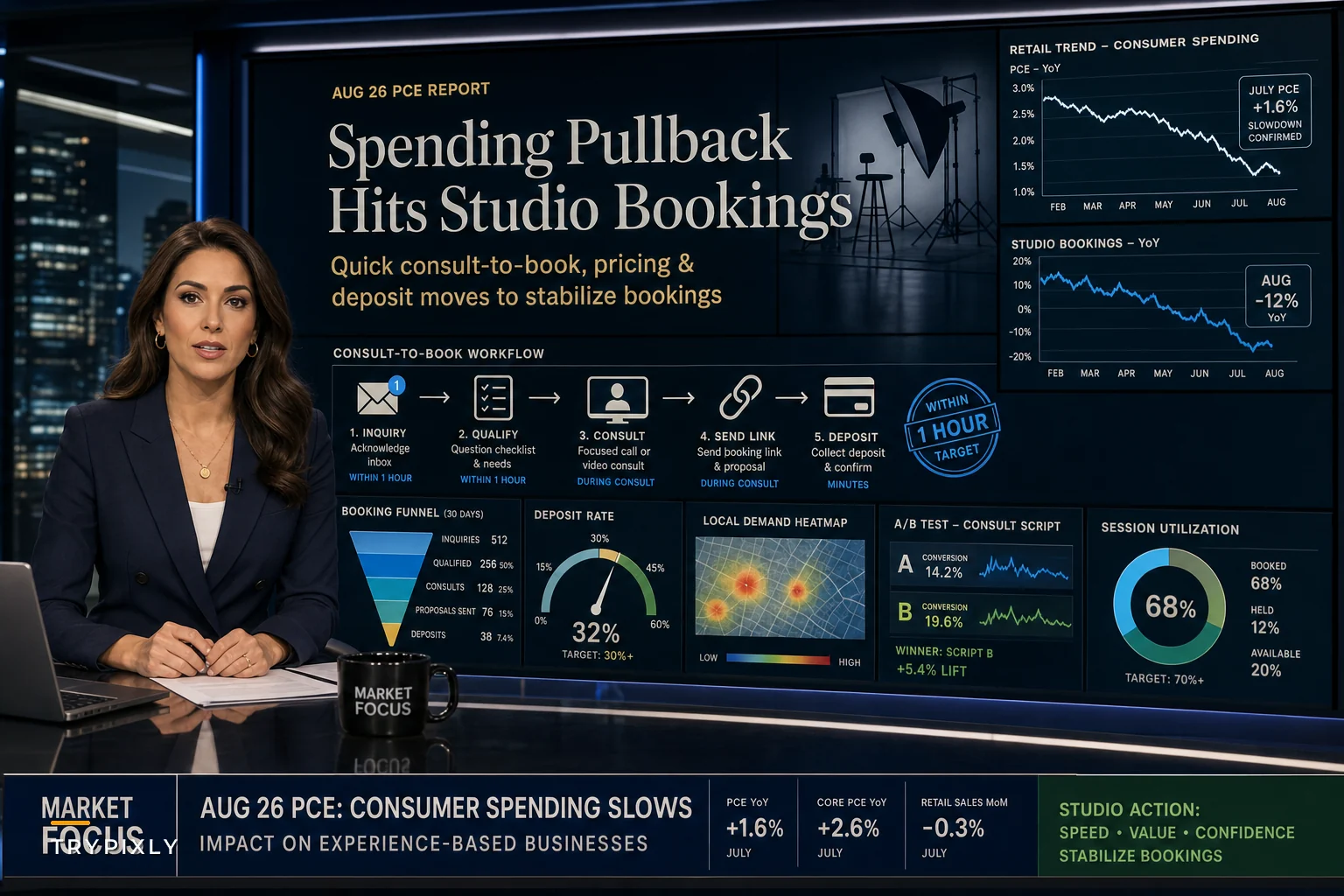

The July numbers weren't a surprise to anyone watching their inquiry inbox. When CNN reported that consumers pulled back on discretionary spending in July while prices stayed sticky, it just confirmed what studio owners were already feeling: people are still inquiring, but they're slower to commit, quicker to ask "what's your cheapest package," and more likely to ghost after a quote.
The tricky thing about a consumer spending slowdown and studio bookings is that it rarely shows up as a dramatic drop in leads. It shows up in the gap between "I'd love to book!" and an actual signed contract with a deposit attached. That gap widens. And if your booking process was already a little leaky, a cautious market turns a slow drip into a real problem right before your busiest fall and holiday stretch.
This isn't a doom piece about the economy. It's about the specific things you can change at the booking desk in the next few weeks to hold your conversion rate and protect your margins while everyone else panics and slashes prices.
What actually changes in buyer behavior (and what doesn't)
Most studios get this wrong. They assume a softer market means clients suddenly can't afford them. That's not what's happening for most portrait, family, and branding studios. What's happening is that clients are being more deliberate with money they still have.
-
They compare more before committing
-
They take longer to respond
-
They're more sensitive to feeling "locked in" too early
-
They respond to reassurance, not discounts
-
They book smaller first, then expand if the experience delivers
The Reuters coverage on sticky inflation and unrevised GDP reinforces this — the economy isn't collapsing, it's grinding. Households are recalibrating, not going broke. Studios that win over the next few months aren't the cheapest. They're the ones that make committing feel safe and low-friction.
Most owners react to softer numbers by dropping prices. It's almost always the wrong first move.
The mistake: reaching for discounts before fixing friction
When bookings slow, the reflex is to cut. Run a 20% fall promo, throw in free prints, undercut the studio across town. The problem is that discounting attacks the wrong variable.
Never miss a shoot or client detail again.
TryPixly helps you book, confirm, and manage every photography session seamlessly.
- Unified session and client management
- Automated client reminders
- Team calendar & resource scheduling
No credit card required
If your consult-to-book conversion is sitting at, say, 35%, dropping prices might nudge it to 40% — but you've torched your margin on every booking, including the ones who would have paid full price. In a soft market, you can't afford that.
The better lever is almost always speed and friction. A cautious buyer who gets a clear, easy path to book within 24 hours of a consult converts far better than the same buyer who waits four days for a custom quote PDF and then has to figure out how to pay.
A typical scenario looks like this: a family studio getting around 60–70 inquiries a month was converting at roughly 32%. Their consult-to-quote turnaround averaged close to three days because pricing was assembled manually per inquiry. They didn't change a single price. They tightened response to same-day and pre-built three clear package tiers. Conversion climbed into the low 40s over about six weeks. No margin lost.
Fix the gap before you touch the price.
Restructure the consult so it ends in a decision
The consultation is where cautious buyers either commit or drift. Most studio consults are structured to inform rather than close — which is fine in a hot market and quietly fatal in a cautious one.
-
It surfaces the real objection early. Budget, timing, or spouse buy-in — you need to know within the first few minutes, not after you've spent twenty minutes presenting packages they can't say yes to.
-
It narrows options instead of expanding them. A hesitant person facing five packages picks "none, let me think about it." The same person facing a clear recommendation plus one step-up decides faster.
-
It ends with a next action that has a deadline attached. Not "let me know" — an actual hold, a deposit link, a date being tentatively reserved.
This is why protecting your capacity gating during a slowdown matters more, not less. When conversion softens, there's a temptation to say yes to everything and let anyone hold dates indefinitely. That's how you end up with a calendar full of soft holds and no deposits. The consult-to-book workflow that protects capacity becomes even more critical when buyers are slow — tentative interest can't be allowed to clog the slots that real bookings need.
Repackage before you re-price
There's a version of "lowering the barrier" that doesn't cost you margin: introducing a genuine entry-tier offer instead of discounting your existing packages.
The psychology is different. A discounted full package signals "our real price was inflated." A smaller, digital-first mini offer signals "here's an easy way to start." One erodes trust; the other builds a ladder.
Here's how those approaches compare in practice:
| Move | Effect on margin | Effect on brand | Best for |
|---|---|---|---|
| Across-the-board discount | Cuts margin on every sale | Signals prices were soft | Almost never right now |
| Free add-ons (prints, extra images) | Hidden cost, erodes fulfillment margin | Feels generous but sets expectations | Occasional, targeted use |
| New entry-tier mini session | Protects premium pricing | Creates a low-risk trial | Cautious first-time buyers |
| Faster delivery as the upsell | Improves cashflow, no discount | Signals premium service | Buyers hesitant about wait time |
The entry-tier mini session stands out. A short session with a small set of digital images gives a hesitant buyer a low-commitment way to experience your studio. The ones who love it — and most do — upgrade later or rebook for the full experience. You've converted a "maybe" into a paying relationship instead of a lost lead.
One caution: your mini offer needs a hard capacity cap and clear limits, or it starts cannibalizing full sessions. Limit the slots, limit the deliverables, and make the upgrade path obvious.
Rework deposits to reduce fear, not revenue
Deposits are the other place cautious buyers stall. A large upfront deposit feels risky to someone being careful with money — but in a market with shorter booking windows and higher cancellation risk, you can't just drop deposits either.
-
A smaller booking deposit that secures the date, with the balance due closer to the session. Lowers the psychological barrier to commit while still filtering out non-serious inquiries.
-
A refundable-to-credit window. If they cancel outside a certain window, the deposit converts to studio credit rather than disappearing. This dramatically reduces the "locked in" feeling — which is exactly the hesitation a cautious buyer carries.
-
Deposit tied to date-holding, communicated clearly. People pay far more willingly when the deposit obviously does something — reserves a specific, limited slot — versus feeling like an arbitrary fee.
Studios that handle slowdowns well treat the deposit as a commitment device, not a revenue grab. A deposit structured to feel safe converts more hesitant buyers than a large non-refundable one, even though the large one feels more protective on paper.
A quick-response workflow for cautious inquiries
Speed is the cheapest conversion lever you have, and it's almost entirely operational. A workflow that consistently moves the needle without touching pricing:
-
Acknowledge within an hour. Even a short "Got your inquiry — can I grab a quick 10 minutes today or tomorrow?" beats a polished response sent two days later.
-
Qualify before the full consult. A couple of pre-consult questions — date range, session type, rough budget comfort — let you tailor the conversation and spot dealbreakers early.
-
Run a focused consult that ends in a recommendation. Not a menu. A "based on what you told me, I'd suggest X" plus one alternative.
-
Send the booking link during or immediately after the consult. The window between "I'm interested" and "I've paid" should be minutes, not days. Every hour of delay lets doubt creep back in.
-
Follow up on soft holds with a real deadline. "I can hold your date until Thursday" outperforms open-ended follow-ups every time.
A quick visual can make it easier to align the team on the steps.
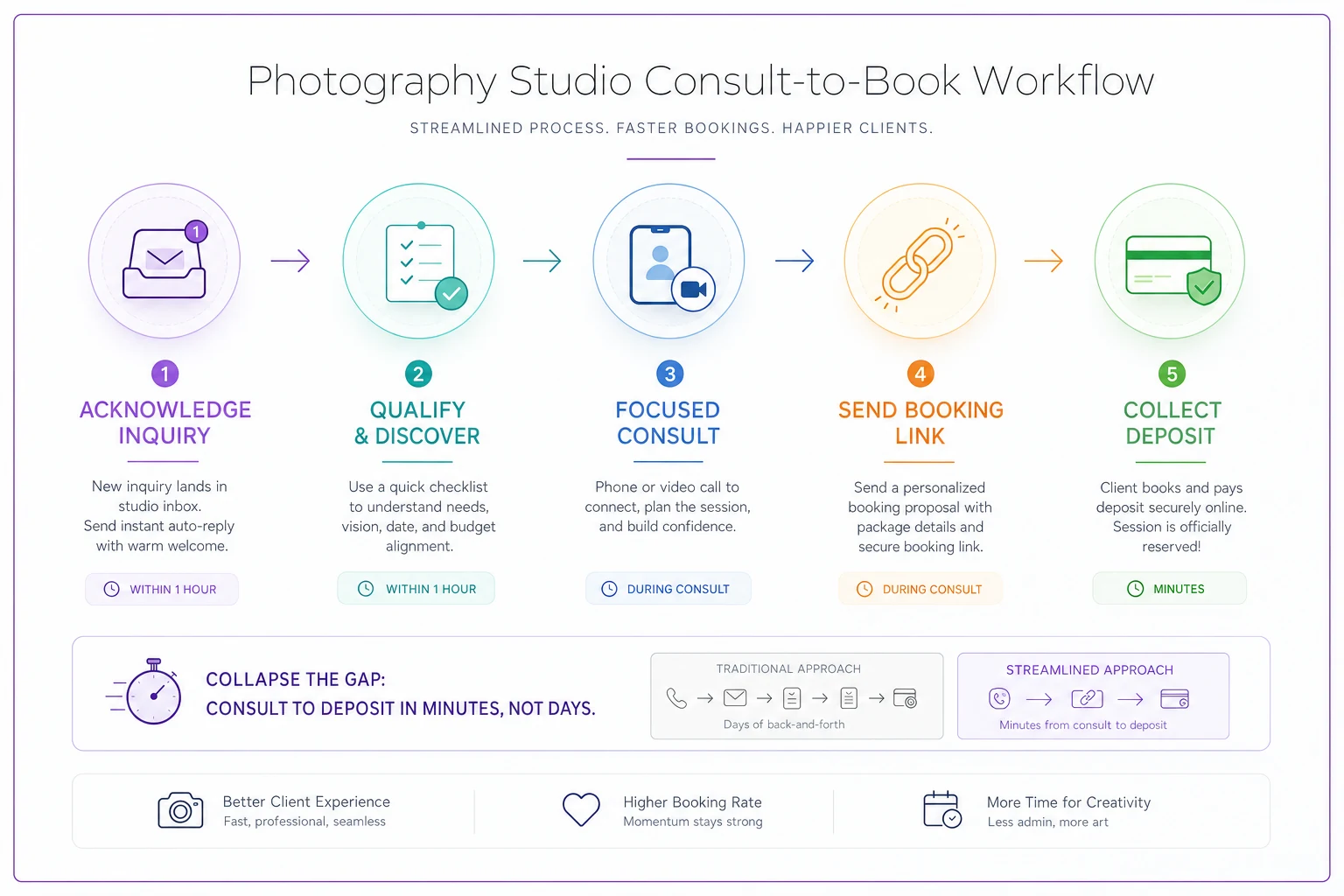
The bottleneck in most studios isn't willingness to do this — it's that pricing, availability, and booking are scattered across a calendar app, an email inbox, and a spreadsheet. When those live in separate places, same-day turnaround is nearly impossible because assembling a quote takes real manual effort.
This is where having your consult flow, availability, package tiers, and deposit collection connected in one booking system actually earns its keep. Not because software is magic, but because it collapses that dangerous multi-day gap into a single same-day flow. Studios running a connected booking process can respond, quote, and collect a deposit while the buyer is still warm — which is exactly when a cautious buyer says yes.
Real scenario: a portrait studio holding conversion through the pullback
A two-photographer portrait studio was seeing the classic soft-market pattern this summer — inquiry volume roughly flat, but conversion slipping from the high 30s down toward the mid-20s. Quotes were going out slowly, deposits were steep and non-negotiable, and clients kept "thinking about it" into oblivion.
They didn't cut prices. They made three changes:
-
Added a short entry-tier mini session, capped at a handful of slots per month
-
Cut the booking deposit roughly in half and moved the balance to two weeks before the session, with a cancel-to-credit window
-
Committed to same-day consult responses and sent the booking link inside the consult itself
Over about two months, conversion recovered into the mid-to-high 30s. A meaningful share of mini-session bookers upgraded or rebooked for full sessions — so the entry tier didn't cannibalize nearly as much as feared. Average booking value dipped slightly, but total booked revenue rose because far fewer warm leads slipped away. Margins held because nothing was discounted.
When these moves make sense — and when they don't
These moves make sense when: your inquiry volume is holding but conversion is slipping, your consult-to-quote turnaround is measured in days, or deposits keep coming up as a friction point.
Be careful when: you're already booked solid. If demand is still outpacing capacity, cutting deposits and adding entry tiers just invites low-commitment bookings into a calendar you can't serve well.
Skip the entry-tier entirely if: your premium positioning is your whole brand and a mini offer would confuse your market. In that case, lean harder on faster response times and safer deposit structures instead.
The point of a soft market isn't to become the cheap option. It's to become the easy option — the studio where a careful buyer feels the least risk in saying yes. Speed, clarity, and a deposit structure that respects their caution will do more for your fall calendar than any discount. And they'll do it without quietly bleeding the margins you'll need when spending picks back up.
Ready to elevate your studio’s workflow?
Join 500+ studios using TryPixly to save time, reduce scheduling conflicts, and deliver exceptional client experiences.