

Most studios don't lose money because their photography is weak or their pricing is wrong. They lose it in the gap between an inquiry landing in the inbox and a deposit hitting the account. That stretch — the consult-to-book segment — is where good leads go stale, where your best weekend slots get claimed by low-margin sessions, and where your team burns hours on inquiries that were never going to convert anyway.
The frustrating part is that this rarely shows up anywhere in a P&L. You see revenue. You see costs. You don't see the mini-session client who took forty-five minutes of consult time and a rescheduled Saturday, blocking a full portrait package that would've paid three times as much. The lost throughput hides inside "we were busy."
A functioning photography lead-to-booking workflow isn't just a faster reply or a nicer consult call. It's a system that decides which leads get attention, when a booking should be triggered, and what price protects your margin given the slot you're about to give away. Miss any one of those, and the other two stop mattering.
The core problem is that most studios treat consult-to-book as a communication issue when it's actually an operational one. You can have the best email templates in the world and still bleed margin if you're quoting the wrong price on the wrong day to the wrong lead.
Why this breaks in almost every growing studio
When you're small, the consult-to-book flow lives in your head. You know which inquiries are serious because you read the email and you feel it. You quote based on the day of the week and how full you already are. You book the session because you happened to have your calendar open during the call.
That works right up until it doesn't. The moment you add a second photographer, a studio manager, or a booking VA, the intuition that ran the whole thing stops being shared. Now three people are answering inquiries with three different instincts about who's worth chasing and what to charge.
A pattern that comes up constantly: the studio owner treats every inquiry as equally valuable, so the team does too. A tire-kicker asking about a $150 mini gets the same twenty-minute consult as a corporate client who needs headshots for forty employees. No triage means attention is distributed evenly — which is the same as distributing it randomly.
The second failure is timing. Studios either book too early — locking in a low-value session before a better one materializes — or too late, letting a hot lead cool off while they "get back to them." Both leak revenue. And because nobody's tracking the interval between inquiry and booking, nobody notices it happening.
The third failure is the one that actually destroys margin: static pricing on finite capacity. A studio has a fixed number of prime slots. When you price the same regardless of how full your calendar is, you sell your scarcest inventory at your average price. That's the exact opposite of what a hotel or airline does, and it's why so many studios end up fully booked but not fully profitable.
The three moving parts that have to work together
The reason consult-to-book is hard to fix piecemeal is that it's really three subsystems that only work when wired to each other:
Never miss a shoot or client detail again.
TryPixly helps you book, confirm, and manage every photography session seamlessly.
- Unified session and client management
- Automated client reminders
- Team calendar & resource scheduling
No credit card required
-
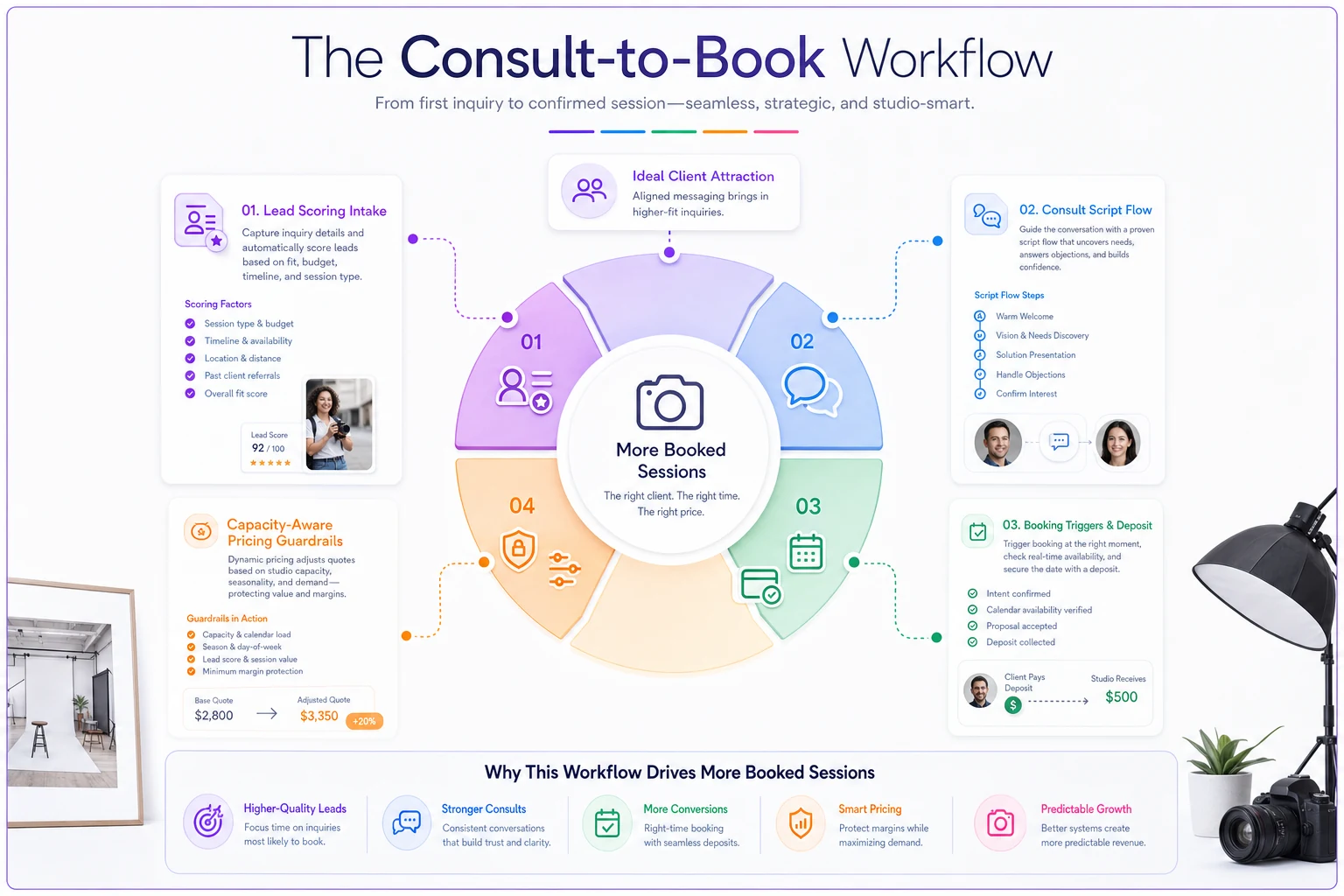
Lead scoring decides where human attention goes.
-
Consult scripts + booking triggers decide when and how you close.
-
Capacity-aware pricing guardrails decide what you charge based on remaining inventory.
Fix scoring without pricing guardrails, and you'll just book your high-value leads faster into slots you underpriced. Fix pricing without booking triggers, and your quotes expire before anyone acts on them. These pieces coordinate or they collapse.
Lead scoring: attention is your scarcest resource, not your calendar
Every studio thinks the bottleneck is calendar slots. Early on, the real bottleneck is consult time. A serious consult call — discovery, expectations, quote, objection handling — runs 20 to 40 minutes. If you're fielding thirty inquiries a week and half are unqualified, you're burning ten-plus hours on people who won't book.
Lead scoring is how you route that time. You don't need a data science model. You need three or four signals that reliably predict value and intent:
| Signal | Weak lead | Strong lead |
|---|---|---|
| Budget indication | "What's your cheapest option?" | Asks about packages, not just price |
| Timeline | "Sometime this year, maybe" | Has a date or event driving it |
| Session type | One-off mini, discount-driven | Full portrait, branding, corporate, recurring |
| Response depth | One-line inquiry, no details | Answers your intake questions fully |
Score each inquiry and you get a rough tier — hot, warm, cold. Hot leads get a same-day consult offer. Warm leads get a templated response with a self-booking link. Cold leads get an automated nurture sequence and none of your live consult time until they show actual intent.
The mistake people make here is scoring on enthusiasm instead of fit. The most excited person in your inbox is often the mini-session bargain hunter. Excitement isn't intent to spend. A calm corporate client who answers your intake form completely is worth ten of them.
Consult scripts: structure is what makes a quote defensible
A consult script isn't a sales pitch you read off a card. It's a repeatable structure that makes sure you gather the right information before you quote — because the number one reason studios under-quote is that they name a price before they understand the scope.
A workable consult flow looks like this:
-
Discovery (5–8 min) What's the session for, who's involved, what's the deliverable they actually care about? Listen for value cues, not just logistics.
-
Frame the offering (3–5 min) Present two or three packages tied to outcomes, not feature lists. Anchor high.
-
Quote against the slot (2 min) This is where capacity awareness enters. The price you name depends on what you're giving up to fit them in.
-
Trigger the booking (2–3 min) Ask for the deposit on the call if the lead is hot. Don't "send details later." Later is where deals die.
-
Objection handling + close Have two or three pre-written responses for the predictable pushbacks — price, date, "need to check with my partner."
What most owners underestimate is how much consistency this buys across a team. When your VA and your junior photographer both run the same consult structure, your conversion rate stops depending on who happened to pick up the phone. That predictability is what lets you forecast, and forecasting is what lets you price capacity intelligently.
Booking triggers: the moment matters more than the message
A booking trigger is the specific, pre-defined condition that moves a lead from "interested" to "committed." Most studios never define theirs, so booking happens whenever it happens — which means it often doesn't.
Good triggers are unambiguous:
-
Hot lead completes intake form → auto-send consult calendar link within the hour.
-
Consult call ends with verbal yes → deposit request sent before the call disconnects.
-
Warm lead clicks the booking link twice without completing → live follow-up within 24 hours.
-
Quote issued → 72-hour expiry, then price reverts or slot releases.
That last one is quietly the most important. A quote with no expiration is an open-ended option you've handed the client for free. They'll sit on it while your calendar fills, then come back expecting the same price on a now-scarcer slot. Expiring quotes protect both your throughput and your pricing integrity.
This connects directly to your no-show and deposit discipline. Booking isn't real until money moves, and the policy around that money is a system of its own — we went deep on that in the testable cancellation and deposit policy playbook. Your booking trigger and your deposit policy are really the same handshake viewed from two angles.
Capacity-aware pricing guardrails: the part everyone skips
Not all slots cost you the same to give away. A Tuesday-morning slot in a slow month is nearly free inventory. A Saturday in October — peak family-portrait season — is your scarcest, most valuable asset. Charging the same for both is leaving margin on the table at one end and killing throughput on the other.
Capacity-aware pricing means your quote adjusts based on how full the relevant period already is. You don't need surge pricing that scares clients. You need guardrails — floors and triggers — that your team follows automatically:
-
When a prime period is under ~40% booked, standard pricing applies. Fill it.
-
When it crosses ~70% booked, minimum package tiers kick in — no low-margin sessions in your last remaining prime slots.
-
When it's near capacity, only premium packages or waitlist. The last two Saturdays of peak season should never sell at your entry price.
This connects directly to how you've structured your calendar in the first place. If you haven't built a genuinely finite-capacity scheduling model yet, pricing guardrails have nothing to attach to — this whole approach assumes you know your true slot inventory and buffers. We laid that out in the finite-capacity studio scheduling system, and the pricing logic here sits directly on top of it.
One thing to avoid: treating guardrails as rigid rules your team resents. They should feel like a floor, not a cage. The photographer can always go up for a client who's clearly high-value. The guardrail just stops them from going down on scarce inventory to win a deal that wasn't worth winning.
A real scenario: how the three pieces compound
A two-photographer portrait studio — family and newborn work, roughly 40–50 sessions a month in season — was fully booked every fall and still frustrated with their income. Classic symptom: busy but not profitable.
When they mapped their consult-to-book flow, three things stood out. No lead scoring: the owner and one assistant answered every inquiry live, burning 8–10 hours a week on consults that converted at maybe 25%. No booking triggers: quotes went out by email with no expiry, and their average "get back to you" window was around four days — plenty of time for prime slots to fill with whoever booked fastest, not whoever paid most. And flat pricing: their $650 signature session sold at $650 whether it was August (wide open calendar) or the second Saturday of October (their highest-demand day of the year).
They changed three things over roughly a quarter. Inquiries went through a short intake form that auto-tiered them, so live consults went only to warm-and-hot leads. Calls ended with a deposit request on the spot, and quotes carried a 72-hour expiry. And they set a simple guardrail: once a peak weekend hit 70% booked, only $900+ packages could fill the remaining slots.
Here's a compact workflow showing how lead scoring, consults, booking triggers, and pricing guardrails interact.
The calendar looked almost identical afterward — still full in season. But the mix shifted. Peak-weekend slots that used to go at $650 were now going at $900–$1,100. Consult hours dropped by roughly a third. In-season monthly revenue came up somewhere in the 15–20% range without adding a single session. Same throughput, better-defended margin.
When this makes sense — and when it doesn't
When it's worth building: You're consistently getting more inquiries than you can convert well, you have identifiable peak periods where demand exceeds supply, and more than one person is touching bookings. That combination is exactly when intuition stops scaling and structure starts paying for itself.
When it's premature: If you're still hunting for enough leads to fill a normal week, don't build capacity guardrails yet. Scoring and pricing floors assume scarcity. With slack in your calendar, your job is fill rate, not margin defense — take the sessions and refine later.
Who should skip parts of this: Solo photographers doing 10–15 sessions a month probably don't need formal lead scoring. You can still hold the whole thing in your head, and the overhead of a scoring system would cost more than it saves. But even solos benefit from booking triggers and quote expiries — those are cheap to implement and stop the slow bleed of "I'll get back to you" deals going nowhere.
Where this quietly lives inside your broader operation
The consult-to-book engine doesn't end at the deposit. A booked session is the front door to the entire client relationship, and how you handle that first conversion sets the tone for everything after — onboarding, delivery, and whether they come back. Studios that turn a first booking into a second and a referral treat the whole thing as one connected lifecycle rather than a series of transactions, which we broke down in the operational client lifecycle piece.
The real reason to systematize consult-to-book is coordination. When scoring, scripts, triggers, and pricing guardrails are written down and consistent, they can be enforced without you personally being on every call. That's also the point where lightweight automation earns its keep — auto-tiering inquiries, sending consult links to qualified leads, expiring quotes on schedule, flagging when a peak period crosses its booking threshold. Not to replace judgment, but to make sure the rules you already decided on actually fire every time, instead of only when you remember to check.
The bottom line
Your calendar being full is not the same as your calendar being profitable. The consult-to-book stretch is where those two diverge, and it diverges quietly. Score your leads so attention flows to value. Structure your consults so quotes are defensible. Trigger bookings and expire quotes so hot leads convert before they cool. Put guardrails on your scarcest slots so you never sell peak inventory at off-peak prices.
Do those together and the same number of sessions produces meaningfully more margin — which is the whole reason you're booking in the first place.
Ready to elevate your studio’s workflow?
Join 500+ studios using TryPixly to save time, reduce scheduling conflicts, and deliver exceptional client experiences.