

Your studio probably tracks new inquiries religiously. You know your booking rate, average package value, maybe even conversion by photographer. But what kills me — studios sitting on 2,000+ past clients in their database who haven't heard from them since gallery delivery.
The math is rough. A family portrait studio averaging $1,800 per session loses somewhere between $45,000–65,000 a year from missed anniversaries alone. Not theoretical money. Real bookings that went to competitors because nobody reached back out.
And I'm not talking about generic email blasts — those "Happy Holidays from our studio!" messages that pull 3% open rates. I mean an actual photography client retention system that treats different clients differently and triggers specific actions at specific times.
Why retention falls apart: the handoff problem
Studios fail at retention for one core reason — they treat client relationships like transactions instead of lifecycles. The photographer finishes editing, someone uploads galleries, accounting processes final payments, and then nothing. The client becomes a closed job in your CRM.
The operational reality gets messy fast. Your lead photographer manages the shoot experience. Your studio manager handles scheduling. Someone else deals with product fulfillment. Maybe a part-time person answers emails. Each person owns their piece, but nobody owns the full client journey.
What typically happens: a newborn client books their session, has a great experience, and the photos are beautiful. Six months pass. The baby's first birthday comes around. That client books with another studio because yours never reached out about milestone sessions. You just lost $4,500 in lifetime value because nobody owned month six of the relationship.
This fragmentation gets worse as you scale. Ten clients? You remember birthdays. Two hundred active clients across different lifecycle stages? Different story entirely. The coordination required between booking, production, delivery, and long-term nurture breaks down without clear systems.
Segmentation that actually works: behavior beats demographics
Most studios segment by session type — newborns, families, seniors, corporate. Makes sense for scheduling. Makes zero sense for retention.
Never miss a shoot or client detail again.
TryPixly helps you book, confirm, and manage every photography session seamlessly.
- Unified session and client management
- Automated client reminders
- Team calendar & resource scheduling
No credit card required
Your newborn clients aren't just "newborn clients." They're either first-time parents figuring everything out, or experienced parents who know exactly what they want. Those groups need completely different follow-up.
Here's segmentation that actually drives repeat business:
Engagement-based segments:
-
Gallery viewers (opened within 48 hours vs. a week later)
-
Product purchasers (albums vs. prints only vs. digital only)
-
Communication preference (responds to text vs. email vs. needs calls)
-
Session add-on buyers (hair/makeup, extra locations, rush delivery)
Lifecycle position segments:
-
Pre-session (booked but not shot)
-
Active production (shot but not delivered)
-
Recently delivered (last 30 days)
-
Nurture zone (31–180 days post-delivery)
-
Re-engagement needed (181+ days silent)
Value-based segments:
-
High-value clients ($3,000+ lifetime spend)
-
Multi-session clients (2+ bookings)
-
Referral sources (sent 1+ referral)
-
Single-session complete (no repeat engagement)
The operational difference: a high-value newborn client who bought an album gets a personal text at 5.5 months about their 6-month milestone session with preferred scheduling. A digital-only family session from 8 months ago gets an automated email series about fall minis. Same "retention strategy," completely different execution based on actual behavior.
KPIs that predict revenue, not vanity metrics
Studios love tracking email open rates and Instagram engagement. Those numbers tell you nothing about retention health.
Real photography client retention system KPIs:
Repeat booking rate by segment Target: 35–45% of portrait clients book again within 18 months. Newborn clients should hit 60%+ for first-year milestones. Below 25% means your retention system is broken.
Time to second booking Average should be 4–7 months for newborn/baby clients, 11–14 months for family portraits. If it's stretching beyond those windows, you're missing critical touchpoints.
Revenue per client (24-month window) Not session average — total revenue across all interactions. Strong studios see $3,200–4,800 from family clients over two years. Weak retention drops this to $1,400–1,900 (single session only).
Referral generation rate 15–20% of clients should generate at least one referral within 12 months. Below 10% points to weak post-session relationship building.
Reactivation success rate When you reach out to dormant clients (6+ months silent), 8–12% should book something. Under 5% means your reactivation messaging needs work.
Track these monthly by cohort. January newborn clients get measured separately from March family sessions. You'll spot retention problems months before they hit revenue.
The pre-session handoff: setting up retention before they arrive
Retention starts during booking, not after delivery. Your onboarding flow determines whether clients see you as a one-time service or an ongoing partner.
Most studios send a booking confirmation and maybe a prep guide. That's transactional thinking. Relationship thinking means using pre-session touchpoints to gather retention data.
Critical pre-session data collection:
-
Kids' birthdays (for milestone reminders)
-
Anniversary dates (for couple/family sessions)
-
Preferred communication channel
-
Extended family in the area (multi-generation session opportunities)
-
Specific photo display goals (annual album vs. holiday cards vs. wall art)
The trick: don't make it feel like a survey. Embed these questions naturally in your styling questionnaire or planning call. "I always like to note important dates in case you want to commemorate them with photos — any birthdays or anniversaries coming up in the next year?" works every time.
Pre-session retention setup checklist:
-
Welcome sequence introduces annual photo philosophy
-
Styling guide mentions seasonal session options
-
Contract includes gentle language about future session priority booking
-
Confirmation mentions birthday club or milestone program
-
Pre-session questionnaire captures key dates and preferences
One portrait studio I worked with added a single question to their booking form: "How often does your family typically update portraits?" The answers segmented clients automatically. "Every year" clients got enrolled in an annual reminder system. "Only for special occasions" got event-based outreach. Repeat booking rate jumped from 28% to 41% in eight months from that one change.
Add one short, retention-focused question to the booking form to automatically segment clients for follow-up.
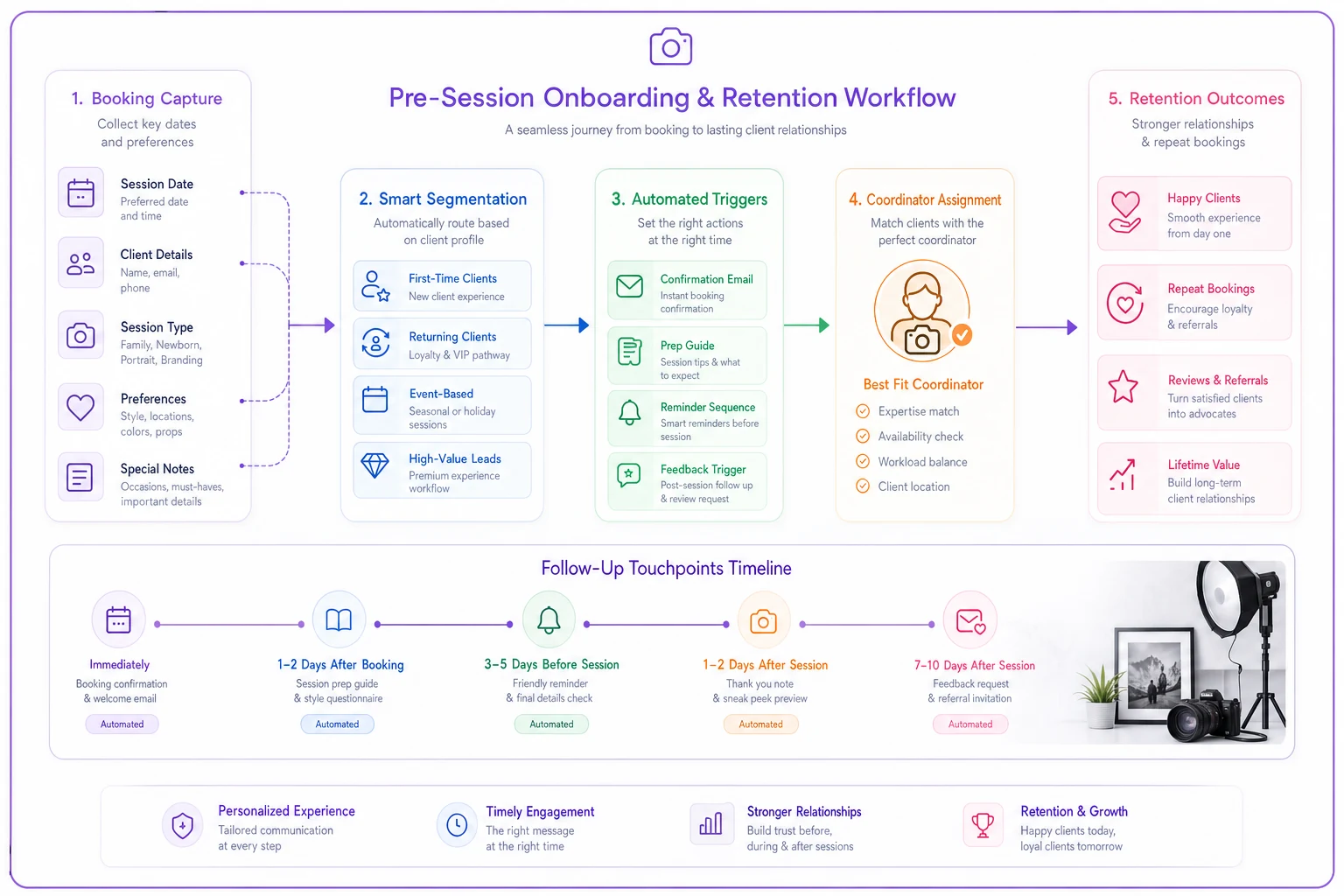
This diagram shows the pre-session workflow and who owns each step.
Delivery isn't the end: the 72-hour retention window
Gallery delivery feels like the finish line. For retention, it's actually the starting gun. Those first 72 hours after delivery determine whether clients become repeat buyers or disappear.
The emotional high of seeing their images makes clients most receptive to future booking. Yet most studios send a "your gallery is ready" email and move on.
The 72-hour retention sequence:
Hour 0 (delivery): Gallery ready notification with a personal note mentioning something specific from their session
Hour 24: "How are you enjoying your photos?" check-in with a subtle mention of seasonal sessions coming up
Hour 48: Share a behind-the-scenes image or outtake they haven't seen with a "loved working with your family" message
Hour 72: If high engagement (multiple gallery visits, sharing photos), send priority booking for next season. If low engagement, wait for day 7 follow-up instead
The coordination challenge: someone needs to monitor gallery analytics and trigger these touchpoints. Can't be the photographer — they're shooting. Can't be random — it needs consistency. This is exactly where retention breaks without clear ownership.
Multi-touch sequences: different clients, different cadences
One-size-fits-all email campaigns are retention theater. Sending the same "book your fall session!" message to everyone guarantees most clients ignore you.
High-value family client sequence (bought album, $3,500+ spend):
Month 1 post-delivery: Personal thank you with printed card Month 2: Behind-the-scenes blog feature request Month 3: Check in about album arrival and setup Month 5: Exclusive preview of new seasonal sets Month 8: Personal invitation to fall/spring sessions Month 11: Anniversary reminder with session credit Month 14: "We miss your family!" reactivation Month 18: Final reactivation with special offer
Standard portrait client sequence (prints only, $1,200–2,000 spend):
Month 1: Email thank you with favorite image attached Month 3: Seasonal mini-session announcement Month 6: General studio update with recent work Month 10: "Almost a year since your session" touchpoint Month 12: Anniversary reminder with booking link Month 15: Mini session or special event invite Month 18: Move to general marketing list
Budget-conscious client sequence (digital only, under $1,000 spend):
Month 2: Product upgrade offer (print sale) Month 6: Group mini-session opportunity Month 11: Early bird special for next year Month 18: Archive to low-frequency list
Higher-value clients get more personal touchpoints spread over longer timelines. Budget clients get fewer touches focused on special offers. Both segments can be valuable, but they need completely different approaches.
Anniversary and milestone automation that doesn't feel robotic
"Happy birthday to little Sarah! Time for another session?" These messages scream automation and get ignored.
Effective milestone outreach feels personal even when it's systematized. The key is layered trigger points and human handoffs.
The three-layer milestone system:
-
Layer 1 — Automated reminder to team (30 days before) System flags the upcoming milestone and assigns to a coordinator. "Emma's first birthday in 30 days — high-value client, previous album buyer."
-
Layer 2 — Personalized outreach (21 days before) Coordinator sends a personal message referencing the previous session. "Can't believe it's almost been a year since Emma's newborn session! That photo of her yawning still makes me smile. If you're thinking about first birthday photos, I wanted to give you first choice of dates."
-
Layer 3 — Gentle follow-up if needed (7 days before) Only if there's no response. "Just wanted to make sure my last message didn't get lost. We have three spots left for birthday sessions this month if you're interested."
The operational complexity: tracking hundreds of dates across multiple photographers and coordinators. Who monitors the system? Who writes the messages? Who handles responses? Without AI-powered operational software handling the tracking and routing, this falls apart around 50 active clients. With good systems in place, you can manage thousands while keeping the personal touch intact.
Referral triggers: engineering word-of-mouth at scale
Studios wait passively for referrals. "If clients love us, they'll tell friends." Except they don't — even when they genuinely love your work. Not because they don't want to, they just forget or don't know how.
Building referral triggers into your photography client retention system removes the guesswork.
Seven natural referral trigger points:
-
Gallery sharing moment — When clients share on social (detected through gallery analytics)
-
Album delivery — Physical product arrival creates a natural sharing opportunity
-
Three-month mark — Excitement is still fresh but not overwhelming
-
Similar life stage — New baby announcement for past newborn clients
-
Seasonal match — Fall family clients get reminded the following fall
-
Community events — School fundraisers, local fairs
-
Client's network growth — Job changes, moves, social expansions
What actually generates referrals: a past newborn client posts about their friend's pregnancy. Within 24 hours, you send a personal message: "Saw your friend is expecting! If she needs a photographer, I'd love to chat with her. I can share the newborn guide I created for you, and she'd get the same friend discount you did."
Not pushy. Not salesy. Just helpful. Conversion on these targeted referral requests runs 15–20%, compared to 2–3% for generic "refer a friend" campaigns.
When retention systems break: scale points and solutions
Every retention system has a break point where what worked stops working.
-
25–50 active clients
Personal memory works. You remember who's who, what they need, when to follow up. Maybe a basic spreadsheet helps.
-
50–150 active clients
Memory fails. Spreadsheets get unwieldy. Clients slip through the cracks. You need actual CRM tracking and calendar reminders. This is where most studios get stuck.
-
150–400 active clients
Manual follow-up becomes a full-time job. You can't personally message everyone. You need automation for standard touchpoints while preserving personal contact for high-value clients.
-
400+ active clients
Pure automation except for the VIP tier. Sophisticated segmentation required. Multiple team members managing different lifecycle stages. Operational handoffs have to be airtight.
The pattern stays consistent across all of these: systematize the predictable, personalize the profitable. Birthday reminders can be automated. Thank you sequences can be templated. But high-value client outreach and referral conversations stay personal.
Sample templates that actually get responses
Generic templates get generic results.
6-Month Milestone Outreach (SMS preferred): "Hi [Name]! Can't believe [Baby] is almost 6 months 😭 That newborn session feels like yesterday! If you're thinking about 6-month photos, I have three spots open [Date Range]. Want to grab one? -[Your name]" Response rate: 34–42%
Annual Family Session Reminder (Email): "Subject: Your walls are calling... [Name], I was organizing client galleries and came across your family's photos from last [Season]. [Specific detail about session or child]. Fall sessions are booking for [Dates]. Since you're repeat clients, you get first pick of dates and 10% off. Here's what's new this year: [One exciting update] Want to lock in a date? Just reply with a few options that work. [Signature]" Response rate: 18–24%
Referral Request After Social Share: "Saw you shared [Child's] photos — they turned out so perfect! 🥰 Thanks for the tag! If any of your friends need a photographer, I'd love to help. I can share the same prep guide you got, and they'd get my friend rate. Just send them my way!" Referral generation: 12–15%
VIP Client Season Invite (Personal video or voice message): "[Name], before I open fall bookings to everyone, wanted to give you first choice since you've been with us for [X years]. I have a new location that would be PERFECT for [specific child/family detail]. Interested?" Booking rate: 65–75%
The tech stack reality: what you actually need
Studios get sold retention "solutions" that create more problems. Email platforms that don't connect to booking systems. CRMs that require manual data entry. Social media schedulers completely disconnected from client databases.
Your photography client retention system needs three core components:
-
Unified client database Every interaction in one place — bookings, communications, purchases, gallery analytics, personal notes. If data lives in multiple systems, retention fails. Simple as that.
-
Automated trigger system Monitors dates, behaviors, and milestones. Routes tasks to the right team member. Sends standard messages automatically. Escalates high-value opportunities.
-
Performance tracking Links retention activities to actual bookings. Shows which sequences work. Identifies dropping engagement before it becomes lost revenue.
The integration challenge: your booking system knows session dates. Your gallery platform knows viewing behavior. Your payment processor knows purchase history. Your email system knows engagement. Without these talking to each other, you're operating blind.
This is where AI-assisted operational platforms make a real difference — not by replacing human connection, but by handling the coordination complexity that makes retention impossible at scale. When software tracks 500 client anniversaries and routes personal outreach tasks to your team at exactly the right moment, retention becomes systematic instead of something that happens when someone remembers.
Who owns retention? The answer nobody wants to hear
Retention fails because nobody truly owns it. The photographer thinks marketing handles it. Marketing thinks operations does. Operations assumes sales manages relationships. Everyone's responsible means no one's accountable.
Studios that nail retention assign one person as "Client Success Manager" or "Relationship Coordinator." Doesn't need to be full-time at first. But someone needs to wake up thinking about client lifecycles.
Retention owner responsibilities:
-
Monitor all client lifecycle stages daily
-
Execute or assign all touchpoints
-
Track retention KPIs weekly
-
Update sequences based on performance
-
Coordinate with all departments on handoffs
-
Report retention health to ownership monthly
Without clear ownership, even perfect systems fail. I watched one studio build elaborate retention sequences, then lose 40% of their repeat booking rate because nobody was checking if messages were actually sending.
Common retention killers hiding in your operation
Some studios do everything right with retention strategy but still lose clients. Usually, operational failures elsewhere poison the relationship before any of it matters.
Hidden retention killers:
-
Inconsistent gallery delivery times — Promise two weeks, deliver in four. Trust is broken, retention is dead.
-
Poor product fulfillment — Album arrives damaged or late. They won't book again.
-
Photographer musical chairs — A different photographer each time prevents relationship building.
-
Price surprises — Unexpected costs during ordering sour the whole experience.
-
Lost client communications — Emails to info@ that nobody monitors.
-
Inflexible policies — Zero empathy for life changes or scheduling needs.
Fix these operational basics before building elaborate retention sequences. No amount of birthday reminders can overcome a bad experience.
Real retention math: what this means for revenue
Running real numbers on a 300-session portrait studio:
| Scenario | Metric | Value |
|---|---|---|
| Without retention system | 300 sessions × average | 300 sessions × $1,600 average = $480,000 |
| Without retention system | Natural repeat rate | Natural repeat rate: 15% = 45 repeat bookings |
| Without retention system | Repeat revenue | Repeat revenue: $72,000 |
| Without retention system | Referrals | Referrals: ~20 per year = $32,000 |
| Without retention system | Total annual | Total annual: $584,000 |
| With systematic retention | Same 300 new sessions | Same 300 new sessions = $480,000 |
| With systematic retention | Improved repeat rate | Improved repeat rate: 38% = 114 repeat bookings |
| With systematic retention | Repeat revenue | Repeat revenue: $182,400 |
| With systematic retention | Referral increase | Referral increase: ~45 per year = $72,000 |
| With systematic retention | Total annual | Total annual: $734,400 |
That's $150,000 in additional revenue from the same initial client base. No extra marketing spend. No additional photographers. Just systematic relationship management.
The compound effect over time is significant. Year two, those retained clients refer more. Year three, you're managing multi-generation family relationships. Studios that start building retention systems at $500k revenue typically hit $800k within 24 months without increasing new client acquisition at all.
Making retention systematic, not special
The biggest mindset shift: stop treating retention as a special project and start treating it as core operations. You don't "sometimes" do scheduling. You don't "occasionally" deliver galleries. Retention needs that same discipline.
Every Monday, someone reviews retention KPIs. Every day, someone monitors trigger alerts. Every week, sequences get optimized based on what's actually working. Every month, you analyze which segments need attention.
This is exactly what modern AI-powered operational software enables. Instead of hoping someone remembers to check birthdays, the system monitors and assigns. Instead of manually tracking who needs follow-up, automation flags opportunities. The human relationship stays human, but the operational complexity gets handled without relying on memory or manual effort.
Your clients want to come back — you're just not asking
Studios spend thousands on ads to find new clients while ignoring the database they already have. Every client who loved their experience but never heard from you again represents pure profit lost to a competitor.
The photography client retention system outlined here isn't complex. It's just coordinated. Segment meaningfully. Touch consistently. Track religiously. Own accountability. The studios doing this well aren't doing anything magical — they're just doing it systematically while others wing it.
Your clients genuinely want reasons to book again. They want to update those wall portraits. They want to capture the next milestone. They just need you to reach out at the right time, with the right message, before someone else does.
Stop treating delivery as the end. Start treating it as the beginning of a multi-year relationship worth tens of thousands per client. The operational system to make that happen isn't optional anymore — it's the difference between studios that scale and studios that stall.
Stop treating delivery as the end. Start treating it as the beginning of a multi-year relationship worth tens of thousands per client. The operational system to make that happen isn't optional anymore — it's the difference between studios that scale and studios that stall.
Ready to elevate your studio’s workflow?
Join 500+ studios using TryPixly to save time, reduce scheduling conflicts, and deliver exceptional client experiences.