

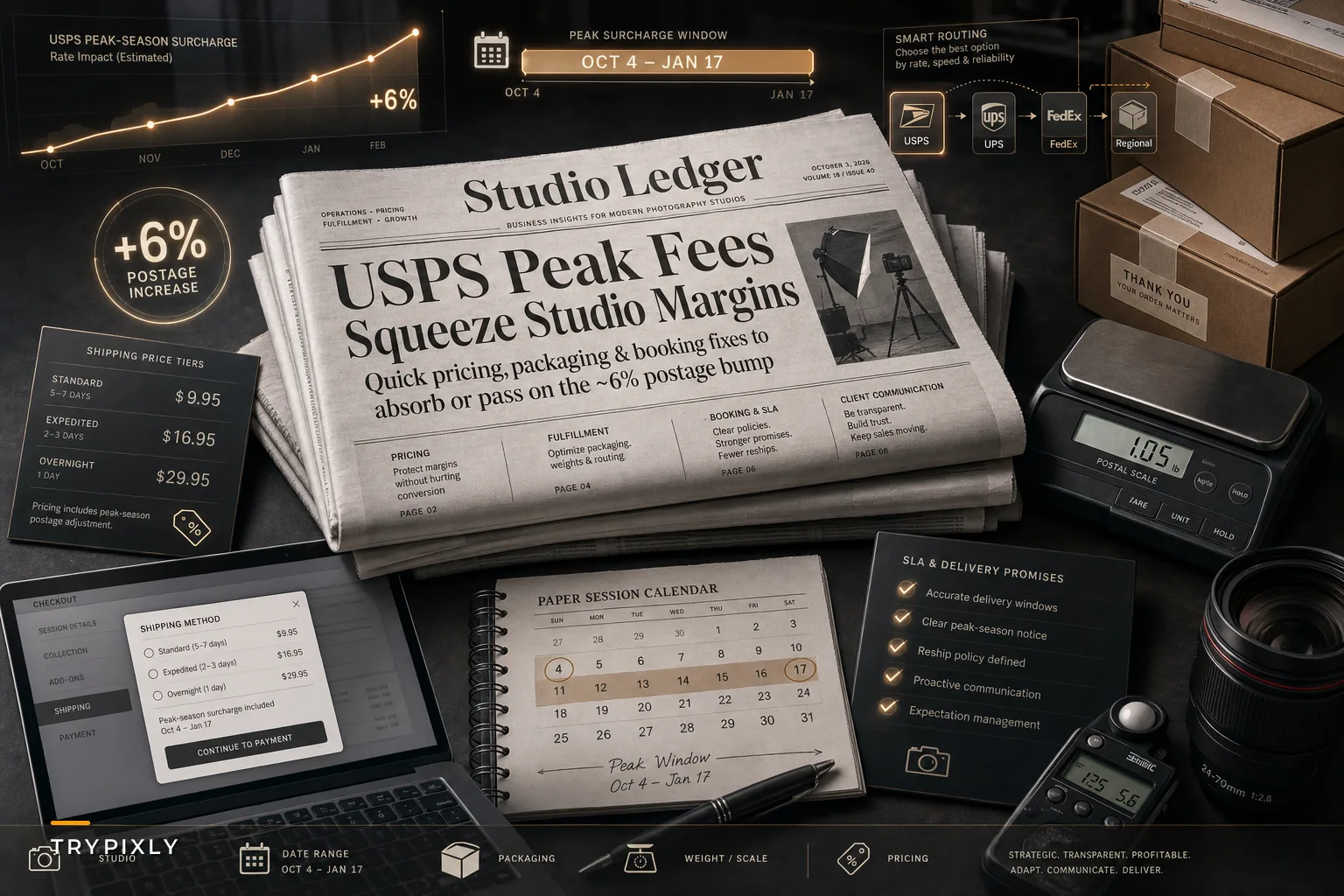

The USPS peak season rate increase landing on October 4, 2026 is annoying for one specific reason: it kicks in the same day your print, album, and holiday card volume starts climbing, and it doesn't end until January 17, 2027 — after you've already shipped everything. The Postal Service laid out the specifics on its Postal Explorer price change page, with final price files dropping September 18, 2026. Supply Chain Dive pegged the average bump at around 6% across Ground Advantage, Priority Mail, and related package services.
Six percent sounds small until you remember that shipping is usually a cost you've been eating or lightly padding — not a line item you've ever actually priced with any real discipline. And the timing is precise enough to hurt. That surcharge window overlaps almost exactly with the stretch where a family studio might ship 200–400 packages instead of the usual 30–50 a month.
This isn't really about the announcement itself. It's about what the announcement exposes — most studios don't know their true cost-per-shipment, and the peak-season hike just turns that blind spot into a margin leak at the worst possible time of year.
Start with the one number almost nobody tracks: fully loaded cost per package
When studios talk about "shipping cost," they mean the postage number on the label. That's maybe 60–70% of what the package actually costs.
A fully loaded cost per package includes:
-
Postage (the part going up ~6%)
-
The mailer, box, or album shipper
-
Tissue, filler, corner protectors, tape
-
The branded card or thank-you insert
-
Labor to pack and label it
-
The occasional reship from damage or a wrong address
For a flat album shipping in a rigid mailer, that fully loaded number is often somewhere between $9–$14 before the hike. For a larger framed print or a multi-item holiday package, you're easily at $18–$30. A 6% postage increase on a $22 total package isn't a 6% problem — if postage is only $11 of that, the actual total cost increase is closer to 3%. That's the part nobody mentions.
The bad news: most studios set their "free shipping over $X" thresholds years ago, never recalculated them, and are now absorbing the full postage increase on every qualifying order — while also swallowing packaging inflation they never passed through.
Where the margin actually leaks during peak
The damage rarely comes from the postage line in practice. It usually comes from three quieter places.
Never miss a shoot or client detail again.
TryPixly helps you book, confirm, and manage every photography session seamlessly.
- Unified session and client management
- Automated client reminders
- Team calendar & resource scheduling
No credit card required
Free-shipping thresholds set too low. A studio offering free shipping over $150 made sense when a mid album sold at $420 and shipped for $9. If that same package now costs $14 fully loaded and your average shipped order sits around $180, you're giving away roughly 8% of the order in fulfillment on an already thin product.
Reships during the crush. Peak is when packing gets rushed, addresses get fat-fingered, and carriers get rough with boxes. A damaged album reship during a slow month is a minor irritation. During peak, with expedited reprint and overnight postage, a single reship can erase the margin on two or three other orders.
SLA promises you can't afford anymore. If your booking page promises "7–10 day delivery on all prints" and Ground Advantage is now both pricier and slower during the surge, you either upgrade to Priority (more cost) or break the promise (client fallout). Neither outcome is good.
A quick comparison: absorb, pass through, or restructure
Studios tend to pick one reaction without really weighing the options. Here's how each one actually plays out under the peak hike.
| Approach | What it looks like | Best for | Hidden downside |
|---|---|---|---|
| Absorb the increase | Eat the ~6% quietly, change nothing | Studios with high AOV and plenty of margin headroom | Compounds with packaging inflation; invisible until year-end books |
| Pass through directly | Add a flat shipping/handling fee at checkout | Volume studios shipping many low-margin items | Checkout friction; can suppress add-on sales if clumsy |
| Restructure the offer | Rebuild thresholds, bundle shipping into package price, nudge local pickup | Studios doing seasonal reviews anyway | Requires actually knowing your cost-per-package first |
The third option is the only one that fixes the underlying blind spot. The other two are coping mechanisms.
The fix most studios skip: price packages with shipping baked in
Clients hate surprise fees far more than they hate a slightly higher sticker price. A $395 album that ships free converts better than a $375 album plus a $20 shipping line at checkout — even though they net the same.
So instead of treating shipping as an add-on, fold a realistic blended fulfillment cost into each package tier. The key word is blended — you're not charging exact postage per order, you're pricing in an average that covers your real cost plus a small buffer for reships and the peak surcharge.
A simple way to build that number:
-
Pull your last 12 months of shipped orders and tag each by product type (prints, single album, holiday package, framed piece).
-
Calculate fully loaded cost per package for each type — postage, materials, labor, and a reship allowance.
-
Apply the ~6% peak adjustment only to the postage portion, not the whole figure.
-
Round to a clean number and bake it into the package price for the peak window.
-
Set your free-shipping threshold above the point where the average order actually covers that cost.
-
Re-check the threshold after peak. The surcharge expires January 17, 2027, so don't let a holiday number become a permanent fixture.
This is also a good moment to tighten up packaging operations more broadly, since weight and dimensions drive both postage and damage rates — the mechanics of that are covered in the breakdown on stopping fulfillment mistakes that cost margins.
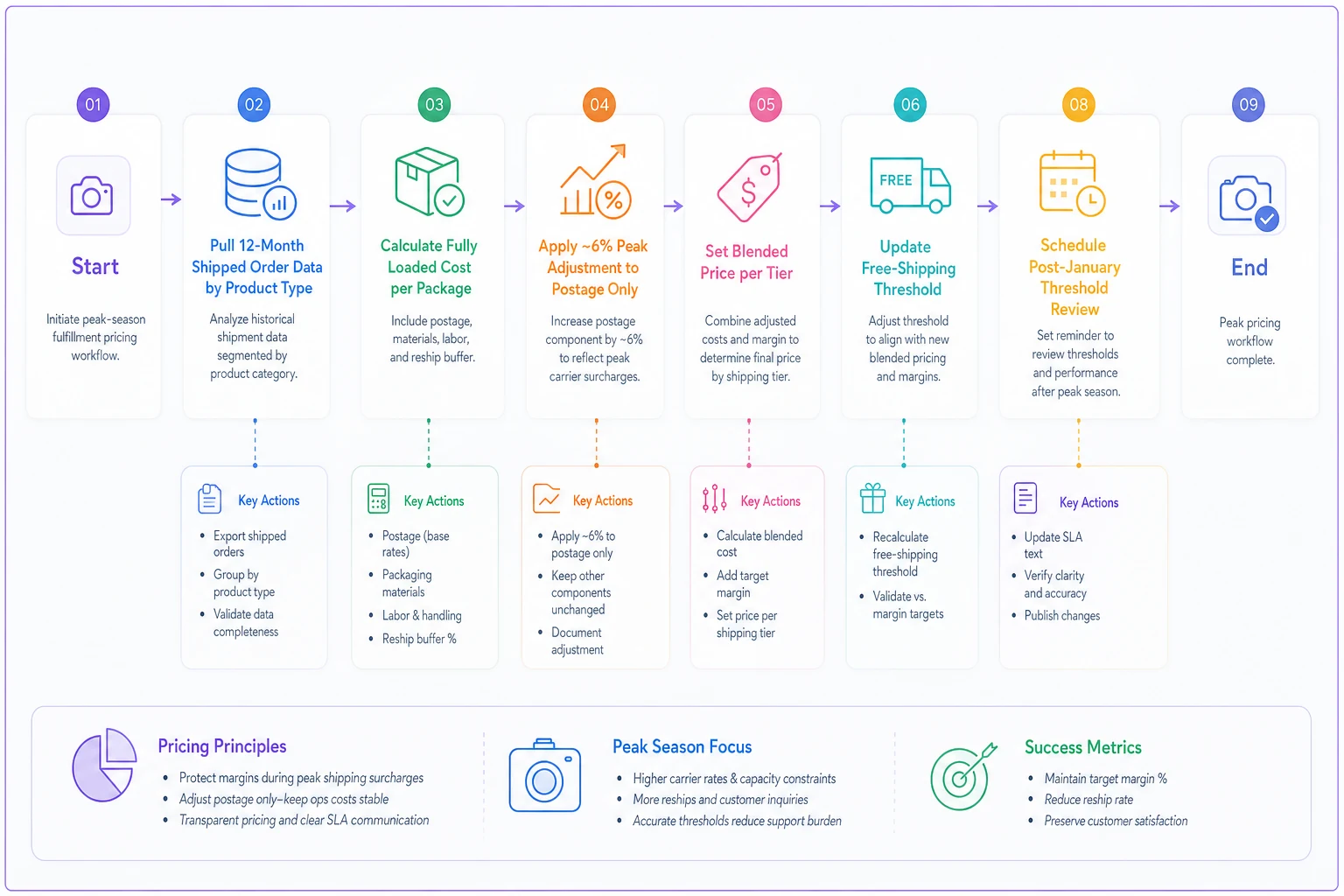
Re-check the threshold after peak so you don't bake a temporary surcharge into permanent pricing.
The workflow above maps the basic pricing steps you should run through once the final price files publish in late September.
A peak-season fulfillment checklist worth running before October 4
Run this once in late September, after the final price files publish but before the window opens:
-
[ ] Recalculate fully loaded cost per package for each product type
-
[ ] Update free-shipping thresholds to cover peak costs
-
[ ] Decide which tiers absorb vs. pass through vs. bake-in shipping
-
[ ] Reweigh your most common packages — a 2 oz overage can bump a rate tier
-
[ ] Test whether a smaller box or different mailer drops dimensional weight
-
[ ] Add a clearly stated local-pickup option for nearby clients
-
[ ] Update delivery SLAs on booking and checkout pages to reflect slower peak transit
-
[ ] Write the client-facing lead-time note now, not during the rush
-
[ ] Set a reship budget cap and a quick-decision rule for who approves them
Most of this is a two-hour afternoon. The studios that skip it are the ones staring at their bank balances in February wondering where December's margin went.
When passing shipping through is actually the wrong move
If your average shipped order is a $600+ album or a wedding package, adding a visible $25 shipping fee at checkout is just clumsy. The client is already committed, the fee is a rounding error on their total, and all it does is leave a mildly sour final impression before delivery. Absorb it or bake it in.
Pass-through makes sense mostly for low-AOV, high-volume items — à la carte print reorders in the $40–$90 range, where a flat handling fee is both reasonable and expected. Even then, label it "handling" or bundle it into print pricing rather than itemizing exact postage, which just invites clients to compare against their local drugstore printer.
If you're a newer studio shipping fewer than 40 orders a month, don't overthink it. Nudge your free-shipping threshold up modestly, reweigh your boxes, and move on. A deep fulfillment overhaul doesn't pay for itself at low volume.
Real scenario: a two-person portrait studio
A family and newborn studio shipping around 260 packages between October and mid-January had a free-shipping threshold of $125 — set back when postage was cheaper and their album mix was different.
Their fully loaded cost per shipped order had crept to about $16, but they were still thinking of shipping as a $9 postage line. With the peak surcharge on top, they were quietly losing $6–$8 on a meaningful chunk of their lower-tier orders.
The fix was unglamorous: they raised the free-shipping threshold to $225, baked a blended $14 into their two most-shipped package tiers, added a local pickup option that about a quarter of nearby clients happily used, and reweighed their album mailers — which let two product types drop into a cheaper rate tier. By the end of the peak window, their per-package margin had recovered to roughly where it had been two years earlier. No client complained, because nothing looked like a fee.
The underlying problem the hike really exposes
The 6% increase is temporary. The lesson isn't. Studios that treat shipping as an afterthought — a label, a box, a vague cost they'll sort out later — get caught every time carrier pricing moves. Which it does, every year, sometimes twice.
The studios that stay healthy through peak are the ones that know their fully loaded cost per package down to the product type, review thresholds seasonally rather than once a decade, and set delivery promises they can actually keep when transit times slip. The postal rate change is just the nudge that forces that discipline now, during the one stretch of the year where getting it wrong costs the most.
Build the cost model once. Update it before each peak. The surcharge expires in January, but the habit is what actually protects your margins the next time a carrier changes the math on you mid-season.
Ready to elevate your studio’s workflow?
Join 500+ studios using TryPixly to save time, reduce scheduling conflicts, and deliver exceptional client experiences.