


Photography fulfillment operations break down in predictable ways. Not during the shoot. Not during editing. But in that final stretch between approval and delivery—where a 40% margin album order becomes a 12% margin nightmare because someone shipped the wrong size, used rush shipping to fix a vendor mistake, or promised a delivery date the lab couldn't actually hit.
Most studio owners discover these problems through angry emails. A bride notices her parent albums have different color grading than the main album. A corporate client receives headshot prints with inconsistent cropping. A family realizes their canvas arrived damaged because someone picked the cheapest shipping option without protective packaging.
The damage shows up in the margins. That $2,800 album package you quoted? After fixing the color mismatch, reshipping the corrected parent albums, and eating rush fees, you're looking at $400 in actual profit instead of the $1,100 you planned for.
Why fulfillment operations collapse at scale
Studios under 20 orders monthly can manage fulfillment through memory and manual checks. The owner remembers that Miller's needs files in sRGB while WHCC wants ProPhoto RGB. They know to add three days to Bay Photo's quoted turnaround during wedding season. They personally check every order before it ships.
But somewhere around 35-40 monthly orders, the system cracks. Orders start overlapping. Different products need different vendors. Rush requests pile up. Staff members make assumptions about packaging requirements. Someone forgets to convert the color space. A vendor changes their file naming requirements and nobody notices until three orders get rejected.
The breaking point usually hits during peak season—October for family portrait studios, June for wedding photographers, December for everyone. Suddenly you're managing 80+ orders, each with different specifications, deadlines, and client expectations. Your carefully maintained mental system becomes a game of expensive whack-a-mole.
What makes this particularly painful: clients judge your entire studio by the final product delivery. They forget the beautiful location, the perfect lighting, the careful retouching. But they remember forever when their prints arrived bent because someone used a regular envelope instead of a rigid mailer.
The vendor routing maze that destroys margins
Here's a scenario that plays out constantly: a client orders a 16x20 canvas, five 8x10 prints, and 20 holiday cards. Simple enough. Except your canvas vendor doesn't do cards cost-effectively, your card printer charges absurd minimums for small print runs, and your regular print lab takes two weeks for canvas orders during the holidays.
Never miss a shoot or client detail again.
TryPixly helps you book, confirm, and manage every photography session seamlessly.
- Unified session and client management
- Automated client reminders
- Team calendar & resource scheduling
No credit card required
So you split the order across three vendors. Canvas goes to one lab with expedited shipping. Prints go to your regular vendor. Cards go to a specialty printer. Now you're managing three different color profiles, three shipping timelines, three tracking numbers, and probably eating extra shipping costs because you couldn't consolidate.
The math gets ugly fast:
-
Canvas from Lab A
$89 + $18 expedited shipping
-
Prints from Lab B
$45 + $12 standard shipping
-
Cards from Printer C
$65 + $15 shipping + $25 setup fee
Total vendor cost: $269 Shipping alone: $45 What consolidation would've cost with some planning: roughly $180 total
You just gave away $89 in margin because there were no clear routing rules for mixed orders.
Building an inventory rulebook that actually works
Successful photography fulfillment operations need specific trigger points, not vague guidelines. "Keep frames in stock" isn't a rule. "Reorder 11x14 walnut frames when inventory hits 8 units, order 24 units, expect 5-day delivery" is an operational system.
Your inventory rules need to account for:
-
Seasonal patterns
Wedding albums spike March through October. Holiday cards explode in November. Corporate headshots cluster around Q1 and Q3. Build your reorder points around these realities.
-
Vendor minimums vs. storage reality
That discount for ordering 100 frames sounds great until you realize you sell 12 per quarter and have nowhere to store 88 extras.
-
Product combinations
If clients who order 16x20 canvases almost always add 8x10 prints, your inventory levels should reflect that relationship.
-
Lead-time buffers
Your vendor promises 5-day delivery. But during their busy season, it stretches to 8-10 days. Your reorder triggers need to reflect worst-case scenarios, not best-case marketing promises.
Start with your fast-moving products. Track what actually sells, not what you think sells. Most studios discover surprising patterns—those 5x7 metal prints that seemed unpopular actually move consistently in sets of three, or that expensive leather album upgrade gets chosen about 30% of the time for destination weddings but almost never for local ones.
Creating packing lists that prevent expensive mistakes
A proper packing list isn't just a checklist—it's a quality control system that catches errors before they become refund requests. Every fulfillment disaster traces back to someone assuming rather than verifying.
Your packing list needs three distinct checkpoint layers:
Pre-production verification
-
File format matches vendor requirements
-
Color space converted correctly
-
Resolution meets print size minimums
-
Crop ratios align with ordered sizes
-
File naming follows vendor format
Production confirmation
-
Order details match client approval
-
Rush timeline flagged and communicated
-
Special finishes noted (matte, glossy, metallic)
-
Mounting and framing specifications clear
-
Packaging requirements specified
Pre-ship inspection
-
Physical products match order sheet
-
No visible damage or quality issues
-
Correct protective packaging selected
-
Shipping method matches delivery promise
-
Tracking and insurance appropriate for value
The key is making these checkpoints impossible to skip. One studio built a simple three-signature system—Person A verifies files, Person B confirms production, Person C inspects before shipping. If only two people are working, the second person waits 30 minutes between their checks. Enough time to reset attention and catch mistakes they might've missed the first time.
QA checkpoints that catch problems before clients do
Quality assurance in photography fulfillment isn't about perfection—it's about catching the problems clients will actually notice. A tiny color variation between two 5x7 prints? Probably fine. That same variation between the main album and parent albums? Relationship-ending disaster.
Build your QA around client perception points:
-
Consistency across sets
When clients order multiple copies of the same image, they expect identical results. Send all prints from a set to the same vendor, on the same day, with the same specifications.
-
Package presentation
A premium album delivered in a beaten cardboard box undermines everything. Your packaging is part of the product. Set clear rules—albums need rigid boxes, canvases require corner protectors, prints over 11x14 get delivered flat, not rolled.
-
Timeline accuracy
Missing a deadline hurts more than slightly imperfect color. Build QA checks around timeline milestones: order placed, files submitted, production confirmed, shipping initiated, delivery confirmed.
One approach that actually works: the 24-hour hold. After preparing an order for submission, let it sit for a day, then have someone else review it fresh. This catches a surprising number of small errors—wrong quantities, typos in personalization, mismatched specifications—that would've cost time and money to fix after the fact.
Realistic lead times that protect both margins and relationships
The biggest fulfillment lie in photography? "Your order will be ready in 2-3 weeks." That timeline assumes perfect file submission, no vendor delays, no quality issues, no shipping problems, and no revision requests. A complex album order realistically needs 4-6 weeks minimum, and that's if everything goes smoothly.
Here's how real timelines actually break down:
-
Week 1
Client reviews and approves designs. Never happens instantly. Budget three rounds of revisions minimum, each taking 2-3 business days.
-
Week 2-3
Production at vendor. The "5-day turnaround" they advertise? That's after they receive perfect files and doesn't include their 2-day file review process or weekend delays.
-
Week 4
Shipping and delivery. Standard shipping takes 5-7 business days. Expedited takes 2-3 days but costs triple. International adds another week minimum.
-
Buffer week
Because something always goes wrong. The vendor's printer breaks down. UPS loses the package. The client suddenly remembers they wanted a different cover material.
Communicate these realities upfront. "Album delivery typically takes 5-6 weeks after final approval. We can rush for an additional $200, which brings it to 3-4 weeks." Clear expectations prevent panic rushes that destroy margins.
SLA tables that set boundaries and save profits
Service Level Agreements sound corporate, but they're really just promises with numbers attached. In photography fulfillment operations, vague promises create expensive problems.
Build your SLA table around real operational capacity:
| Order Type | Standard Delivery | Rush Available | Rush Fee | Revision Rounds Included |
|---|---|---|---|---|
| Single Prints (up to 10) | 10 business days | 5 business days | $35 | 1 |
| Bulk Prints (11-50) | 15 business days | 7 business days | $75 | 1 |
| Canvas Prints | 15 business days | 8 business days | $50 per canvas | 1 |
| Photo Albums | 30 business days | 20 business days | $200 | 2 |
| Holiday Cards (up to 100) | 12 business days | 6 business days | $60 | 1 |
| Wall Galleries | 20 business days | Not available | N/A | 2 |
Notice what this table does: it makes rush orders profitable instead of painful. That $200 rush fee for albums covers expedited vendor processing, faster shipping, and the staff time to manage a compressed timeline. Without clear fees, you absorb these costs every time a client asks "can you make it happen faster?"
The revision rounds matter too. "Unlimited revisions" sounds client-friendly but kills margins. Two rounds covers legitimate concerns. Beyond that, charge hourly for additional changes. Make this clear upfront and most clients suddenly become much more decisive in their feedback.
When vendor relationships make or break your fulfillment
Not all print vendors operate equally under pressure. Some labs maintain quality when rushed. Others fall apart completely. Some communicate proactively about delays. Others leave you finding out about problems when an angry client calls.
-
Primary vendor (handles 60-70% of orders)
Consistent quality, reasonable prices, good communication, 7-10 day standard turnaround. Your workhorse for standard prints and basic products.
-
Premium vendor (handles roughly 20% of orders)
Superior quality for high-end albums and wall art. Longer turnaround, higher prices, but clients can see the difference. Reserve for orders above a certain price threshold.
-
Rush vendor (handles maybe 10% of orders)
Not the best quality, not the best price, but they deliver when you're in trouble. Keep this relationship warm for emergency situations.
-
Specialty vendor (occasional orders)
Unique products like metal prints, acrylic, or unusual sizes. Higher minimums, longer lead times, but necessary for differentiation.
The vendor routing rules write themselves once you map capabilities. Standard prints under $500? Primary vendor. Albums over $1,000? Premium vendor. Anything needed in under 5 days? Rush vendor, with appropriate fee markup.
The real cost of fulfillment mistakes
A client orders a three-album package for $3,400—main album for them, two parent albums as gifts. You promise 4-week delivery for their anniversary party.
Week 3: you discover the parent albums were produced with slightly different color settings. Not huge, but noticeable side-by-side. The vendor offers a 20% discount to accept them as-is. You obviously can't deliver mismatched albums for an anniversary gift.
The cascade:
-
Rush reproduction of parent albums
$180
-
Expedited shipping from vendor
$85
-
Express shipping to client
$120
-
Discount offered for the inconvenience
$200
-
Staff time managing the crisis
roughly 4 hours at $35/hour = $140
Total cost of one mistake: $725
Original margin on the order: $1,360 Actual margin after fixing it: $635
But the real damage goes beyond this single order. That client's review mentions the stress of almost missing their anniversary deadline. Future clients read it and choose another studio. One fulfillment mistake ripples out and affects future bookings in ways that are genuinely hard to put a number on.
Building systematic fulfillment that scales
Studios that nail photography fulfillment operations share common traits. They document everything. They assume nothing. They build buffers into every timeline. They charge appropriately for rush requests. They maintain vendor relationships before they need them.
They treat fulfillment as a core operational function, not an afterthought. The same attention you give to lighting setups and retouching workflows? That same discipline applies to your fulfillment process.
Start with one product line. Document every step from order to delivery. Note every decision point, every vendor requirement, every potential failure point. Build rules and checkpoints around each one. Test the system with 10 orders. Refine. Then expand to the next product line.
Here's a simple workflow that captures the order-to-delivery process.
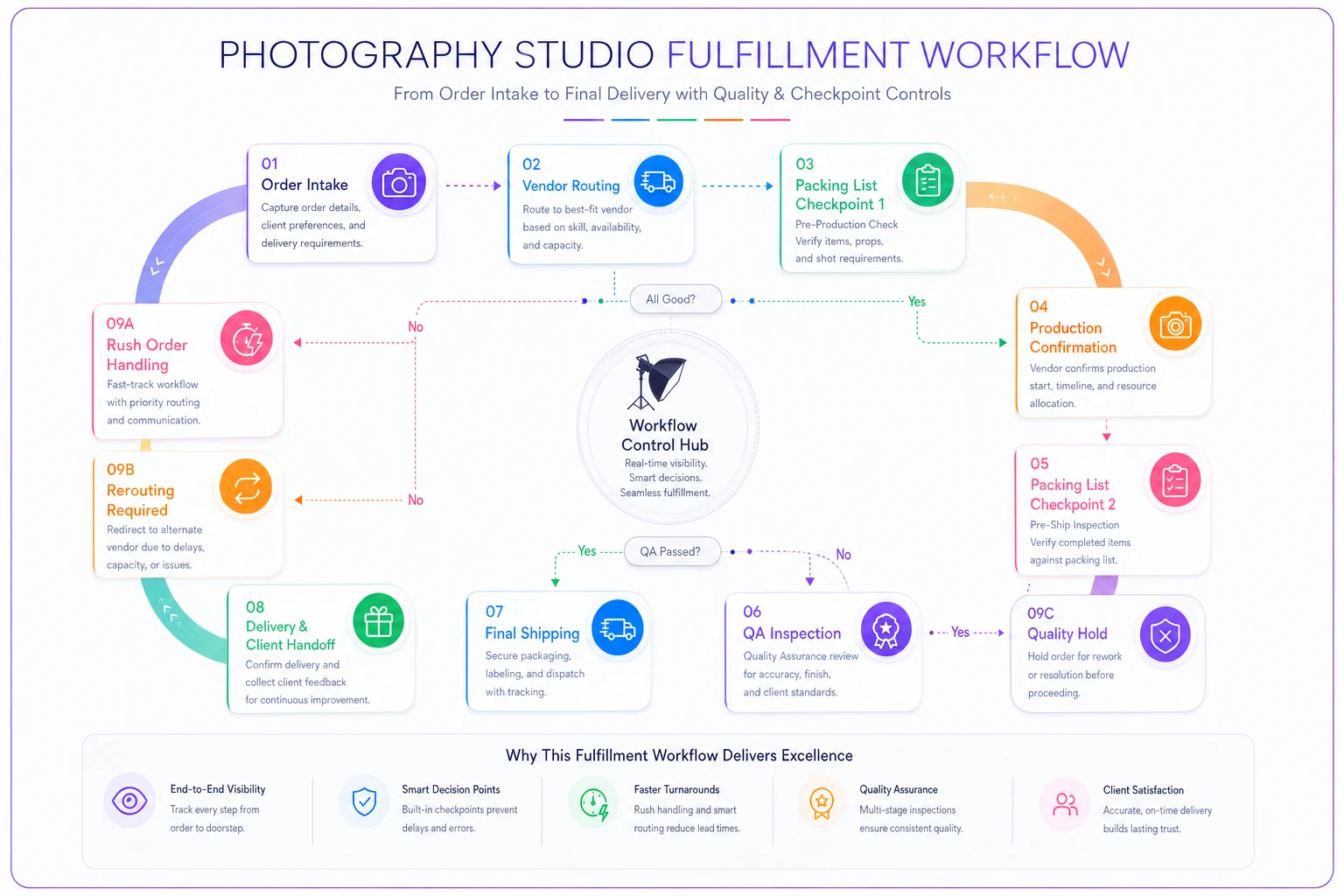
The transformation happens gradually. Orders stop requiring heroic efforts to fulfill. Margins become predictable. Staff members know exactly what to do without asking. Rush requests become profitable opportunities instead of margin-killing obligations.
This is where AI-powered operational software earns its place—not replacing human judgment, but handling the repetitive tracking, the vendor requirement matching, the timeline calculations, the inventory triggers. Software tracks color space requirements across multiple vendors so your team doesn't have to memorize them. Automated alerts flag when an order's timeline is at risk before it becomes a crisis. Packing lists generate with product-specific requirements already built in. The goal isn't automation for its own sake—it's freeing your team to focus on quality control, client relationships, and exception handling instead of drowning in operational details.
Protecting margins through operational discipline
Photography studios often treat fulfillment as something to endure between the creative work and getting paid. But fulfillment is where carefully cultivated margins either survive or die. Every unplanned rush shipment, every absorbed vendor mistake, every package sent without adequate protection chips away at profitability.
Studios that are actually growing understand this: operational discipline in fulfillment creates real competitive advantage. While competitors scramble to fix mistakes and eat costs, you deliver consistently at healthy margins. While they fear scaling because complexity breeds chaos, you grow knowing your systems can handle volume.
Your fulfillment playbook should be a living document. Review it quarterly. Update vendor requirements when they change. Adjust lead times based on seasonal patterns. Refine QA checkpoints when new issues emerge. This isn't a one-time setup—it's an operational asset that gets more valuable the more attention you put into it.
Clients judge your entire studio by their delivery experience. The album that arrives in perfect condition, on time, beautifully packaged cements your reputation. The print order that shows up bent, late, with mismatched colors defines you—regardless of how beautiful the original session was.
And if you want to protect deposit structures and reduce no-shows on the front end while tightening fulfillment on the back end, those two systems together are what separate studios that scale from ones that stall.
Master your photography fulfillment operations and you're not just delivering products—you're protecting margins, building reputation, and creating the operational foundation for sustainable growth. In a business where everyone can buy the same camera and learn the same techniques, how you operate is your real differentiator.
Ready to elevate your studio’s workflow?
Join 500+ studios using TryPixly to save time, reduce scheduling conflicts, and deliver exceptional client experiences.