


There's a specific kind of studio pain that doesn't show up in your P&L until it's too late. You land a corporate account — say a 400-headshot rollout for a law firm, or a quarterly product-photography retainer with a retailer. Everyone's thrilled. Then eight weeks later you're on a tense call where their procurement lead is asking why milestone three slipped, why the invoice doesn't match the PO, and why nobody flagged that the delivery format was wrong until the whole batch was done.
The shoot went fine. The photography was good. The governance fell apart.
That's the part almost nobody plans for. Studios obsess over the creative and the pitch, then treat the actual delivery of a big account like it's the same as handing a wedding gallery to a bride. It isn't. Enterprise clients don't buy photos — they buy a predictable process wrapped around photos. When that process has gaps, they don't complain politely. They escalate, withhold payment, or just don't renew.
This is the layer of enterprise photography account governance that separates studios who keep landing six-figure retainers from the ones who win one big deal, blow the delivery, and spend the next year wondering why the referrals dried up.
Why post-sale governance breaks (and why it's almost always structural)
The failure pattern is remarkably consistent. It's rarely one dramatic mistake — it's a slow accumulation of small coordination gaps that a small studio never had to worry about when clients were individuals.
With a bride, the whole relationship lives in one head, usually the owner's. She knows the shoot date, the deliverables, when the gallery's due, roughly what she owes. That informal memory works fine up to a point.
Enterprise accounts detonate that model. Now you've got:
-
- A buyer who signed the contract but isn't the one receiving files
-
- An end user (the marketing team, the HR department) who has opinions the buyer never mentioned
-
- A finance/AP contact who only cares about POs, invoices, and matching numbers
-
- A procurement or vendor-management function that measures you against an SLA you may not have read carefully
Four stakeholders, four different definitions of "done." When your delivery process assumes one person, information gets lost in the seams between those roles. That's the actual root cause — not laziness, not bad photography. Your operational model was built for one relationship, and you're now running four in parallel per account.
In practice, this usually surfaces around the second or third milestone. The first batch goes out, everyone's happy, guard drops. Then the end user requests changes the buyer never scoped, finance holds payment because the invoice references the wrong PO line, and suddenly you're doing unpaid rework while your cash sits frozen.
The four checkpoints every enterprise delivery actually runs on
Think of a big account as a pipeline with gates. Files don't just flow from shoot to client — they pass through checkpoints, and each checkpoint is a place where you either catch a problem or inherit it.
Never miss a shoot or client detail again.
TryPixly helps you book, confirm, and manage every photography session seamlessly.
- Unified session and client management
- Automated client reminders
- Team calendar & resource scheduling
No credit card required
| Checkpoint | What it controls | What breaks without it |
|---|---|---|
| Staged delivery milestone | Work is delivered in defined batches, each with its own acceptance | You deliver everything at once; one rejection torpedoes the whole invoice |
| PO / finance checkpoint | Every deliverable ties to a PO line and approved budget before work starts | You do work that was never authorized and can't bill for it |
| SLA enforcement | Turnaround and quality standards are tracked and reported | Client claims you're late; you have no record proving otherwise |
| Milestone gating | Next stage can't start until current stage is formally accepted | Rework piles up downstream because early errors weren't caught |
| Dispute workflow | A defined path for handling disagreements and rejections | Every conflict becomes an emotional escalation to the owner |
A simple visual helps make the checkpoints obvious.
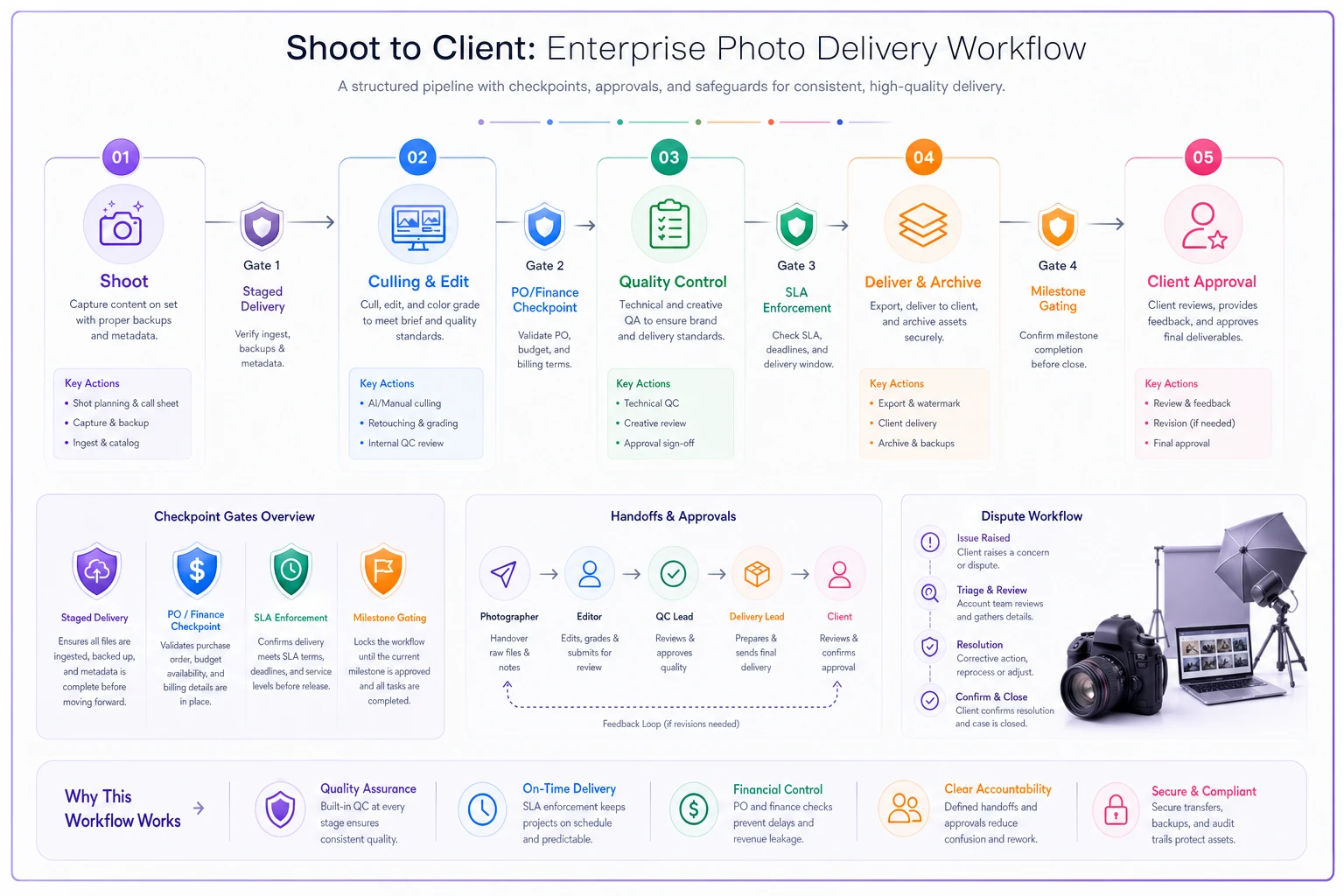
The insight most studios miss: these gates aren't bureaucracy you add to protect the client. They protect you. A signed milestone acceptance is what lets you invoice with confidence. A logged SLA timestamp is what wins the argument when a client misremembers when they sent approvals. Governance is leverage, not overhead.
Staged delivery: stop shipping everything at once
The single most damaging habit in enterprise photo delivery is the all-or-nothing drop. You shoot 400 headshots, retouch all 400, deliver all 400, invoice for all 400 — and then one department head decides the lighting style is "too soft" and your entire invoice is in limbo over a subjective note.
Staging fixes the exposure. You break a large account into batches — by department, by location, by product line, whatever natural boundary exists — and each batch gets delivered, accepted, and invoiced on its own.
-
1. Pilot batch (10–15 images) Deliver a small first set specifically to lock style, format, crop, and file-naming. Get written sign-off on the standard, not just the images.
-
2. Milestone batches (roughly 80–100 each) Deliver in chunks tied to the pilot-approved standard. Each batch has its own acceptance window.
-
3. Final reconciliation batch Cleanup, re-shoots, and any stragglers, delivered last with a closeout summary.
The pilot batch is the underrated move here. Spending an extra few days getting the standard approved on 12 images saves you from redoing 200 of them because nobody agreed on what "professional" meant. Studios running high-volume corporate work that skip the pilot almost always eat a full-batch revision at least once — and that rework is unpaid, unbudgeted, and morale-crushing.
Treat the pilot batch sign-off as the canonical standard — get it in writing.
Staging also changes your cash position. Instead of one invoice sitting frozen for six weeks, you've got three or four smaller invoices clearing on their own timelines. Your revenue stops being hostage to the slowest approver.
The PO and finance checkpoint nobody wants to run
The checkpoint studios hate most and need most: nothing gets produced until it's tied to a purchase order.
Enterprise finance departments live in a world of matching. The PO, the deliverable, and the invoice all have to line up, or AP won't release payment — regardless of how good your work is or how cooperative the buyer was. If you did work that isn't referenced on an approved PO, you're not in a billing dispute; you're in a "we literally cannot pay this" dead zone that can drag 60–90 days.
-
- No PO line, no production. Scope expansions get a change order and a new or amended PO before the shutter clicks.
-
- Every deliverable batch references its PO line on the delivery note and the invoice, so AP matching is trivial.
-
- The finance contact is looped in at kickoff, not at invoice time. You want to know their matching requirements before you've done the work, not after.
This feels rigid, and small studios resist it because it slows down the "yes." But the alternative is doing free work for a client big enough to have a procurement department — and that's the worst possible client to do free work for, because in their system, if there's no PO, it doesn't exist.
We covered a lot of the upstream pricing and scoping discipline in the piece on how to stop enterprise bids from eating your margin, and the finance checkpoint is really the downstream enforcement of everything you scoped there. If your bid was tight but your PO discipline is loose, the margin leaks right back out during delivery.
SLA enforcement: you can't enforce what you don't timestamp
Most studios have an SLA in the contract they never actually track. "48-hour turnaround on approved edits." Sounds great. But when the client says "you were late three times," can you prove otherwise? Usually not, because the clock was living in someone's inbox.
-
- When did the client send approvals?
-
- When did the clock start (it starts on their approval, not on the shoot)?
-
- When did you deliver?
-
- Was any delay caused by the client sitting on a decision?
That last point is the one that saves relationships. In practice, most "you were late" complaints are actually the client having sat on an approval for nine days, then measuring your turnaround from the original request. If your records show the approval only landed on day nine and you delivered two days later, the conversation shifts from "you're unreliable" to "oh, right, that was on us." You can't win that conversation from memory. You win it from a log.
This enforcement logic runs through the whole delivery pipeline, which the SLA gaps operations playbook from inquiry to delivery walks through in more depth. Enterprise accounts just raise the stakes — the SLA isn't a nice-to-have, it's a clause procurement will hold you to at renewal.
Milestone gating: the discipline that stops rework from compounding
Gating means a stage can't start until the previous stage is formally accepted. It sounds obvious. Almost nobody does it under deadline pressure.
The failure without gating: batch one is delivered but not yet approved, and because the client's "busy," you go ahead and start editing batch two using the same assumptions. Then batch one comes back — the crop's wrong, they want more headroom. Now batches one and two both need redoing, because you built two on unapproved assumptions from one.
A simple gating checklist per milestone:
-
- [ ] Deliverables match the approved pilot standard
-
- [ ] PO line confirmed and referenced
-
- [ ] Delivery note sent with SLA timestamp
-
- [ ] Formal acceptance received (written, not verbal)
-
- [ ] Invoice issued against the accepted batch
-
- [ ] Only then
next batch enters production
The "written, not verbal" line is the one that matters most. A Slack thumbs-up is not acceptance. A reply-all "looks good, thanks" is. Train yourself to treat the difference as the boundary between billable and unbillable work.
Dispute workflow: because rejections are inevitable, chaos isn't
On a big account, someone will eventually reject something. The question isn't whether — it's whether you have a path for it or whether every disagreement becomes a 40-minute call that lands on the owner's desk.
A dispute workflow is just a predefined sequence for handling "we don't accept this":
-
1. Log the objection against a specific deliverable and reason. Vague rejections ("we're not feeling it") get pushed back to specifics before anything else happens.
-
2. Classify it. Is this within the approved standard (your responsibility) or a scope change (their change order)? This single classification resolves most disputes, because half of them are the client asking for something they never scoped.
-
3. Route it. In-scope defects go to rework at no charge. Out-of-scope requests go to a change order and a PO amendment.
-
4. Set a resolution SLA. Disputes get their own turnaround clock so they don't sit and rot.
-
5. Close it in writing with an updated acceptance.
The classification step is where you protect your margin without becoming the difficult vendor. When you can calmly say "that's a great idea and it's outside what we scoped in the pilot — here's a quick change order," you're not saying no. You're saying yes with a price. Enterprise buyers respect that far more than a studio that either fights every note or silently absorbs endless free rework.
A real scenario
A mid-size studio took on a recurring corporate account — roughly 250–300 headshots per quarter across several regional offices, worth somewhere around $60k–$70k a year. The first quarter went badly. They delivered everything in one drop, one office rejected the style, the whole invoice froze, and a scope expansion they'd verbally agreed to bounced at AP because there was no PO. Payment on that first quarter took nearly 80 days to sort out, and the account came close to not renewing.
Second quarter, they rebuilt the process around gates. Pilot batch of a dozen images to lock the standard first. Delivery split into three milestone batches tied to specific PO lines. Every handoff timestamped. A one-line change-order rule for anything out of scope.
The change wasn't dramatic on paper, but the account behavior shifted completely. Invoices cleared inside the client's normal 30-day cycle instead of dragging into disputes. Rework dropped to almost nothing because the pilot caught the style disagreement up front. And the account renewed — which was really the whole ballgame, since a renewed enterprise retainer is worth far more than any single quarter's fee.
Nothing about the photography changed. The governance did.
When heavy governance actually makes sense — and when it doesn't
This machinery is real overhead. Worth being honest about where it fits.
When it makes sense:
-
- Accounts with a separate buyer, finance function, and end user
-
- Contracts with an SLA or procurement relationship attached
-
- High-volume or recurring work where one frozen invoice is real money
-
- Any client big enough to have an AP department
When it's overkill:
-
- Individual clients, families, weddings, portrait sessions
-
- One-off small jobs where the whole thing is one person's decision
-
- Work under a few thousand dollars where the governance cost exceeds the risk
Who should NOT bolt this on wholesale: a studio that's still mostly consumer work and lands one corporate job a year. Don't rebuild your entire operation for a single account. Run a lightweight version — a PO reference and a written acceptance — and save the full pipeline for when enterprise work becomes a real revenue line.
The mistake in the other direction is just as costly, though. Studios cross into meaningful B2B revenue and keep running it on the same informal memory that worked for brides. That's the version that blows a six-figure relationship over a coordination gap nobody owned.
Where tooling quietly earns its keep
You can run all of this in spreadsheets and shared docs, and plenty of studios do at first. It works until you're juggling three or four enterprise accounts at once, each with its own batches, PO lines, SLA clocks, and open disputes. Then the tracking itself becomes the bottleneck, and things start slipping through the seams again — just at a higher revenue level.
This is the point where an operational platform that keeps milestones, PO references, acceptance records, and SLA timestamps in one place stops being optional. Not because software is magic, but because governance is fundamentally a tracking problem, and manual tracking degrades exactly when you're busiest. AI-assisted operational tools can flag a milestone approaching its SLA deadline, catch an invoice that doesn't reference a valid PO line, or surface a batch that's been sitting in "delivered, not accepted" for too long — the small watchfulness that a stretched team stops doing under pressure. The value isn't replacing your judgment; it's making sure the checkpoints actually fire when they're supposed to.
The real takeaway
Enterprise accounts don't fail on the shoot. They fail in the space between four stakeholders who each think "done" means something different, over a delivery process built for a single relationship. Staged milestones, PO discipline, timestamped SLAs, gating, and a real dispute path aren't corporate ceremony — they're the operating system that lets a studio deliver a big account without the relationship, the cash flow, and the renewal all riding on nobody dropping the ball.
Get the governance right and the same client that nearly walked in quarter one becomes the recurring retainer you build the next few years of growth on. That's the whole point of treating post-sale delivery as its own discipline instead of an afterthought.
Enterprise accounts don't fail on the shoot. They fail in the space between four stakeholders who each think "done" means something different, over a delivery process built for a single relationship. Staged milestones, PO discipline, timestamped SLAs, gating, and a real dispute path aren't corporate ceremony — they're the operating system that lets a studio deliver a big account without the relationship, the cash flow, and the renewal all riding on nobody dropping the ball.
Get the governance right and the same client that nearly walked in quarter one becomes the recurring retainer you build the next few years of growth on. That's the whole point of treating post-sale delivery as its own discipline instead of an afterthought.
Ready to elevate your studio’s workflow?
Join 500+ studios using TryPixly to save time, reduce scheduling conflicts, and deliver exceptional client experiences.