

Corporate photography operations are a completely different animal than standard studio work. You land that Fortune 500 headshot contract or multi-location product shoot, celebrate the win, then watch your margins evaporate through procurement delays, scope creep, and revision rounds that weren't in the original bid.
The operational reality hits when you're dealing with procurement departments that take 45 days to process a PO, legal teams that redline your standard contract into something unrecognizable, and project managers who treat "minor adjustments" like free add-ons. Without proper operational controls, enterprise deals become resource drains disguised as revenue wins.
Why corporate deals destroy studio margins
Enterprise clients operate on timelines and processes that clash with typical studio workflows. Their procurement cycle alone can stretch 30 to 90 days from verbal agreement to first payment. Meanwhile, you're fronting costs for location scouting, equipment rentals, and team scheduling based on project dates that keep shifting.
Margin erosion hits through multiple vectors at once. Procurement delays force you to hold calendar slots that could generate other revenue. Scope discussions happen across multiple stakeholders who each interpret deliverables differently. Payment terms stretch to NET 60 or NET 90, crushing cash flow. And the revision process becomes an endless loop because nobody defined what "final approval" actually means in operationally specific terms.
What makes this particularly damaging is the high fixed-cost nature of shoots. When a corporate client pushes a date by two weeks, you've already committed to location deposits, freelancer holds, and equipment rentals. Those sunk costs don't disappear—they compound into margin pressure that standard wedding or portrait clients never create.
The RFP response framework that protects profitability
Most studios approach RFPs like elaborate quote requests. They focus on creative concepts and pricing while missing the operational landmines buried in procurement requirements and delivery specifications. A protective RFP response needs three operational anchors most studios overlook entirely.
Never miss a shoot or client detail again.
TryPixly helps you book, confirm, and manage every photography session seamlessly.
- Unified session and client management
- Automated client reminders
- Team calendar & resource scheduling
No credit card required
First, your response must include explicit timeline dependencies—not just shoot dates, but procurement milestone dates that trigger specific actions. Something like: "Project timeline contingent upon PO receipt by [date]. Each week of procurement delay shifts all subsequent milestones by 7 business days, with rush charges of 15% for compressions under 14 days."
Second, deliverable specifications need quantifiable boundaries. Instead of "product photography for catalog," specify: "Up to 150 individual SKUs, maximum 3 angles per SKU, white background only, delivered as 300 DPI JPEGs at 2400x2400 pixels. Additional angles, backgrounds, or formats constitute change orders at $75 per variant."
Third, the approval chain must be mapped with named stakeholders and turnaround commitments. Generic "client approval" language creates endless revision loops. Better: "Marketing Director approval required within 5 business days of watermarked proof delivery. Non-response constitutes approval. Revisions beyond the initial round billed at $150/hour."
A response framework that actually holds up:
Section 1: Operational Prerequisites
-
PO required before location scouting begins
-
50% deposit upon PO receipt
-
Named project manager with decision authority
-
Consolidated feedback mechanism (no individual stakeholder emails)
Section 2: Deliverable Matrix
| Deliverable Type | Base Quantity | Overage Rate | Format | Revision Rounds |
|---|---|---|---|---|
| Executive Headshots | Up to 25 subjects | $195/additional | Web + Print | 1 global, 1 per subject |
| Product Shots | Up to 150 SKUs | $75/additional | E-commerce ready | 2 rounds total |
| Location Photography | 8 hour day | $500/additional hour | Editorial + Web | 1 round per location |
| Event Coverage | 6 hour blocks | $400/additional hour | Documentary | No revisions |
Section 3: Timeline Protection Clauses
-
Procurement delays beyond 14 days trigger 5% weekly holding fees
-
Rescheduling within 14 days
25% rescheduling fee
-
Rescheduling within 7 days
50% of shoot fee
-
Day-of cancellation
100% of shoot fee plus documented costs
The timeline clauses feel aggressive until you've eaten a $12,000 loss because a client pushed a shoot three times and then cancelled. They're not aggressive—they're just honest about how costs actually work.
Procurement timeline mapping that prevents bottlenecks
Enterprise procurement follows predictable patterns studios can map and manage proactively. The typical flow runs: verbal agreement → vendor onboarding → contract negotiation → legal review → PO generation → finance approval → PO release. Each stage has hidden substeps that create delays if not explicitly managed.
[WORKFLOW GRAPH: Enterprise Procurement Flow]
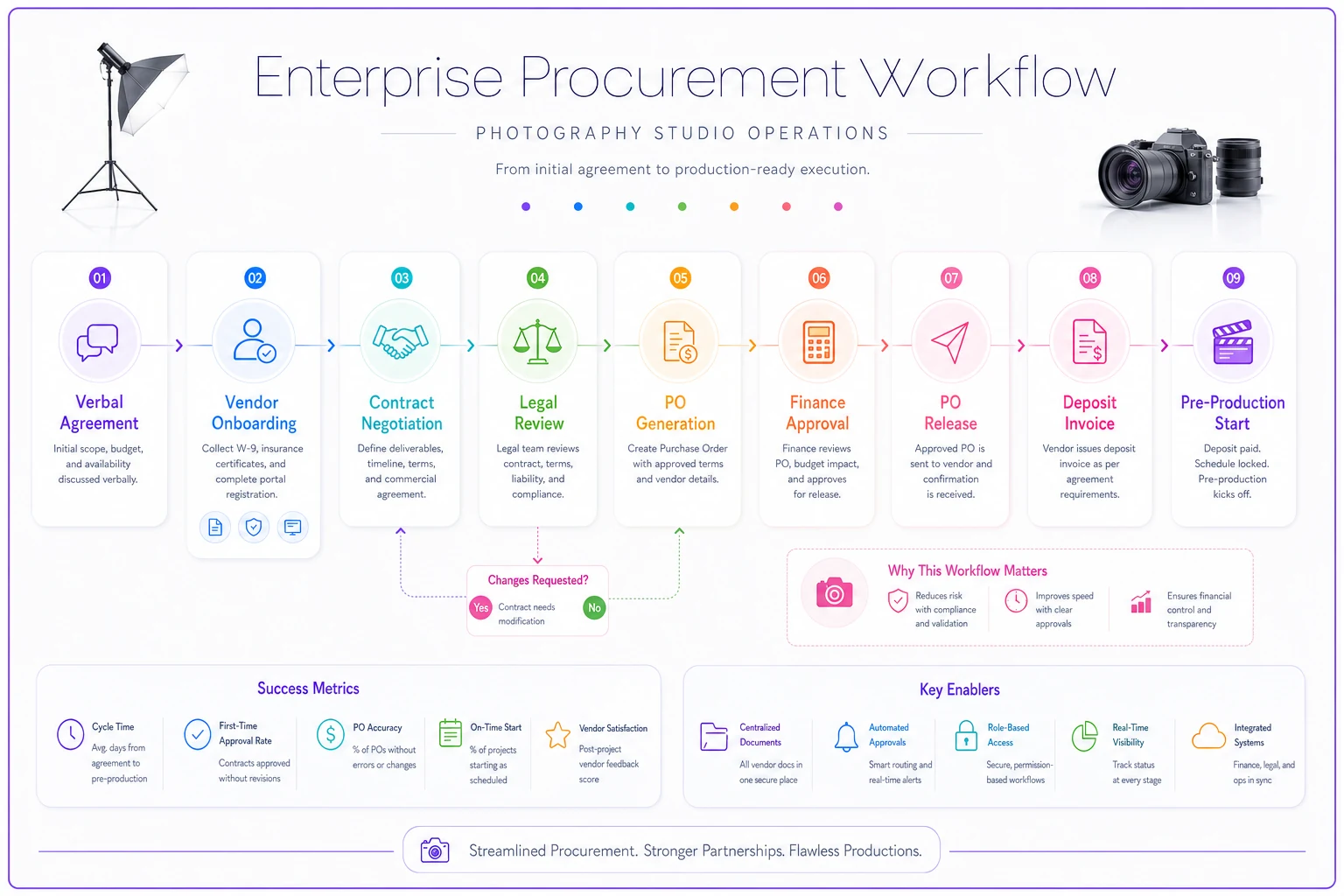
Verbal Agreement → Vendor Onboarding (W-9, insurance, portals) → Contract Negotiation → Legal Review → PO Generation → Finance Approval → PO Release → Deposit Invoice → Pre-Production Start
Vendor onboarding alone can take 2 to 4 weeks. They'll need your W-9, insurance certificates, sometimes background checks, and often diversity certifications. Smart studios pre-package these documents into a vendor packet that accompanies every RFP response. Include banking details for ACH setup, the NET terms you'll accept, and any certifications already completed.
The contract negotiation phase kills margins through death by a thousand cuts. Corporate legal will redline your entire agreement, adding indemnification clauses, IP assignments that go beyond reasonable scope, and liability caps that don't align with project value. Having pre-negotiated fallback positions prevents endless back-and-forth. You might accept their indemnification language, for instance, if they accept your revision limit language in return.
A practical procurement timeline that maps to how this actually plays out:
-
Week 1–2
Vendor Onboarding - Submit vendor packet - Complete procurement portal registration - Provide insurance certificates - Schedule procurement call if required
-
Week 3–4
Contract Negotiation - Receive redlined contract - Counter with must-have operational protections - Accept non-critical legal language changes - Finalize service agreement
-
Week 5–6
PO Processing - Confirm PO request submitted - Follow up with procurement contact - Verify PO amount matches contract - Obtain written start authorization
-
Week 7+
Project Initiation - Issue deposit invoice against PO - Begin pre-production upon deposit receipt - Lock shoot dates only after deposit clears
This assumes everything goes smoothly. Build in buffer weeks and communicate them upfront: "Standard procurement timeline runs 6 to 8 weeks from RFP award to project start. Compressed timelines available with a 20% rush charge."
PO and invoicing standards that ensure payment
Corporate invoicing operates nothing like standard studio billing. One misaligned invoice can delay payment by months while it bounces between accounts payable, procurement, and project management. Corporate AP departments process invoices mechanically—any deviation from expected format triggers manual review and delays.
Your invoices must mirror their PO exactly. Same line items, same descriptions, same quantities. If their PO says "Photography Services - Project Alpha" and you invoice for "Corporate Headshot Session," that invoice gets rejected. If their PO shows $15,000 and you invoice $15,000 plus applicable taxes—even if completely legitimate—rejected. Every deviation creates friction.
Invoice Header Requirements:
-
Exact vendor name matching their system
-
Your vendor number (not optional)
-
PO number in subject line and body
-
Project code if provided
-
Billing contact from PO (not your main contact)
Line Item Matching:
-
Copy descriptions verbatim from PO
-
Match quantities exactly
-
Break out taxes as a separate line if PO includes them
-
Never add line items not on PO
Documentation Attachments:
-
Signed delivery receipts
-
Approval confirmations
-
Change order authorizations
-
Timesheets if T&M components exist
For complex projects, establish milestone billing tied to specific deliverables. Instead of one massive invoice at project end, structure it as:
-
25% upon PO receipt (mobilization)
-
25% upon shoot completion (production)
-
25% upon initial delivery (post-production)
-
25% upon final approval (project close)
Each milestone gets its own PO line item, which makes invoicing cleaner and cash flow smoother. This also protects you from the scenario where a project stalls at approval and you're waiting months on the final 100%.
Staged delivery milestones that control scope
The biggest margin killer in corporate photography happens during the delivery phase. Without staged milestones, projects devolve into endless revision cycles where "quick tweaks" multiply into complete re-shoots. Staged delivery creates operational boundaries that protect both quality and profitability.
Structure your delivery into discrete, approved stages:
Stage 1: Contact Sheets (Day 1–3 post-shoot) Deliver low-res watermarked contact sheets for selection only. The client selects specific images for post-production—this prevents editing 500 images when they only need 50. Include a selection deadline: "Selections required within 5 business days. Non-selection results in studio-curated selection."
Stage 2: Initial Edits (Day 7–10 post-selection) Deliver watermarked versions of selected images with basic color correction and cropping. Client provides consolidated feedback in a single document—individual stakeholder feedback not accepted. This stage catches major issues before deep retouching begins.
Stage 3: Final Delivery (Day 14–17 post-feedback) Deliver unwatermarked final images in specified formats. Client has 48 hours to flag technical issues only (corrupt files, wrong dimensions). No creative revisions accepted at this stage without a change order.
Stage 4: Archive Transfer (Day 30 post-approval) Transfer all raw files and project assets per contract terms. Include documentation of what's in the transfer and what's excluded. A lot of studios skip this stage entirely, then face requests years later for files that were purged long ago.
| Stage | Deliverable | Acceptance Criteria | Revision Scope | Deadline |
|---|---|---|---|---|
| Contact Sheets | All captured images | Technical review only | None | 5 days |
| Initial Edits | Selected images edited | Creative feedback | Consolidated document | 5 days |
| Final Files | Approved images finalized | Technical issues only | File errors only | 48 hours |
| Archive | Raw files + assets | Completeness check | None | 30 days |
This structure transforms vague "deliver photos" requirements into manageable operational phases with clear boundaries. Without it, you're negotiating scope informally at every stage—and informal scope conversations almost always go against you.
Contract clauses every studio needs for enterprise work
Standard photography contracts fail when applied to enterprise deals. Corporate clients have legal teams that will shred your two-page agreement and impose their forty-page master service agreement. But certain operational protections must survive that negotiation, or the project becomes unmanageable.
The Designated Approver Clause
"Client shall designate a single individual with full approval authority. All feedback must be consolidated through the designated approver. Studio not responsible for conflicts between stakeholder feedback or delays caused by internal client approval processes."
The Scope Creep Defender
"Services limited to deliverables explicitly listed in Exhibit A. Additional shots, angles, locations, subjects, or formats constitute change orders requiring written approval and separate PO. Verbal requests for additions not valid without written confirmation and pricing agreement."
The Payment Protection Package
-
Suspension Rights "Studio may suspend work upon invoice aging beyond 45 days. Suspension does not alter delivery timelines, which remain tied to payment receipt."
-
Intellectual Property Retention "Copyright and usage rights transfer only upon payment in full. Client usage prior to full payment constitutes copyright infringement subject to statutory damages."
-
Collection Costs "Client responsible for all collection costs including attorney fees, court costs, and collection agency fees, plus 18% annual interest on overdue amounts."
The Revision Boundary
"Project includes [X] rounds of revisions as defined in Exhibit B. Revisions must be requested within 10 business days of delivery. Revisions requested after 10 days billed at $200/hour minimum 2 hours. Revisions beyond included rounds billed at standard hourly rate."
Define what constitutes a "round"—it's all changes identifiable in a single review, not ongoing piecemeal requests. Also spell out what isn't a revision: fixing actual errors, file format conversions within original scope, or replacing corrupted files.
The Force Majeure That Actually Works
"Either party may invoke force majeure for: natural disasters, government actions, or pandemics. For Studio: inability to access locations, key personnel illness, or equipment failure also qualify. Client remains liable for all costs incurred prior to force majeure event."
Coordinating multi-location shoots without chaos
Enterprise shoots often span multiple locations, sometimes across different cities or countries. The operational complexity multiplies fast. You're not managing one shoot—you're orchestrating multiple parallel productions that must maintain consistent quality and style.
The challenge starts with location scouting. Corporate clients assume their facilities are photography-ready. They're not. That stunning headquarters lobby has mixed lighting that creates color cast problems. The "state-of-the-art" conference room has glass walls that cause reflection disasters. The manufacturing floor has safety requirements that restrict equipment placement.
Build location assessment into your operational workflow:
-
Power availability (specific amp requirements)
-
Loading access (elevator dimensions, dock availability)
-
Lighting conditions throughout the day
-
Sound levels if there's a video component
-
Security requirements and restrictions
-
Available staging areas
-
On-site contact with decision authority
For multi-location shoots, the hub-and-spoke model works well—your primary team handles the main location while trained secondary teams handle satellite locations. This requires extensive coordination on style guides, equipment specs, and quality standards, something we explored in depth when discussing role matrices and calibration sessions for multi-photographer consistency.
The timeline complexity compounds with multiple locations. A two-day shoot at one location becomes a two-week production across five locations once you factor in travel, setup, breakdown, and location-specific requirements. Your operational plan needs to account for:
-
Travel days between locations (billable or not?)
-
Equipment shipping vs. traveling with gear
-
Local crew hiring and training
-
Backup plans for each location
-
Centralized vs. distributed post-production
-
File transfer and backup protocols
One approach that consistently reduces chaos: send a small advance team one day ahead to each location. They handle final location prep, equipment pre-staging, local crew briefing, test shots for lighting validation, and problem identification before the main crew arrives. It costs more upfront but prevents day-of disasters that destroy margins through delays and re-shoots.
Post-production workflows for enterprise volume
Enterprise projects generate file volumes that standard studio workflows simply can't handle efficiently. A single corporate headshot session might produce 2,000+ raw files. A multi-day product shoot could hit 10,000+. Without proper operational structure, post-production becomes a bottomless pit of time and revisions.
The challenge starts immediately after capture. Dumping everything into Lightroom and starting to edit doesn't scale. You need intermediate steps that filter and organize before editing begins.
The Triage System:
-
First pass
Technical rejection (out of focus, motion blur, closed eyes)
-
Second pass
Composition selection (best of similar shots)
-
Third pass
Client selection (if contracted)
-
Fourth pass
Edit priority (hero shots vs. supporting)
This filtration typically cuts editing volume by 75 to 85%. You're editing 200 images instead of 1,000 but delivering the same quality outcome.
Batch processing becomes essential at this scale. Instead of individual image editing, develop preset packages:
-
Corporate headshot standard (consistent background, skin tone, cropping)
-
Product photography template (white balance, shadow/highlight, sharpening)
-
Architectural base (perspective correction, HDR processing, color grading)
Apply presets first, then fine-tune individual images. This maintains consistency while cutting processing time considerably.
The revision challenge in enterprise post-production is different from standard studio work. You're not dealing with one client who wants minor tweaks—you're managing feedback from multiple stakeholders across hundreds of images. A revision matrix handles this cleanly:
| Revision Type | Included | Additional Cost | Turnaround |
|---|---|---|---|
| Global adjustments (all images) | 2 rounds | $500/round | 3 days |
| Individual image edits | 10% of delivered | $25/image | 5 days |
| Re-crops/reformats | Unlimited in first round | $10/image after | 2 days |
| Background replacement | Not included | $150/image | 7 days |
This matrix prevents revision scope creep while setting clear cost expectations from the start.
When enterprise deals actually make sense
Not every studio should chase corporate photography work. The operational overhead, cash flow requirements, and margin pressure make these deals genuinely harmful for studios that aren't set up for them. Knowing when to pursue versus pass is its own skill.
Enterprise deals make sense when you have operational depth—backup photographers who can maintain your style, established vendor relationships for equipment and locations, and cash reserves to handle 60 to 90 day payment cycles. Without those three elements, one enterprise deal can destabilize your entire operation.
Volume threshold matters too. If enterprise work represents less than 30% of your revenue, the operational burden rarely justifies the margin compression. You're maintaining parallel systems—one for standard clients, one for corporate—without enough volume to justify the complexity. Better to optimize your core business than chase prestige clients.
Think carefully about opportunity cost. That Fortune 500 headshot contract might generate $50,000 in revenue. But if it consumes resources that could generate $75,000 in wedding bookings with better margins and faster payment, you're actually losing money by winning the deal.
Enterprise deals work when:
-
Payment terms align with your cash flow reality
-
You have excess capacity in traditionally slow periods
-
The client relationship opens doors to similar opportunities
-
You can systematize the work for recurring revenue
-
The margins support the operational complexity
They destroy value when:
-
You're stretching financially to fund the project
-
You lack backup resources for contingencies
-
The client culture emphasizes endless revisions
-
Payment history shows consistent delays
-
The project disrupts your profitable core business
Prestige clients aren't profit by default. Run the numbers honestly before you say yes.
The technology layer that makes enterprise manageable
Managing enterprise photography operations through email and spreadsheets guarantees margin erosion. The coordination complexity, revision tracking, stakeholder management, and file handling at this scale genuinely demand proper operational infrastructure.
The real value of AI-powered operational software isn't in flashy features—it's in coordination. When procurement sends the PO, it automatically triggers your vendor onboarding checklist. When the client approves contact sheets, it kicks off the editing workflow. When revisions exceed contract limits, it generates change orders automatically. That kind of automation prevents the small failures that compound into margin disasters.
Modern operational platforms also create documentation you actually need. They track which stakeholder provided which feedback, when revision rounds were submitted versus when they were due, and how actual timelines compare to contracted ones. That paper trail becomes invaluable during payment disputes or scope creep conversations.
File management alone justifies proper systems at enterprise scale. These projects generate terabytes of data across raw files, working files, delivered files, and archives. AI-assisted platforms can automatically organize, tag, and track files while maintaining the audit trail corporate clients expect—handling contact sheet generation, batch corrections, and deliverable packaging to client specs. That's the tedious but critical work that eats hours when done manually.
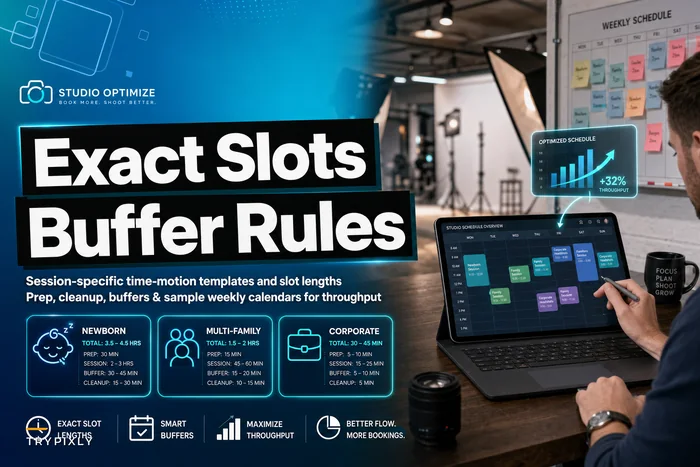
For multi-location coordination, centralized operational software becomes genuinely essential. It synchronizes schedules across locations, tracks equipment movement, manages local crew assignments, and consolidates production notes, giving you central visibility into everything moving at once. If you're building out a multi-photographer operation, the scheduling frameworks outlined in slot lengths and buffer rules for high-volume sessions translate directly into enterprise workflows too.
This infrastructure investment makes sense only if you're serious about enterprise work. For occasional corporate projects, the overhead probably isn't justified. But for studios where enterprise represents meaningful revenue, proper operational software turns complex projects from margin-eating nightmares into systematized, profitable workflows.
Building margins into enterprise operations
Enterprise photography work doesn't have to destroy margins. The studios succeeding with corporate clients aren't necessarily better photographers—they're better at operations. They've built systems that protect profitability at every stage from RFP response through final delivery.
The components interconnect. Your RFP response sets boundaries that your contract clauses enforce. Your procurement timeline prevents surprises that your milestone structure manages. Your delivery stages control scope that your revision matrix prices appropriately.
Enterprise clients operate in a fundamentally different world than standard photography clients. They have procurement processes, legal requirements, and stakeholder dynamics that can't be wished away. Studios that thrive in this space adapt their operations to that reality rather than fighting it.
Start with one piece. Pick staged delivery milestones or a revision matrix and implement it on your next corporate project. See what holds, what breaks, what needs adjustment. Build your playbook from actual experience on real projects rather than trying to implement everything at once.
For studios already doing significant corporate work, the investment in proper operational infrastructure pays for itself through margin protection and efficiency gains. The right systems turn enterprise photography from a necessary evil into a profitable growth channel—and transform operational complexity from a burden into a competitive advantage that less organized competitors simply can't match.
Start with one piece. Pick staged delivery milestones or a revision matrix and implement it on your next corporate project. See what holds, what breaks, what needs adjustment. Build your playbook from actual experience on real projects rather than trying to implement everything at once.
For studios already doing significant corporate work, the investment in proper operational infrastructure pays for itself through margin protection and efficiency gains. The right systems turn enterprise photography from a necessary evil into a profitable growth channel—and transform operational complexity from a burden into a competitive advantage that less organized competitors simply can't match.
Ready to elevate your studio’s workflow?
Join 500+ studios using TryPixly to save time, reduce scheduling conflicts, and deliver exceptional client experiences.