



Most studios don't fail in their busy months. They fail in the slow ones, or in the messy handoff between the two. You'll book a monster October — weddings, fall family sessions, corporate headshot rushes before annual reports — and then January hits and the calendar goes quiet, but the studio rent, the retoucher retainer, and the equipment lease don't care what month it is.
The frustrating part is that seasonality isn't a surprise. You know the peaks and valleys. You've lived them for years. And yet most studios still treat marketing, staffing, pricing, and cashflow as four separate decisions — made by four different people, or the same overwhelmed owner, at four different times. That disconnect is what actually causes the crash, not the season itself.
Good photography seasonality planning isn't about predicting demand better. It's about making these four levers move in a coordinated sequence so a slow February doesn't force a panic promo that you then can't staff for, which blows your margins, which leaves you short on cash for the next hiring cycle. That loop is the real enemy.
Why the four levers drift apart
In a small studio, the marketing calendar usually lives in the owner's head or a booking tool. Staffing lives in group texts. Pricing lives in a PDF that hasn't been updated in eight months. Cashflow forecasting? For most studios that's just checking the bank balance and hoping.
When they're disconnected, things break in very specific ways. A studio notices bookings are soft in mid-summer, so they fire off a "20% off mini-sessions" email on a Tuesday. Bookings spike. Great — except now they've got 30 minis scheduled in a two-week window, they only have one shooter who's already booked on two of those Saturdays, and the discounted price barely covers the cost per slot once you factor in editing. They filled the calendar and lost money doing it.
That's not a marketing failure. It's a coordination failure. The promo fired without checking capacity, and the price wasn't gated to protect margin. If you've read about how studio profitability ties cost-per-slot, package mix, and post-production into decision rules, you already know a discounted slot isn't free money — it's a slot that has to clear its own cost before it does anything for you.
-
Marketing pushes demand without knowing what capacity exists
-
Staffing reacts to demand instead of being planned against it
-
Pricing stays static even when demand swings 3x between quarters
-
Cashflow gets discovered rather than forecasted
The pattern repeats across studios of every size:
What breaks as you scale
When you're a solo shooter, you are the coordination layer. You know your calendar, your cash, what you can handle. The system works because it all lives in one brain.
Never miss a shoot or client detail again.
TryPixly helps you book, confirm, and manage every photography session seamlessly.
- Unified session and client management
- Automated client reminders
- Team calendar & resource scheduling
No credit card required
The trouble starts around the two-to-four-photographer mark. Now the owner is booking, a second shooter is running weekends, a part-time editor is drowning during peak, and nobody has a shared view of what's coming. This is where seasonality starts doing real damage, because the natural response to a busy season — hire more, promise more, book more — doesn't reverse cleanly when the season ends.
A typical example looks like this. A studio ramps up for wedding season, brings on two contract shooters and a second retoucher around May. Revenue looks great June through September. Then October tapers and suddenly they're carrying labor cost against a calendar that's half-empty. By December they're either eating payroll they can't cover or scrambling to cut people they just spent three months training. Both outcomes are expensive.
At scale, the real bottleneck isn't demand. It's the speed of your response to demand changes. Studios that plan seasonally can flex staff up and down on a schedule. Studios that don't are always reacting a month too late — hiring after the rush started, cutting after it ended.
Building the quarterly playbook
The fix is a single quarterly view where all four levers are planned together, and where changes to one force you to check the others. It doesn't need to be fancy. It needs to be shared and sequenced.
Start by mapping your actual demand curve, not the one you assume you have. Pull two to three years of bookings and plot them by month and session type. Most studios find their "busy season" is more specific than they thought — it's not "fall," it's the six weeks of family sessions between mid-September and early November plus a headshot bump in Q1.
Once you have the curve, build the calendar backward from it.
The quarterly template, by lever
| Quarter | Demand pattern | Marketing focus | Staffing posture | Pricing move | Cash priority |
|---|---|---|---|---|---|
| Q1 (Jan–Mar) | Slow, corporate headshot bump | Rebook past clients, sell memberships | Core team only, no contractors | Full price, no promos | Rebuild reserve after Q4 |
| Q2 (Apr–Jun) | Ramp into weddings/grads | Book peak season, waitlists | Begin onboarding contractors | Premium peak pricing | Fund peak-season payroll |
| Q3 (Jul–Sep) | Peak, capacity-constrained | Minimal — protect capacity | Full flex team active | Highest pricing, gated promos only | Bank surplus for slow months |
| Q4 (Oct–Dec) | Family/holiday rush, then drop | Mini-sessions early, holiday early | Flex down mid-quarter | Tiered — premium early, mini later | Reserve for Q1 lull |
The specific entries will differ by market and session mix. The point is that every quarter has an intentional posture for all four levers, decided in advance, instead of four independent reactions happening in real time.
Here's a simple workflow to visualize the quarterly planning sequence.
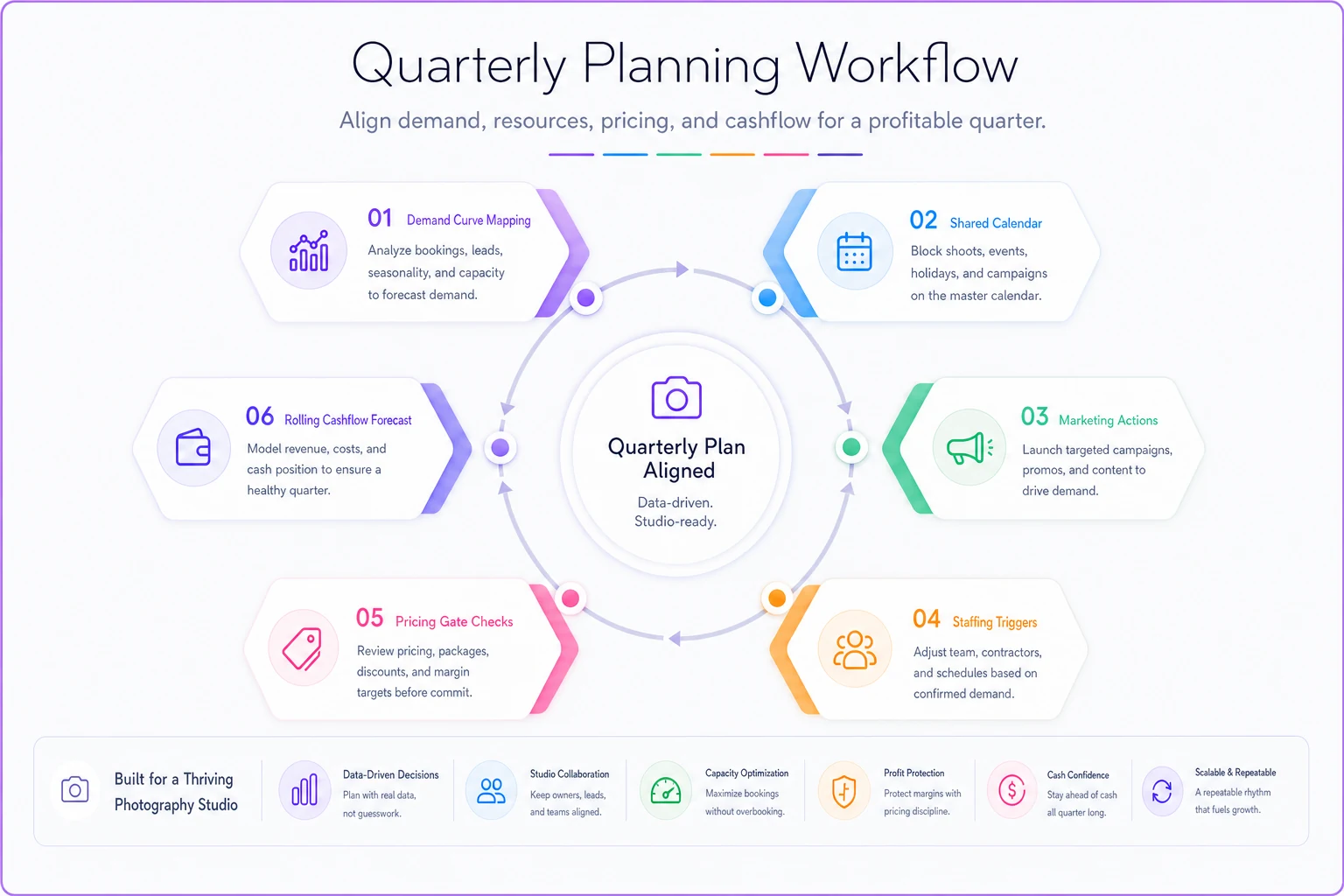
This sketch helps teams agree on sequence: map demand, set marketing windows, confirm staffing, gate pricing, and then check cash impact.
Staffing flex rules that don't burn people
The hardest lever to move is people, because humans aren't a faucet you turn on and off. This is where most seasonal plans quietly fall apart — the owner knows they need fewer hands in January but can't bring themselves to have the conversation, so they carry the cost instead.
The way out is to build flex into the arrangement before anyone starts. Contractors hired for peak season should know from day one that the engagement is seasonal, with clear ramp-up and ramp-down dates tied to the calendar. This isn't cold — it's honest, and good contract shooters actually prefer it because they can plan their own year around known windows.
-
Define your core capacity — the baseline team that stays year-round regardless of season. Size this to your slow-month demand, not your peak.
-
Set trigger thresholds — e.g., "when advance bookings for a given month exceed X% of core capacity, activate contractor onboarding for that window."
-
Onboard early, not on the day — contractors need calibration and file-standard training before the rush, so trigger onboarding four to six weeks ahead of the demand.
-
Ramp down on a date, not a feeling — end seasonal engagements on pre-agreed dates so nobody's carrying payroll on hope.
-
Keep a rebook list — the same contractors invited back next season cuts your onboarding cost dramatically.
Lock returners with a small seasonal retainer to cut onboarding time and keep quality consistent.
Sizing core capacity to slow months is the counterintuitive move that saves studios. It feels safer to staff for the peak, but that's exactly what turns a good season into a break-even year. If you're rethinking capacity from the ground up, the mechanics in designing a finite-capacity scheduling system pair directly with seasonal flex — one sets how many slots you can run, the other sets when to add and remove the hands to run them.
Promo gating: the discipline most studios skip
Promotions are the fastest way to wreck a season, because they solve a real problem (empty calendar) with a tool that creates a worse one (thin margins, overbooked staff). The answer isn't "never discount." It's gating — attaching conditions to promos so they only fire when they actually help.
-
Capacity gate Don't promote sessions you can't staff. If contractors aren't confirmed for the window, the promo doesn't run.
-
Margin gate Discounted price must still clear cost-per-slot plus a minimum contribution. If a mini-session priced at $149 doesn't cover shooting time, editing, and overhead allocation, it's not a promo — it's a donation.
-
Timing gate Promos fire in defined windows (early Q4, deep Q1) and never during peak, when you'd just be discounting demand you already had.
-
Volume cap Every promo has a hard limit on bookings so you don't fill your whole calendar at the discounted rate.
One studio worth pointing to gates every promo behind two numbers: current advance-booking fill rate and confirmed shooter availability for the target window. If fill is already above 70% for that period, no promo runs — they don't need it. If shooters aren't locked, no promo — they can't deliver it. That single rule prevents the classic "successful promo that lost money" outcome.
Cashflow forecasting that connects to everything else
Cashflow catches the failures of the other three levers, which is why it should be the scoreboard your quarterly plan is built around. The mistake most studios make is forecasting revenue and forgetting that revenue and cash aren't the same thing — a wedding booked in June with delivery in September might collect a deposit now and the balance later, while your contractor payroll for that shoot is due immediately.
A simple rolling 13-week cash forecast, updated weekly, catches the seasonal squeeze before it becomes a crisis. You're looking for the moment where committed outflows — payroll, rent, lease payments, contractor invoices — cross above expected inflows: deposits, balances, print and album sales. That crossover point is almost always in the shoulder between peak and slow. You've ramped up cost for the busy season, and the slow season's low bookings haven't rebuilt the reserve yet.
The whole reason for banking surplus during peak quarters is to cover that crossover. Studios that treat a great summer as "extra money" and spend it are the same studios scrambling in January. The forecast makes the discipline concrete — you can see that the July surplus is spoken for by February, so it stops feeling like extra.
When this level of planning actually makes sense
If you're a solo shooter running maybe 60–100 sessions a year, a full cross-functional playbook is overkill. You can hold it in your head, and the coordination cost of formal templates outweighs the benefit. A simple demand curve and a basic cash cushion will do.
This system starts earning its keep once you're running multiple shooters, carrying fixed costs like a lease or retainers, and seeing revenue swing meaningfully between quarters. That's when the four levers genuinely need a shared view, because no single person can track them all by feel anymore.
Who should not do this: studios with flat, predictable year-round demand — some corporate and e-commerce shops have almost no seasonality. If your demand curve is basically a straight line, don't manufacture complexity you don't need. Seasonal playbooks solve seasonal problems.
A real scenario
A four-person portrait studio — one owner, one full-time shooter, a part-time editor, and seasonal contractors — was running roughly $280k–$320k a year but living paycheck to paycheck despite a strong fall. Their pattern was textbook: big Q4, brutal Q1, and a habit of firing off panic discounts every January that filled the calendar with barely-profitable minis.
The changes weren't dramatic. They mapped three years of bookings and confirmed the real curve. They sized their core team to slow-month demand and moved everything above that to dated seasonal contracts. They gated promos behind fill rate and shooter availability, which killed the January panic discount entirely — turned out they didn't need it once they'd banked part of the Q4 surplus. They also ran a rolling cash forecast so the summer-to-fall crossover stopped being a surprise.
Revenue barely changed the first year, maybe up a little. But the shape of it changed completely. Instead of a feast-then-scramble cycle, they carried a reserve into Q1, cut the money-losing discounts, and stopped over-carrying payroll into slow months. The owner described it as finally being able to sleep in February. Same business, roughly the same top line, materially better margins and no more cash panic.
Where software quietly helps
None of this requires expensive tooling, but it does require the four levers to share one source of truth — and that's where most studios' spreadsheets fall down. When your booking calendar, staffing plan, pricing rules, and cash position live in separate files, the coordination has to happen in someone's head, and that's exactly what breaks under seasonal pressure.
AI-assisted operational platforms help mostly by keeping these connected: surfacing the fill rate that gates a promo, flagging when advance bookings cross a staffing trigger, and rolling your cash forecast forward automatically instead of waiting for you to update a sheet you've been avoiding. The value isn't the automation itself — it's that the checks you'd skip when you're busy still happen. A promo that shouldn't fire doesn't, because the system already knows the shooters aren't confirmed.
Seasonality doesn't crash studios because owners lack discipline. It crashes them because the discipline lives in four disconnected places and there's never time to reconcile them during the exact weeks it matters most.
Bringing it together
Seasonality is predictable. The crash isn't caused by the slow season — it's caused by four business functions reacting to it independently and a beat too late.
Map your real demand curve. Build a quarterly posture for marketing, staffing, pricing, and cash in advance. Size your core team to the valley instead of the peak. Gate your promos so they only fire when they help. Forecast cash far enough ahead to see the crossover coming.
Do that consistently, and the slow months stop being a threat. They become the part of the plan you already funded during the busy ones — which is exactly what good seasonal planning is supposed to buy you.
Ready to elevate your studio’s workflow?
Join 500+ studios using TryPixly to save time, reduce scheduling conflicts, and deliver exceptional client experiences.