


Most photography studios hit the same wall around $400k in annual revenue. Steady bookings, decent margins on prints and albums, enough word-of-mouth to keep the calendar filled. Then they hire their third or fourth photographer and everything starts unraveling.
Work gets inconsistent. Clients complain about different shooting styles. The new photographer bills their hourly rate for a newborn session that runs three hours instead of ninety minutes. Your lead photographer starts cherry-picking weddings and dumping family portraits on whoever's available. Somehow you're paying more in labor while delivering worse results.
This isn't a talent problem. It's a photography studio staffing system problem — or more accurately, the complete absence of one. Compensation decisions made session by session, hiring based on availability rather than fit, and a vague hope that experience somehow translates into consistency.
Why traditional hiring breaks down in photography studios
Photography studios don't operate like other service businesses. You're not running a restaurant where everyone works the same shift. You're not a dental office with predictable schedules and clear procedures. You're juggling photographers who might shoot two newborn sessions Tuesday morning, a corporate headshot gig Wednesday afternoon, and a wedding Saturday.
Each photographer brings their own shooting style, editing preferences, and client interaction habits. The one who's brilliant at getting real smiles from toddlers might completely fumble a corporate shoot. The one who creates stunning wedding portraits might take four hours to shoot what should be a 45-minute family session.
Without a staffing system, you end up with a patchwork of pay structures. Sarah gets $75/hour because she negotiated well. Mike gets $350 per wedding because that's what he asked for. Jennifer gets 40% of session fees because another studio offered her that. Nobody knows if they're being paid fairly, you have no idea if you're over or underpaying, and every new hire becomes a fresh negotiation instead of a repeatable process.
The problems compound as you scale. Your first photographer was probably a friend or former colleague who understood your vision. Your second hire came recommended by a client. By the time you're hiring your fifth or sixth, you're grabbing whoever has a decent portfolio and some availability. No consistency in skill level, no standard for client interaction, no clear path for growth.
The hidden costs of bad compensation structures
When you don't have clear compensation bands, things start going sideways in ways that aren't immediately obvious.
Never miss a shoot or client detail again.
TryPixly helps you book, confirm, and manage every photography session seamlessly.
- Unified session and client management
- Automated client reminders
- Team calendar & resource scheduling
No credit card required
A photographer discovers they're making less than someone with half their experience. They start showing up a little late, rushing sessions, or worse — they quit right before busy season and take their client relationships with them.
Or the opposite: you're paying someone $500 for a second-shooter wedding role when market rate is around $350. They're happy, you're bleeding margin on every wedding. Multiply that across a full season and you've lost enough to fund an additional part-time editor.
Per-session pay sounds simple until you realize it incentivizes speed over quality. A photographer paid $300 per family session regardless of length will rush through in 35 minutes. Clients feel it. Reviews start mentioning how "rushed" everything was.
Hourly pay creates the opposite problem. That headshot session scheduled for an hour somehow takes two because the photographer is "being thorough." Your studio's carefully planned session slots get blown apart and the next client walks into chaos.
Percentage-based compensation seems fair until you notice your photographer makes the same cut on a $400 mini session as a $4,000 wedding. They start steering clients toward cheaper packages — less work, same percentage — and your average order value quietly tanks.
Building compensation bands that actually work
A functional compensation structure starts with understanding what you're actually paying for. Not just time behind a camera. Consistency, reliability, and the ability to deliver your studio's specific style and experience.
Entry Level ($28–$35/hour or $150–$200/session)
-
Handles standard family portraits and mini sessions
-
Follows shot lists and posing guides closely
-
Every session reviewed before delivery
-
Maximum 12–15 sessions per month to maintain quality
Standard Level ($40–$50/hour or $250–$350/session)
-
Manages newborn, family, and basic event photography
-
Adapts positioning and lighting for different scenarios
-
Spot-checking on delivered images
-
Can handle 20–25 sessions monthly
Senior Level ($55–$70/hour or $400–$500/session)
-
Shoots everything from newborns to weddings independently
-
Mentors junior photographers
-
Maintains consistent style without supervision
-
25–30 sessions per month while holding standards
Lead Level ($75–$90/hour or $500–$700/session)
-
Defines and evolves studio style standards
-
Handles VIP clients and complex multi-location shoots
-
Trains new photographers on studio methods
-
Reviews and approves others' work
These aren't just arbitrary pay increases. Each level carries specific capabilities and responsibilities. A senior photographer isn't someone who's been around longer — they handle more complex sessions, work without supervision, and maintain quality at volume.
The probation period most studios skip
Studios hire a photographer based on their portfolio, throw them into sessions immediately, then wonder why clients complain about inconsistency three months later. You're essentially letting someone learn your approach while experimenting on paying clients.
Days 1–30: Observation and assisted shooting
The new photographer shadows experienced team members across at least five different session types. They assist with lighting, help with posing, and watch how client interactions unfold. They're also documenting what they observe — typical flow for a newborn session, how the lead photographer handles a crying toddler, what phrases actually calm a nervous corporate client.
Days 31–60: Supervised lead shooting
Now they're leading sessions, but with oversight. Start simpler — mini sessions, single-child portraits, basic headshots. A senior photographer reviews every image before delivery. Not just for technical quality, but for style consistency. Are the crops matching studio standards? Is posing aligned with your brand? Are they getting safe shots before attempting creative angles?
Days 61–90: Independent shooting with review
Running sessions solo, but everything still gets reviewed before delivery. Track specifics: How do their sessions run against schedule? What's the reshoot rate? Are clients buying products at similar rates to established photographers?
Only after all three phases do they move to unsupervised shooting. Roughly 30% won't make it through — better to know during probation than after twenty sessions that need fixing.
Calibration schedules that prevent style drift
Even solid photographers drift from studio standards over time. Shortcuts develop. Personal style creeps in. Specific requirements get forgotten. Without regular calibration, you end up with five photographers delivering five different experiences.
Monthly style reviews (2 hours)
Every photographer brings three recent sessions for group review. Not their best work — their typical work. The group looks at consistency: background exposure, crop ratios, editing approach. You're not looking for identical images, just consistent quality within your studio's style parameters.
Quarterly skills workshops (4 hours)
Targeted sessions addressing actual gaps. Maybe everyone's struggling with overhead lighting for newborns. Or the new backdrop system has everyone guessing on positioning. Generic photography workshops don't help here — these need to address what your studio actually needs.
Annual full-team shoots (full day)
Once a year, every photographer shoots the same model family in the same location with the same equipment. Compare results side by side. The differences show you exactly where your standards are clear and where they need better definition. It's genuinely surprising how different "soft, natural light" can look across five photographers when you've never specifically defined what that means.
Track calibration attendance and outcomes in your ops software to spot drift early.
Your operational software should track calibration automatically. A photographer who misses two monthly reviews gets flagged for additional oversight. Someone who consistently delivers clean work gets marked ready for advancement.
Career ladders tied to actual performance metrics
Most studios promote based on tenure or subjective quality assessments. Advancement should be tied to measurable performance that actually connects to profitability.
Utilization rate triggers
Entry-level photographers maintaining around 80% utilization for three consecutive months are likely ready for more complex sessions. But utilization alone isn't enough — pair it with quality data.
Revenue per session benchmarks
Track total session revenue — prints, albums, digital packages, not just the session fee. A photographer consistently generating $800+ per family session against a studio average of $650 has proven they can upsell without being pushy. That's worth rewarding with advancement.
Client satisfaction scores
Post-session surveys with specific questions: "How comfortable did the photographer make you feel?" and "How well did they handle unexpected moments?" Photographers maintaining 4.7+ ratings across twenty sessions have demonstrated consistent client skills.
Technical proficiency gates
-
Adjusting lighting for unexpected weather in outdoor sessions
-
Managing multi-generational group portraits efficiently
-
Handling wardrobe malfunctions and styling issues on the fly
-
Keeping sessions on schedule even with difficult subjects
Did they keep a newborn session moving despite the baby refusing to sleep? Did they get sharp headshots despite terrible conference room lighting? These aren't subjective assessments — you're tracking how specific situations get handled.
Why mixing compensation models destroys team cohesion
Studios often think flexible payment structures help attract diverse talent. In practice, it creates operational chaos and quiet resentment.
When Sarah makes $75/hour, Mike gets $350 per wedding, and Jennifer takes 40% of session fees — nobody can figure out who's actually earning more. Sarah feels underpaid when she calculates Mike made $116/hour for a three-hour wedding. Mike's frustrated when Jennifer made $600 from a high-ticket newborn session that took half the time. Jennifer's upset when she finds out Sarah made $450 for a six-hour corporate shoot while she only cleared $400 from a similarly priced family session.
The operational impact goes beyond morale. Mixed models make scheduling a mess. You can't efficiently assign photographers when you're juggling three different cost structures. The hourly photographer gravitates toward long corporate gigs. The per-session photographer grabs quick mini sessions. The percentage-based photographer only wants premium packages.
Pick one primary model and use it across every level. If you choose hourly, everyone from entry to lead gets hourly — the rates change, the structure doesn't. This lets you build predictable cost models and fair advancement paths.
The real math on scaling without quality drift
Most studios assume hiring more photographers means more capacity and more revenue. The math rarely works that cleanly.
A common scenario: you're at capacity with two photographers handling around 40 sessions per month. You hire a third expecting 20 more sessions of capacity. Six months later, you're doing 45 sessions instead of 60, labor costs are up 40%, and your reshoot rate has doubled.
What happened? Without proper systems, new photographers actually reduce overall capacity for their first three to four months. They need supervision. Their sessions require more editing correction. They generate more client complaints that eat administrative time. Your senior photographers spend hours training instead of shooting. Your editing team spends extra time fixing inconsistent work.
Here's what scaling with systems looks like instead:
| Scaling Phase | Without System | With System |
|---|---|---|
| Month 1–3 | -20% capacity (training burden) | -5% capacity (structured onboarding) |
| Month 4–6 | +10% capacity (partial productivity) | +35% capacity (calibrated performance) |
| Month 7–12 | +25% capacity (inconsistent quality) | +45% capacity (consistent delivery) |
| Reshoot Rate | 8–12% of sessions | 2–3% of sessions |
| Edit Time | +40% per session | +10% per session |
| Client Satisfaction | Drops to 4.2/5 | Maintains at 4.6/5 |
The difference is systematic onboarding, clear performance standards, and regular calibration. The studio with systems reaches profitable expansion in roughly half the time, with far less quality variance.
Protecting your operation from photographer turnover
Turnover kills studios in ways owners rarely calculate fully. You lose availability and skills — that's obvious. But you also lose client relationships, institutional knowledge, and team stability. A senior photographer leaving can trigger a cascade where other team members start questioning their own position.
Knowledge documentation requirements
Every photographer keeps updated notes on their regular clients, techniques they've developed, and solutions to common problems. When someone leaves, their knowledge stays.
Client relationship distribution
No photographer should "own" more than 30% of any client segment. Spread corporate relationships across multiple photographers. Rotate family session photographers periodically. A single departure shouldn't take meaningful revenue with it.
Succession planning at every level
For each photographer level, know who could step up if needed. Entry-level photographers should shadow standard-level sessions monthly. Standard photographers should occasionally lead more complex shoots. Natural advancement pipelines mean you're not scrambling when someone leaves.
Non-compete structures that actually work
Broad non-competes are often unenforceable. Focus on specific protections instead: photographers can't solicit studio clients for eighteen months, can't use studio-developed presets or workflows, can't replicate specific package structures you've built. Narrow and specific holds up better and actually protects what matters.
Integration with studio-wide operational systems
Your staffing system can't exist in isolation. It needs to connect with the rest of your operation to actually drive efficiency.
When someone books a newborn session, the system should assign it based on photographer level, availability, and recent performance — not just who's free. The scheduling system needs to account for different productivity rates. An entry-level photographer might need 90 minutes for a standard family session; a senior photographer handles it in 60. Your session buffers need to flex based on who's actually shooting.
Editing workflows change based on photographer consistency. Entry-level work needs full review, adding around 40% to editing time. Senior work might need spot-checking only, cutting editing burden by 25%. Your capacity planning has to account for that variation.
Performance tracking becomes automatic. Every delivered session feeds data into photographer profiles — session duration vs. scheduled time, client satisfaction scores, product sales rates, reshoot requests. AI automation can surface patterns that are easy to miss manually, like a photographer whose outdoor sessions consistently run long but whose studio sessions always finish on time.
Quality calibration sessions get sharper when they're backed by data. Instead of generic style reviews, you're addressing specific gaps: "Sarah's newborn sessions average 20% lower product sales — let's look at her presentation approach." Or "Mike's corporate headshots have three times the revision requests — let's check his posing consistency."
Compensation calculations happen automatically based on completed work, verified quality checks, and performance benchmarks. No manual calculation of complex pay structures, no forgetting bonuses tied to utilization targets.
A visual workflow helps align scheduling, performance, and editing steps.
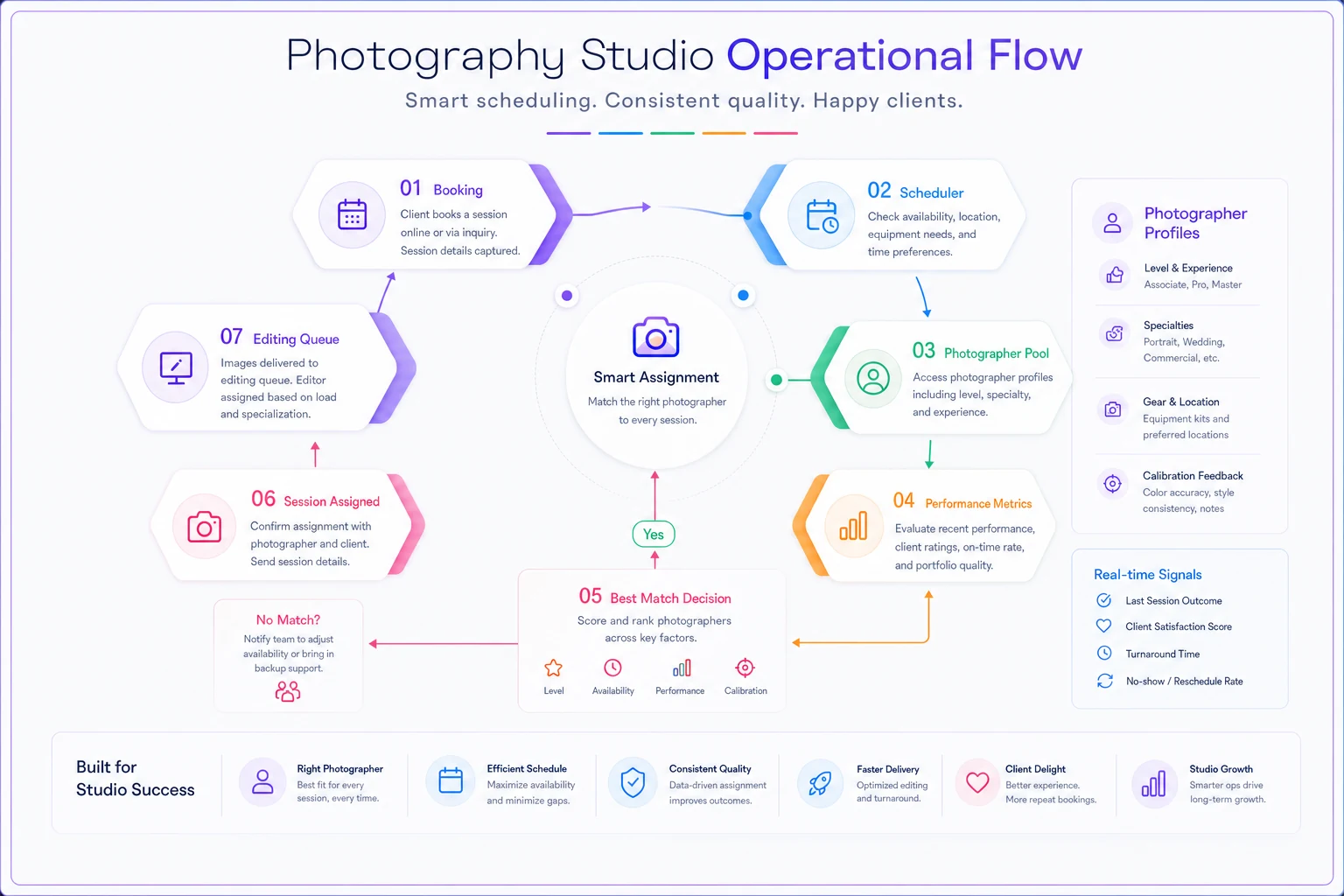
When a photographer's session times start creeping up, you know before it affects bookings. When product sales rates drop, you can step in with targeted coaching instead of waiting for a quarterly review. Compensation calculations happen automatically based on completed work, verified quality checks, and performance benchmarks.
Building tomorrow's studio capacity today
The studios that survive the next five years won't necessarily have the best photographers. They'll have systems solid enough to maintain quality while scaling efficiently.
Start with compensation bands that make sense for your market and margins. Build them around capability, not tenure. Entry-level rates in Nashville might look different than Boston — that's fine. Internal consistency and clear advancement criteria matter more than the specific numbers.
Implement probation periods that actually verify capability. Not everyone who takes beautiful photos can deliver your specific studio experience. Better to find that out early than after they've disappointed dozens of clients.
Run calibration sessions before drift becomes a problem. Monthly reviews feel like overhead until you calculate the cost of reshooting sessions or losing clients over inconsistency. Two hours of monthly calibration prevents far more work downstream.
Build career ladders around measurable performance. Photographers should be able to see exactly what they need to do to advance. When the triggers are clear and achievable, retention improves and quality stabilizes.
The operational software behind all this doesn't need to be complicated. It needs to track the right metrics, automate routine calculations, and flag variations before they become real problems. When a photographer's session times start creeping up, you know before it affects bookings. When product sales rates drop, you can step in with targeted coaching instead of waiting for a quarterly review.
Studios still treating hiring as isolated decisions — grabbing whoever's available, negotiating rates case by case, assuming experience guarantees consistency — are the same ones posting on photography forums wondering why they can't find good people or why their photographers keep leaving.
Build the system once, adjust it as you learn, and let it protect your operation from the chaos that comes with growth. Your future self, drowning in bookings and struggling to hold quality, will appreciate the structure you put in place today.
Ready to elevate your studio’s workflow?
Join 500+ studios using TryPixly to save time, reduce scheduling conflicts, and deliver exceptional client experiences.