


Your biggest wedding package just went out with mismatched skin tones across the bridal party. The retoucher applied magazine-style smoothing to documentary moments. Corporate headshots came back with aggressive teeth whitening that makes executives look like game show hosts.
This isn't about finding better vendors. It's about operational control when you're handing off $12,000 worth of client images to someone you've never met.
The vendor quality spiral starts innocently
You outsource retouching to handle volume. Makes sense financially — paying $2 per image beats $45/hour local rates. The first batch looks decent. You send more work. Standards drift. You complain. They apologize. Quality improves briefly. Then slides again.
Six months later, you're spending 3 hours daily reviewing work, sending revision notes, and apologizing to clients about delays. The margin advantage you expected evaporated into coordination overhead.
Why vendor relationships deteriorate predictably
Offshore retouching failures follow a pattern. You send RAW files with minimal instructions. The retoucher applies their interpretation. You request changes. They adjust based on what they think you meant. Neither side has clear standards.
Never miss a shoot or client detail again.
TryPixly helps you book, confirm, and manage every photography session seamlessly.
- Unified session and client management
- Automated client reminders
- Team calendar & resource scheduling
No credit card required
That vendor is also dealing with 30 other studios. Each wants something different. Your wedding style guide gets mixed with someone else's portrait preferences. Their team rotates. New editors inherit your account without context. Quality becomes random.
Meanwhile, you're juggling shoot schedules, client communications, and business development. Vendor management turns reactive — you only engage when something goes wrong. By then, the damage has already spread across multiple galleries.
Three gates catch disasters before client delivery
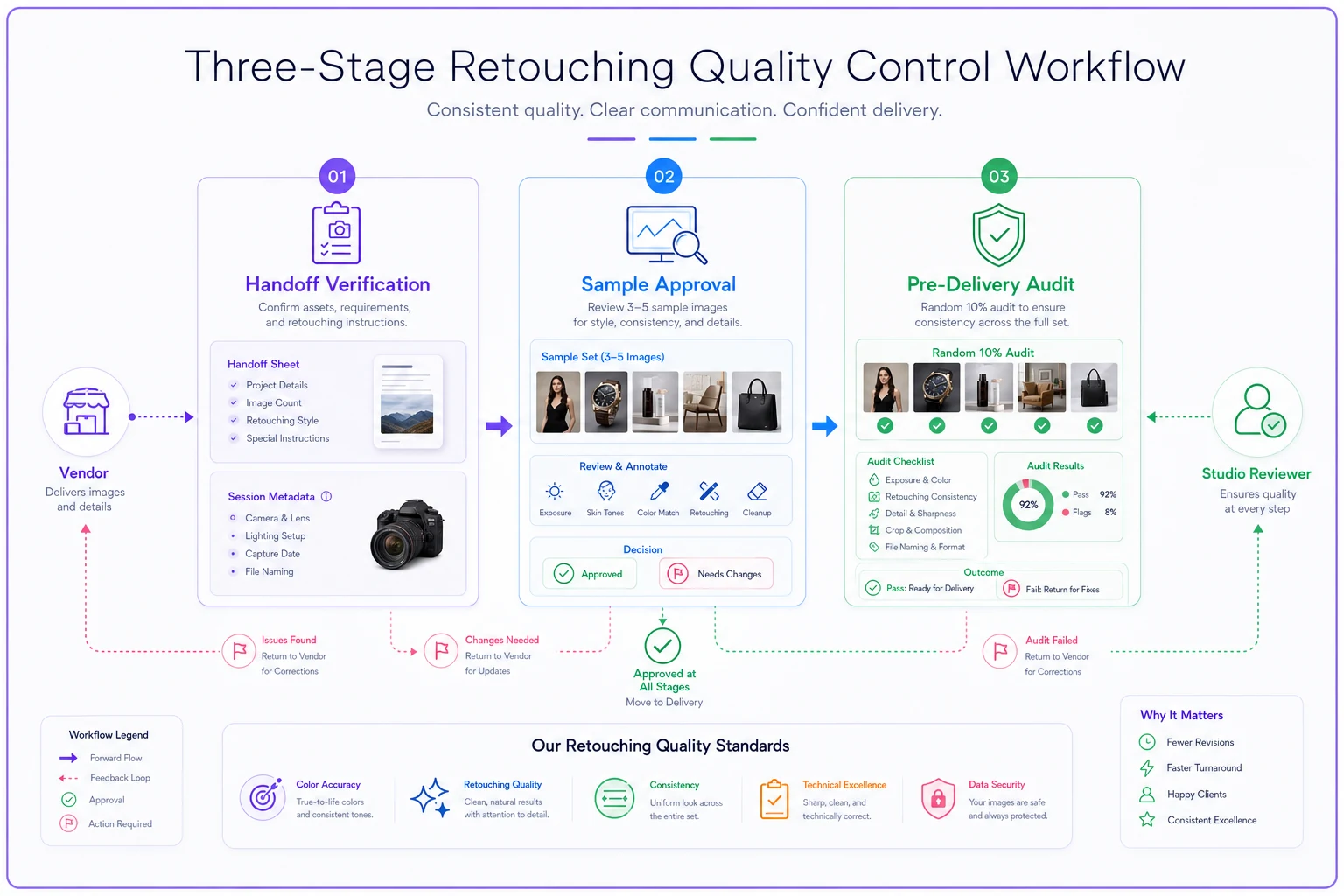
Most studios check retouching after completion. That's too late. Problems compound through the production pipeline. Implement quality gates at handoff, mid-process, and pre-delivery instead.
Gate 1: Handoff verification Before sending files, confirm the batch meets outsourcing criteria. Session type, image count, turnaround window, and special requirements get documented in a handoff sheet. This prevents sending time-sensitive corporate headshots to a vendor who specializes in wedding work.
Gate 2: Sample approval Vendors process 3–5 images first. You review within 4 hours. Approve or correct. They proceed with remaining images using those approved samples as reference. This catches interpretation gaps before they affect 200 photos.
Gate 3: Pre-delivery audit Randomly check 10% of completed images against your style matrix. Compare skin consistency, color grading, cropping ratios. Flag systematic issues for batch correction before packaging galleries.
Studios that implement three-gate review typically reduce client complaints about retouching by roughly 70% while cutting revision rounds from around 2.3 to under 1 per gallery.
The three gates work because they shift quality control from a single final check into a staged process — each gate handles a different failure mode, so problems get caught at the point where they're still cheap to fix.
Visualize the three gates as a simple linear workflow: handoff → sample approval → pre-delivery audit.
Most studios check retouching after completion. That's too late. Problems compound through the production pipeline. Implement quality gates at handoff, mid-process, and pre-delivery instead.
Building your outsourcing retouching SLA framework
Service Level Agreements sound corporate, but they're just documented standards. Your SLA needs five components that actually matter for photography workflows.
Turnaround commitments by session type:
-
Corporate headshots
48 hours
-
Family portraits
72 hours
-
Weddings under 500 images
5 business days
-
Weddings over 500 images
7 business days
-
Events
72 hours
Late penalties apply after grace periods. Not harsh — maybe $25 per day. Enough to maintain urgency without destroying the relationship.
Technical specifications:
-
Export format
JPEG, Adobe RGB, 300dpi
-
Sizing
Long edge 3000px for web, full resolution for print
-
File naming
[SessionID][ImageNumber][Version]
-
Folder structure
/Session/Selects/Edited/
-
Metadata preservation
Camera settings, copyright, keywords
Style consistency markers: Define measurable standards. "Natural skin" means nothing. "Preserve texture visible at 100% zoom" gives them something to actually work from. Document specific Lightroom presets or Photoshop actions as baselines.
Include a 100% zoom reference image to show acceptable texture and retouching depth for each session type.
Revision protocols:
-
First round
Unlimited within style parameters
-
Second round
3 revisions per image
-
Third round
Charged at hourly rate
-
Revision window
48 hours from delivery
Communication standards:
-
Response time
4 business hours
-
Revision turnaround
24 hours
-
Progress updates
Daily for large batches
-
Escalation contact
Direct manager access
Our previous exploration of QA loops showed how structured review processes prevent cascading revisions. The same principle applies here — clear processes beat vague quality discussions every time.
Handoff specifications that eliminate confusion
Vendors fail when they guess. Your handoff package removes ambiguity through standardized components.
Session brief includes:
-
Client type (wedding, corporate, portrait)
-
Shooting conditions (studio, outdoor, mixed lighting)
-
Final usage (web, print, both)
-
Quantity for editing
-
Priority images flagged
Style references show:
-
3 previous edited images from similar sessions
-
Specific adjustment preferences (warm/cool, contrast levels, crop ratios)
-
Do-not-touch elements (documentary moments, candids)
-
Enhancement level by image category
Technical requirements specify:
-
RAW processor settings (if applicable)
-
Color space requirements
-
Output specifications
-
File organization structure
-
Delivery method
Special instructions highlight:
-
VIP subjects requiring extra attention
-
Brand colors for corporate clients
-
Specific retouching requests from clients
-
Cultural considerations
-
Deadline flexibility
A portrait studio in Denver reduced vendor confusion by 85% after switching to standardized handoff templates. Revision requests dropped from 40+ per gallery to under 10.
Vendor scorecards track performance beyond feelings
"They seem okay" isn't operational data. Scorecards quantify vendor reliability across measurable factors.
| Metric | Weight | Measurement | Target |
|---|---|---|---|
| On-time delivery | 30% | % delivered by deadline | >95% |
| First-pass quality | 25% | % images accepted without revision | >80% |
| Technical compliance | 20% | Files meeting specifications | 100% |
| Communication responsiveness | 15% | Average response time | <4 hours |
| Revision turnaround | 10% | Time to complete revisions | <24 hours |
Track monthly. Share scores with vendors quarterly. Poor performers see consequences — reduced volume, extended review periods, or contract termination. Strong performers earn preferential treatment — priority scheduling, volume bonuses, direct client work.
One studio managing 8 offshore retouchers saw quality improvements across all vendors after implementing transparent scorecards. When vendors know they're being measured against each other, standards tend to rise on their own.
Required metadata prevents production nightmares
Missing metadata breaks workflows. Images disconnect from sessions. Clients receive wrong galleries. Copyright information disappears. You need to specify exactly which metadata must survive the retouching process.
Preservation requirements:
-
Original capture date/time
-
Camera/lens information
-
Copyright notice
-
Creator contact
-
Session identifier
-
Image rating/flags
-
Keywords
Addition requirements:
-
Retoucher ID
-
Edit date
-
Version number
-
Color profile confirmation
-
Export specifications
Modification rules:
-
Never alter capture date
-
Preserve original filename in metadata
-
Add retoucher notes in designated field
-
Update copyright year if different from capture
Studios lose roughly 6 hours monthly to metadata-related issues when vendors strip or modify critical information. Getting this right upfront eliminates that overhead entirely.
Calibration sessions align expectations
Your definition of "light retouching" and theirs are probably not the same thing. Calibration sessions build shared understanding through supervised practice rather than lengthy written explanations.
Schedule monthly 30-minute video calls. Screen-share while editing 2–3 images together. Explain decisions. Answer questions. Build intuition about your preferences over time.
Focus calibration on the usual problem areas:
-
Skin retouching depth
-
Color grading preferences
-
Background cleanup standards
-
Cropping decisions
-
Detail enhancement levels
Record sessions for onboarding new vendor team members. Build a library of style decisions. Reference specific examples during revision requests instead of trying to describe things from scratch.
Just as multi-photographer studios need calibration, vendor relationships require ongoing alignment to prevent drift. The written style guide helps, but nothing replaces watching someone edit and telling them in real time where they're off.
Early warning signals before quality collapses
Vendor problems rarely appear suddenly. Watch for deterioration patterns:
Response delays signal capacity issues. If 2-hour responses stretch to 8 hours, they're overwhelmed. Quality follows.
New team member notifications mean inconsistency ahead. When vendors add staff, standards wobble until training solidifies.
Revision patterns reveal systematic issues. Multiple clients flagging similar problems points to process breakdown, not isolated mistakes.
Communication tone shifts suggest relationship strain. Defensive responses or minimal acknowledgments usually predict coming problems.
Pricing pressure can hint at business instability. Vendors requesting sudden rate increases or offering suspiciously steep discounts sometimes signal deeper issues.
A studio in Austin avoided several major disasters by tracking these signals across 5 vendors and addressing issues before they affected client work.
Recovery protocols when vendors fail
Despite all your systems, vendors occasionally implode. Hard drives crash. Teams quit. Companies disappear. Recovery protocols minimize damage when it happens.
Immediate actions:
-
Retrieve all work in progress
-
Document incomplete deliverables
-
Assess deadline impact
-
Activate backup vendor
-
Communicate delays to affected clients
Backup vendor requirements:
-
Pre-vetted quality standards
-
Signed framework agreement
-
Access to style guides
-
Tested communication channels
-
Surge capacity confirmation
Client communication templates:
-
"Production delay" notification
-
Revised timeline commitment
-
Compensation offer (print credit, session discount)
-
Quality assurance promise
Keep backup vendors warm with occasional small projects. Pay slightly higher rates for reliability. When a primary vendor fails, that relationship is what prevents a client disaster.
One wedding studio survived their primary vendor's bankruptcy by activating backup relationships within 4 hours. Every gallery delivered — only about 3 days late.
The technology layer for vendor coordination
Manual vendor management breaks at scale. Email chains fragment. Revisions scatter across platforms. Standards documents get buried or lost.
Operational software centralizes vendor workflows. Upload portals maintain handoff specifications. Automated scorecards track performance. Revision tools capture feedback precisely. Quality gates enforce checkpoint reviews.
AI automation helps most with metadata validation and technical compliance checking — verifying file specifications, flagging missing information, and confirming delivery requirements before vendor payment. This removes hours of manual verification while catching issues immediately rather than days later.
Some platforms now include automation that monitors vendor communication patterns and alerts you to degradation signals before quality problems surface. That kind of proactive visibility turns vendor management from reactive firefighting into something you can actually stay ahead of.
Real vendor transformation
A multi-location portrait studio was handling around 1,200 sessions annually across 4 photographers. Retouching costs ate 22% of revenue through a mix of local editors and offshore vendors. Quality varied wildly. Clients complained. Photographers spent hours writing revision notes.
They implemented structured SLAs with their 3 primary vendors. Created detailed handoff templates. Built scorecards. Scheduled monthly calibrations. Added three-gate quality reviews.
The first month looked messy. Vendors pushed back on requirements. Gates caught numerous issues. Revision rounds actually increased temporarily as standards clarified.
By month three, patterns emerged. One vendor was excellent at weddings but inconsistent with corporate work. Another delivered reliable portrait retouching but missed deadlines regularly. The third maintained steady B+ quality across all categories.
They restructured vendor assignments based on those strengths. The wedding specialist got all wedding work. The reliable vendor handled time-sensitive corporate sessions. The steady generalist managed portrait overflow.
Six months later: revision rates dropped 73%. Client complaints about retouching essentially disappeared. Photographer revision time dropped from 8 hours weekly to about 90 minutes. Overall retouching costs fell 18% through efficiency gains despite keeping the same per-image rates.
The transformation wasn't about finding perfect vendors. It was about building operational infrastructure that made good vendors more consistent and revealed quickly which ones couldn't meet professional standards.
Moving forward with vendor confidence
Outsourcing retouching works when you control the operation. Not through micromanagement, but through systems that create clarity, maintain standards, and catch problems early.
Your SLA document becomes the foundation. Handoff specifications eliminate interpretation gaps. Three-gate reviews catch issues before client impact. Scorecards drive improvement. Calibration maintains alignment over time.
This infrastructure takes roughly 20 hours to build properly. Then maybe 3 hours weekly to maintain. Compare that to the endless revision cycles, client complaints, and margin erosion that come from uncontrolled vendor relationships.
The studios thriving with outsourced retouching aren't lucky. They're not working with secret vendors nobody else has access to. They've built operational systems that turn decent vendors into reliable partners — and reveal quickly which vendors can't actually meet professional standards.
Start with one vendor. Implement the three-gate system. Build your first SLA. Create handoff templates. Track basic scores. Watch quality stabilize while coordination overhead drops. Your clients see beautiful, consistent images delivered on time. You see predictable costs and less management burden. Vendors get clear expectations and fair evaluation. That's how it's supposed to work.
Start with one vendor. Implement the three-gate system. Build your first SLA. Create handoff templates. Track basic scores. Watch quality stabilize while coordination overhead drops. Your clients see beautiful, consistent images delivered on time. You see predictable costs and less management burden. Vendors get clear expectations and fair evaluation. That's how it's supposed to work.
Ready to elevate your studio’s workflow?
Join 500+ studios using TryPixly to save time, reduce scheduling conflicts, and deliver exceptional client experiences.