


Most studios do the hard part well. They book the client, shoot the session, edit the gallery, and then walk into the sales room and let the whole thing fall apart. Not because the images aren't good enough. Because the operation of the reveal — who does what, where product sits, how the POS behaves, what the salesperson actually says — is held together by memory and gut feel.
That's the part almost nobody systematizes. And it's the part that decides whether your average order value is $600 or $1,900 on the exact same session.
This is a walkthrough of how in-studio photography sales operations actually work when they're built as a system — from the moment the client sits down to the moment the order hands off to fulfillment — and where the money leaks at each stage. If you run a studio where the shooter is also the salesperson and they just kind of feel it out, this is for you.
Start with the handoff, not the pitch
The reveal doesn't begin when the client sits in the sales room. It begins the moment the shoot ends. The quality of your in-person sale is mostly set before anyone talks about money.
A typical failure looks like this. The photographer shoots a beautiful newborn session, uploads the images, and someone — often whoever's free — assembles a gallery three days later with no notes about what the client said during the shoot. Mom mentioned twice that she wanted something for the grandparents. She pointed at the big frame on the wall. She said the nursery is gray and white. None of that made it out of the shooting room.
Then a salesperson who wasn't there tries to sell her a package cold. They're guessing. They pitch albums when she wanted wall art. The order comes in at the floor price and everyone shrugs.
The fix isn't a better closer. It's a shoot-to-sales handoff that treats client intent as an asset you capture, not something that evaporates. At minimum, the photographer should log:
-
What the client reacted to emotionally during the session
-
Any room, wall, or gift they mentioned out loud
-
Existing product in their home (framed prints? nothing on the walls?)
-
Who wasn't there but matters (grandparents, spouse, the "I need to check with him" person)
Studios that pass this information forward have reveal conversations that feel personal instead of transactional. It's not magic — it's just the salesperson finally having the same context the photographer walked away with.
Role responsibilities: stop making one person do three jobs
The most common structural problem in small studios is role collapse. One person shoots, edits, sells, and processes the order. At two sessions a week that works fine. At twelve it quietly caps your revenue, because the person best at connecting with clients is stuck exporting files at 11pm and has nothing left for the sales room.
Never miss a shoot or client detail again.
TryPixly helps you book, confirm, and manage every photography session seamlessly.
- Unified session and client management
- Automated client reminders
- Team calendar & resource scheduling
No credit card required
| Role | Owns | Where it breaks if unassigned |
|---|---|---|
| Shoot lead | Capturing client intent, emotional notes | Salesperson walks in blind |
| Gallery curator | Culling to a sellable set, ordering images to build a story | 400 images dumped on client → decision paralysis, low order |
| Sales lead | Running the reveal, guiding to product, closing | Prices quoted defensively, discounts given to end awkwardness |
| Order/POS operator | Building the order accurately, taking payment | Wrong sizes, missed upsells, math errors on multi-item orders |
| Fulfillment handoff | Verifying specs before production | Reprints, missed deadlines, margin eaten by remakes |
The gallery curator role gets underrated constantly. Showing a client every usable frame feels generous. In practice it tanks the sale. A client shown 24 curated images in a deliberate sequence buys more confidently than a client shown 90 and told "pick your favorites." Decision fatigue is a real margin killer, and it's one of the quieter ones.
Once you name these roles — even if the same two people rotate through them — accountability appears. When "who curated this gallery" has a real answer, quality stops being random.
Product placement: the room sells before you do
If your sales space is a laptop on a folding table, your highest-margin products are invisible. Nobody buys a 30-inch wall canvas they've never seen at scale. They buy the 8x10 because it's the thing they can actually picture.
Physical product on display is the cheapest AOV lever there is, and it's mostly a one-time setup cost. The principle: the client should see the thing you most want to sell, at the size you most want to sell it, before you talk price.
Placements that actually move orders:
-
A large framed wall piece (24x36 or bigger) hung at eye level where the client sits. This anchors the idea that wall art is normal here.
-
A sample album they can hold. Albums sell by weight and feel, not JPEG previews on a screen.
-
A small grouping (a gallery wall of three) so clients see multi-piece sets as a category, not a single purchase.
-
Price-anchored samples
your premium product visible first, so the mid-tier reads as reasonable.
One family studio added a single 30x40 framed sample above the reveal couch — one product, hung once — and started selling large wall pieces in roughly a third of sessions where they'd previously sold almost none. The cost was one frame and a nail. The image was already theirs.
Screen presentation matters too, but as a supplement. Projecting the gallery large, in room context — dropping the image onto a photo of a living room wall — does more than a small laptop preview ever will. The goal is always the same: make the expensive thing imaginable.
POS integration: where AOV quietly dies
This is the least glamorous section and probably the one costing you the most.
In a lot of studios the sale happens in one place (a conversation, maybe a spreadsheet or a written order form), payment happens in another (a separate card terminal or a Square account), and the actual order — sizes, finishes, quantities — lives in a third (someone's notebook or memory). Three disconnected steps. Every gap between them is a place where money and accuracy leak.
What breaks at scale:
-
Manual order building means math errors and forgotten upsells. When the client says yes to the album and the wall piece and the gift prints, someone has to remember all three and price them correctly on the spot.
-
Separate payment tools make it easy to close a deal but slow to collect. Deals "close" and then payment gets chased for a week.
-
No connection to fulfillment means the order gets re-typed later, which is where the wrong size gets ordered.
Pre-build your common package combos and add-on presets in the POS so the sales lead can add them with one tap during the reveal.
A properly integrated point of sale should let the sales lead build the order live in front of the client, apply package logic automatically, take payment in the same flow, and pass confirmed specs straight to fulfillment without re-entry. This is where AI-assisted operational platforms quietly earn their keep — not by "selling" anything, but by removing manual re-entry between sale and production, flagging when an order is missing a common add-on, and keeping package math correct so nobody has to calculate it under pressure with a client watching.
The point isn't automation for its own sake. A smooth, confident order-building moment raises the order itself. Clients add more when the process feels effortless and the numbers appear cleanly. Fumbling with a calculator and a card reader signals "this is hard," and hard purchases shrink.
For the tie between what you're selling and what it actually costs you to deliver, it's worth mapping your package structure against real per-item margins — the logic in this profitability system applies directly to how you price the add-ons you're pushing in the sales room.
Training scripts: sell the outcome, not the file
Untrained sales conversations default to two bad habits: apologizing for price, and describing files instead of outcomes. "So this is the 8x10, that's $95, um, or we have a package that's a little more..." — that's a salesperson talking their client down.
Scripts aren't about turning your team into robots. They're about removing the moments where people freeze, over-explain, or discount out of discomfort. A good script gives someone a confident default for the situations that repeat every single session. The scripts worth writing down:
-
The opening reframe. Before showing images, set the frame
"We're going to look at everything, and then I'll help you figure out what to actually do with these." This tells the client there's a guided process, and it positions the salesperson as an advisor, not a vendor.
-
The wall-art walk-up. When a client loves an image
"That one's a wall piece. Where would it go in your home?" Move them from liking a photo to placing a product. Placement talk sells size.
-
The package pivot. When a client picks individual items that total near a package: "You're actually right at our collection — for a little more you get all of this plus [the album/the extra]." Never make the client do this math themselves.
-
The price-hold. When someone hesitates
silence, then "Take your time — which of these feels like the one you'd regret not having?" Discounting to fill silence is the fastest way to give away margin. The script's real job here is to stop the salesperson from talking.
-
The gift close. "Grandparents are going to want these too — want me to add a gift set?" This is the easiest add-on in the business and the most consistently forgotten.
The mistake most owners make with scripts is writing them once and never revisiting. Scripts should be reviewed against actual outcomes — which lines correlate with higher orders, where people are still discounting. A script is a living operational document, not a laminated card that yellows in a drawer.
Fulfillment handoff: the sale isn't done when they pay
An order that's sold high and fulfilled wrong doesn't protect margin — it destroys it. Reprints, wrong finishes, missed deadlines, and the apology discounts that follow can turn your best sale of the month into a break-even headache.
The handoff between the sales room and production is a defined checkpoint, not an assumption. Before anything goes to print or to a lab, someone should verify:
-
Every item's exact size, finish, and quantity matches what the client agreed to
-
Image files selected match the order line items (the number one source of remakes)
-
Cropping and orientation are correct for the product (a horizontal image forced into a vertical frame = remake)
-
Delivery timeline is set and communicated
-
Payment is fully collected before production starts on custom items
This is where the whole system either pays off or unravels. You can nail every prior stage and still lose the margin at the lab. The mechanics of getting print, album, and packaging fulfillment right without eating remakes are worth studying on their own — this breakdown of fulfillment operations covers the failure points that specifically show up after the sale closes.
When a scripted, staged sales operation is worth it — and when it isn't
Not every studio should build this out fully.
When it makes sense: you're doing enough volume that in-person sales revenue meaningfully affects your income (roughly a dozen-plus sessions a month), your average order feels lower than your image quality deserves, or you're adding staff and can no longer rely on one talented person's instincts. This is also the right move if you're selling physical product — albums, wall art — because those categories respond most to placement, scripting, and confident order-building.
When it's a bad idea: if you're an all-digital, gallery-download studio with flat pricing, most of this is overhead you don't need. If you do two sessions a month as a side business, formalizing roles and scripts is premature.
Who should not do this: studios where the "sales problem" is actually a product or pricing problem in disguise. If your images or your package structure are the real issue, no script fixes that. Sort the offer first.
A short real scenario
A two-person portrait studio — mostly families and seniors — was running around 14–16 sessions a month with an average order somewhere near $550. Solid bookings, flat sales. Everything ran through the lead photographer, who shot, edited, and sold, usually presenting galleries of 60–80 images on a laptop with no physical samples in the room.
They changed three things, not ten. They cut galleries down to a curated 20-something images shown in a deliberate sequence. They hung two product samples in the reveal space — one large framed piece, one album on the table. And they moved order-building into an integrated point of sale so the second team member could build and take payment live while the photographer stayed focused on the client.
Over the following few months, average order moved into the $850–$950 range on similar sessions. No price increase, roughly the same client base. The lift came almost entirely from clients seeing larger product and from a smoother, more guided order moment — not from selling harder.
That's the whole thesis. In-person sales gains rarely come from a better pitch. They come from a better operation.
Pulling it together
The sales room is the most concentrated margin opportunity in a studio and the least systematized part of most operations. When you treat it as a connected workflow — intent captured at the shoot, galleries curated deliberately, product staged physically, orders built cleanly in an integrated system, scripts that keep people confident, and a fulfillment handoff that protects the sale you just made — the AOV lift shows up on its own.
Each stage feeds the next, and a weak link anywhere pulls the whole number down. Fix the handoffs, stage the room, name the roles, and let the process do the selling your team is currently doing on instinct and adrenaline. The images are already good. Give them an operation worthy of the price they deserve.
Here's a simple workflow to picture:
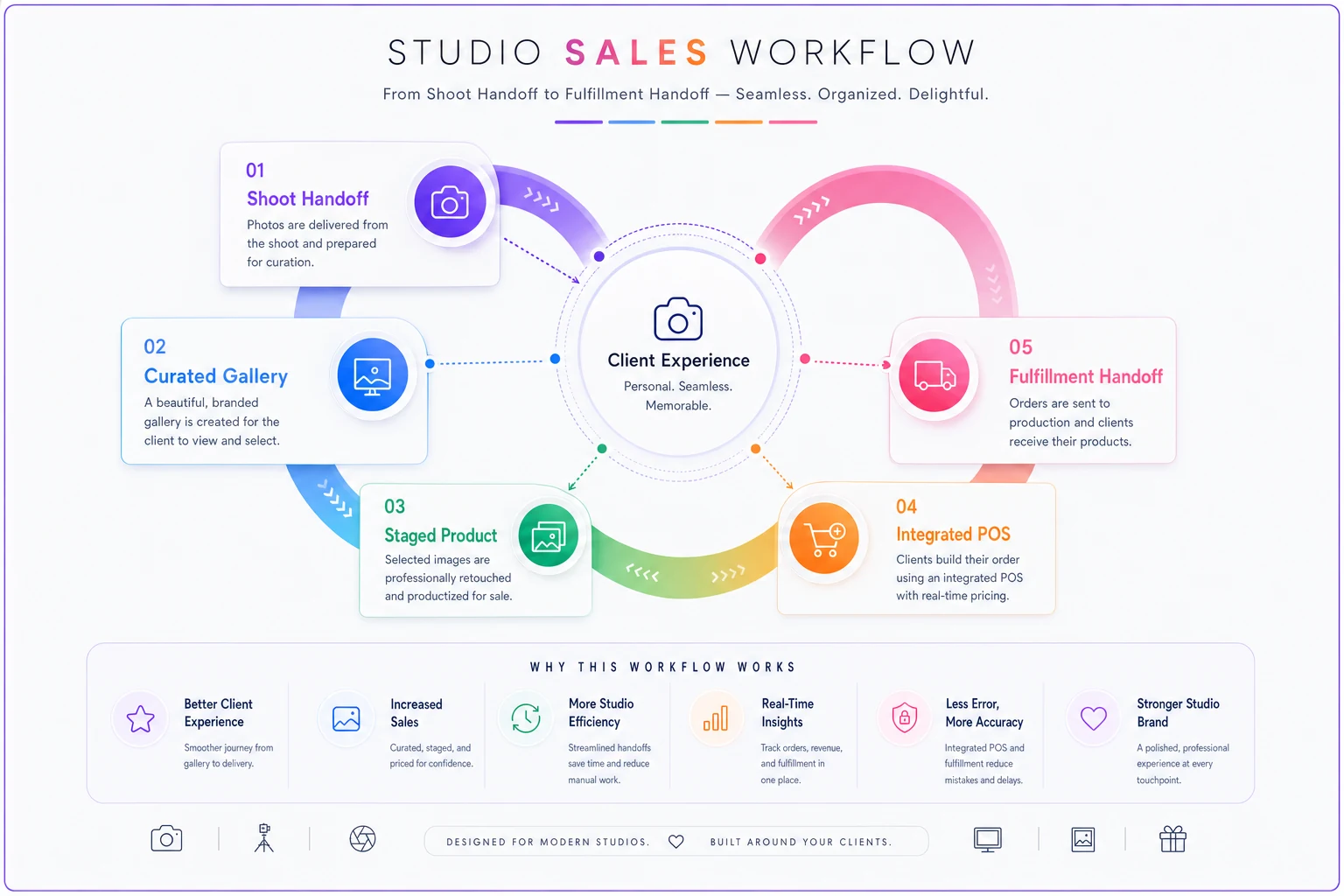
Each stage feeds the next, and a weak link anywhere pulls the whole number down. Fix the handoffs, stage the room, name the roles, and let the process do the selling your team is currently doing on instinct and adrenaline. The images are already good. Give them an operation worthy of the price they deserve.
Each stage feeds the next, and a weak link anywhere pulls the whole number down. Fix the handoffs, stage the room, name the roles, and let the process do the selling your team is currently doing on instinct and adrenaline. The images are already good. Give them an operation worthy of the price they deserve.
Ready to elevate your studio’s workflow?
Join 500+ studios using TryPixly to save time, reduce scheduling conflicts, and deliver exceptional client experiences.