



There's a specific kind of failure that only shows up once a studio starts charging real money. The website looks polished, the packages read beautifully, and the "Signature" or "Platinum" tier promises a hand-crafted, white-glove experience. Then a client actually buys it — and delivery falls apart in ways nobody planned for. The retoucher didn't know this was a priority job. The editor wasn't told the turnaround was 10 days, not 21. Nobody flagged that the print vendor needed two extra weeks for the premium album stock.
The gap here isn't talent. Most studios that overpromise premium can absolutely shoot and edit at a premium level. What breaks is the connection between what the sales page says and what the operation is actually built to do. Premium photography service operations live or die on that alignment. And the bigger the studio gets, the wider that gap tends to grow — because more people are touching each job and fewer of them can see the whole picture.
This is a systems problem. You can't fix it by telling your team to "care more" or by adding a rush charge. You fix it by mapping every tier to the staffing, turnaround, revision rules, and handoffs that make the promise physically possible — and then refusing to sell promises the operation can't keep.
Why premium promises drift away from operational reality
Most studios build their tiers backwards. They start with what sounds impressive or what a competitor offers, price it, and put it live. The operational questions — who does this, how fast, how many revisions, what happens at handoff — get answered later, one panicked job at a time.
That works fine at low volume. When you're doing eight or ten sessions a month and the owner personally touches everything, the "system" is just the owner's memory. The premium client gets premium treatment because the owner is emotionally invested and physically present.
The drift starts when volume climbs and the owner stops being the bottleneck for every decision. A typical example: a studio grows from around 12 sessions a month to 40, hires two associate shooters and an outsourced retoucher, and suddenly the premium tier is being fulfilled by people who never saw the sales conversation. They don't know this client was promised a same-week sneak peek. They don't know the album was sold as "fully custom design with unlimited layout revisions." They're just working the queue.
So the premium job gets treated like every other job — because operationally, it is every other job. Nothing in the workflow tells the team otherwise. That's the core failure: the tier exists on the pricing page but not in the operation.
A few patterns show up almost every time:
-
The premium tier has faster promised turnaround but sits in the same production queue as standard jobs
-
Revision allowances are vague ("we'll make it perfect") so scope creep is guaranteed
-
Nobody owns the handoff between shoot, edit, retouch, and delivery — so things stall in the gaps
-
Marketing keeps adding perks to the top tier without checking whether ops can absorb them
That's the core failure: the tier exists on the pricing page but not in the operation.
What actually breaks at scale
Small studios fail at premium delivery occasionally and quietly. Growing studios fail at it systematically, and the failures compound.
Never miss a shoot or client detail again.
TryPixly helps you book, confirm, and manage every photography session seamlessly.
- Unified session and client management
- Automated client reminders
- Team calendar & resource scheduling
No credit card required
The mechanism is straightforward. When you add tiers without mapping them to capacity, every tier competes for the same finite production hours. Your retoucher has, realistically, maybe 25–30 hours of high-focus editing in them per week. If your premium tier promises deep retouching and you sell four premium jobs in a week that each need six hours, that's your entire retouching capacity gone — and you still have twenty standard galleries waiting.
Now the standard jobs slip. To recover, someone rushes the premium work. Quality drops on the exact jobs where quality was the whole point. The client who paid the most gets the most disappointing result, leaves the worst review, and doesn't refer anyone. Meanwhile the standard clients are also late. One overloaded week quietly damages both ends of your book.
This is why tiering without an SLA matrix is dangerous. An SLA isn't a customer-facing marketing line — it's an internal contract that says: this tier consumes this much capacity, moves through this lane, and gets delivered in this window. Without it, you're not running tiers. You're running a single chaotic queue with different price tags stapled on.
At scale, three specific things break:
-
Turnaround becomes a lie. Promised windows are set by sales optimism, not production math. The premium 7-day gallery ships in 16 because it never had a protected lane.
-
Revisions become unbounded. "Unlimited revisions" on a premium tier sounds generous until one client cycles through nine rounds and eats a full day of an editor's time that three other clients were waiting on.
-
Handoffs become where jobs die. Every point where work changes hands — shooter to editor, editor to retoucher, retoucher to delivery, delivery to the client's sales session — is a place where context gets lost and jobs stall.
At scale, those breakages compound and damage both client relationships and your team's morale.
Mapping tiers to staffing: the piece everyone skips
The fix starts with an honest map of who does what for each tier, and how much of your finite capacity each tier is allowed to consume. This is uncomfortable because it forces you to admit your premium tier costs more to deliver than you were accounting for.
A tier-to-staffing map answers, per tier:
-
Who shoots it (senior lead only, or any associate?)
-
Who edits it, and to what standard
-
Who does retouching, and how many hours are budgeted
-
Who owns the client relationship through delivery
-
What the total production-hour cost is
Here's a simplified version of what that map looks like across three tiers:
| Element | Standard | Premium | Signature |
|---|---|---|---|
| Shooter | Any associate | Senior associate | Lead / owner only |
| Editing standard | Batch, template | Custom color, hand-selected | Full custom, individually graded |
| Retouching budget | 0–1 hr | 4–6 hrs | 10+ hrs, priority lane |
| Revision rounds | 1 | 2 | 3, then billed |
| Promised turnaround | 3–4 weeks | 10–14 days | 7 days sneak peek, 14 full |
| Dedicated owner? | No | Yes (coordinator) | Yes (lead + coordinator) |
| Est. production hours | ~3 hrs | ~9 hrs | ~18 hrs |
The number that matters most in that table is the bottom row. Once you know a Signature job eats roughly 18 production hours and a standard job eats 3, you can finally answer the question that keeps studios out of trouble: how many premium jobs can we actually sell per month before the operation cracks?
Most studios have never calculated this. They sell whatever comes in, then wonder why the busy months feel like a slow-motion crash. If you tie your tier mix to real capacity, you can protect delivery on the jobs that matter most. If you're thinking about smoothing that capacity across the year, the way membership and recurring work fills the quiet lanes ties directly into this same math — worth reading how to turn idle capacity into recurring revenue alongside your premium planning.
Building the SLA matrix so turnaround stops being a guess
An SLA matrix is where you convert the staffing map into promises you can actually keep. The key move is separating customer-facing turnaround from internal turnaround, and building buffer between them.
If your premium tier promises delivery in 14 days, your internal target should be 10–11. That buffer absorbs the sick day, the reshoot, the client who takes four days to answer a selection email. Studios that set internal deadlines equal to customer deadlines are late constantly, because they've left no room for the normal friction of real production.
The matrix should define, for each tier:
-
The clock start. When does the countdown begin? Shoot date? Gallery-ready date? Client selection date? Ambiguity here is where disputes come from.
-
Each stage's internal deadline. Edit by day X, retouch by day Y, QC by day Z, deliver by day W.
-
The escalation trigger. What happens when a stage misses its internal deadline? Who gets notified, and what gets bumped?
-
The stop-clock conditions. When the client owes you something — selections, approvals, address — the SLA clock should pause. Otherwise you eat delays that aren't yours.
That last one saves more premium relationships than almost anything else. A huge share of "you were late" complaints trace back to time the client actually caused. If your SLA formally pauses when you're waiting on the client — and your workflow tracks that — you protect both the deadline and the relationship.
Revision allowances: the quiet margin killer
Vague revision language on a premium tier is one of the most reliable ways to destroy the profitability of your best-paying work. "Unlimited revisions until you're thrilled" reads like premium generosity. Operationally, it's an open door for a small number of clients to consume an enormous amount of your most skilled labor.
The pattern is predictable. Roughly 80% of premium clients approve within one or two rounds. A handful cycle endlessly — round three becomes round six becomes "can we try it the original way again." Each round pulls your best editor off other work. On a tier where you budgeted six retouching hours, three of those clients in a quarter can blow your entire margin on that tier.
The fix isn't stingy. It's clear:
-
Define a hard number of revision rounds per tier
-
Define what counts as a "round" (a consolidated set of changes, not a trickle of individual emails)
-
Define what happens after the cap — hourly billing, a flat additional-round fee, or a scheduled paid revision session
-
Put the client's remaining rounds in front of them so they self-regulate
Put the client's remaining rounds in front of them so they self-regulate
The moment clients can see "you have one revision round remaining," their behavior changes. They batch their notes. They stop nitpicking. A structured approval loop that reduces rework is its own discipline, and it's worth pairing this tier mapping with the mechanics of how to cut revision rounds and protect margins so your premium tier stays premium and profitable.
The handoffs: where premium jobs actually die
Even with a solid staffing map and SLA matrix, jobs still fail at the seams. Every handoff is a place where context leaks out and momentum stalls.
Walk through the lifecycle of a premium job and count the handoffs: Sales sells the tier → coordinator books and briefs → shooter captures → files transfer to editor → editor culls and grades → retoucher does detailed work → QC reviews → coordinator preps delivery → sales session or gallery release → album/print handoff to vendor → final delivery.
That's ten-plus handoffs. At each one, three things can go wrong: the work doesn't move, the context doesn't move with it, or nobody notices it stopped moving. The premium promise — "we told them same-week sneak peek" — only survives if it travels through every one of those handoffs as an explicit instruction, not as something the owner is hoping someone remembers.
A workable handoff system needs three things at every seam:
-
A trigger — a clear signal that stage A is done and stage B should start
-
A carried brief — the tier, the promises, the deadline, and any special notes travel with the job
-
A watcher — someone or something notices when a job has been sitting too long
This is the layer where the right operational software earns its place — not by doing the creative work, but by making the invisible visible. When your tier rules, SLA clocks, revision caps, and handoff triggers live in one platform instead of in six people's heads, the system can flag the premium job that's been idle for three days, or the revision count that's about to blow past its cap, before it becomes a client problem. AI-assisted operational tools are genuinely useful here — quietly monitoring the gaps between stages and surfacing the job that's about to break its promise. The point isn't automation for its own sake. It's that a growing studio can't rely on the owner's memory to run ten handoffs across forty jobs a month.
Here's a simple visual to map the handoff workflow and show where triggers, carried briefs, and watchers should sit.
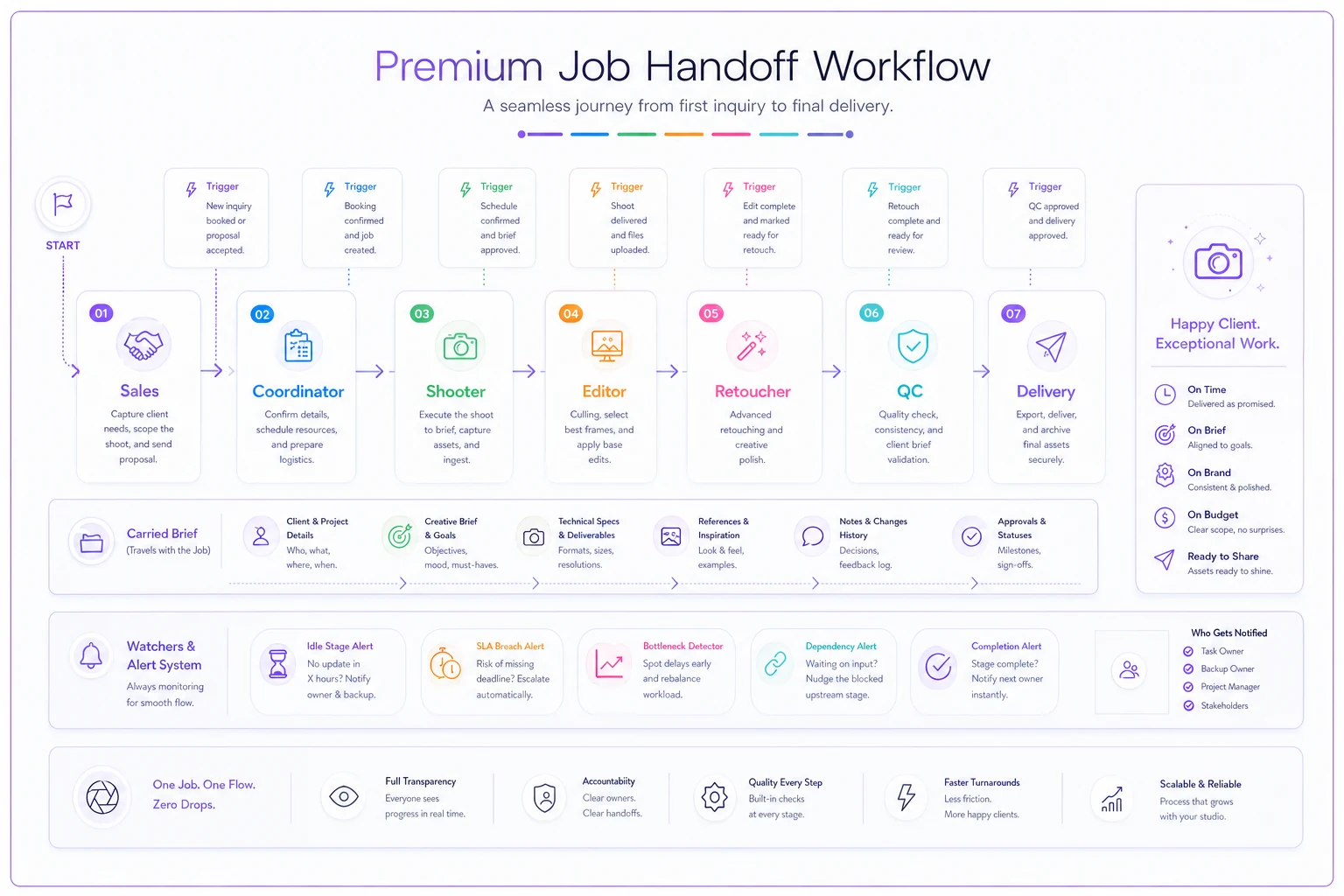
When your tier rules and those handoff triggers live in one place, the system surfaces the premium job that's about to miss its promise before a client calls.
Marketing handoffs: stop selling perks ops can't absorb
The most overlooked failure point is between marketing and operations. Marketing's job is to make the top tier irresistible. Ops's job is to deliver it. When those two functions don't talk, marketing keeps sweetening the premium tier — "now with a same-day sneak peek!" "now with a private viewing session!" — and ops finds out when the first client expects it.
Every customer-facing promise needs an operational owner before it goes live. The rule is simple and rarely followed: no perk goes on the pricing page until someone in operations confirms the studio can deliver it at expected volume. A "48-hour sneak peek" sounds like a marketing win. At three premium bookings a week, it might mean your editor has to touch every premium job within two days of the shoot, on top of everything else. That's an operational commitment, not a tagline.
Build a standing checklist for any new tier perk or premium promise:
-
Which staff role delivers this?
-
How many production hours does it add per job?
-
At our expected premium volume, do we have that capacity?
-
Does it change the SLA clock or revision rules?
-
What's the escalation plan when we can't deliver it?
-
Who signs off before it goes live?
If a proposed perk can't clear that checklist, it doesn't go on the page. That single discipline prevents most premium overpromising, because it forces the marketing promise and the operational reality to meet before a client is caught in the gap.
A real scenario: portrait studio, premium tier that kept slipping
A family and portrait studio doing roughly 45 sessions a month had launched a premium "Heirloom" tier at nearly triple their standard price. The tier promised a 10-day gallery, custom retouching, and a wall-art design consult. On paper it was their best margin. In practice, Heirloom galleries were shipping in 18–22 days, and two of their last five premium clients had left lukewarm reviews specifically about the wait.
The problem wasn't skill. It was that Heirloom jobs sat in the same production queue as standard sessions and got no priority. The outsourced retoucher had no idea which jobs were premium. And "custom retouching" had no hour cap, so one Heirloom client had cycled through five revision rounds while three others waited.
They rebuilt it around the pieces above: a protected production lane for Heirloom, an SLA matrix with a 10-day customer promise against an 8-day internal target, a hard cap of three revision rounds with the count shown to clients, and a tagged handoff so every stage knew a job was premium. They also cut one perk marketing had added — a same-week teaser — because the capacity math didn't support it at their volume.
Over the next couple of months, Heirloom turnaround settled into the 9–11 day range consistently. The revision spiral basically stopped once clients could see their remaining rounds. Premium review sentiment recovered, and — maybe most tellingly — the owner stopped getting pulled into every premium job to personally rescue the deadline. The tier finally ran as a system instead of as a series of emergencies.
When strict tiering makes sense — and when it doesn't
This whole approach assumes you have enough volume and enough people that the owner can't personally hold everything together. If you're doing eight sessions a month and you touch every job yourself, a heavy SLA matrix is overkill. Your memory is the system, and formalizing it too early just adds friction.
Strict tier mapping starts paying off when you move into multi-photographer, multi-tier territory — usually somewhere around 25–40+ jobs a month across different price points, with other people fulfilling the premium work. That's when the gaps between departments become invisible to you and start swallowing jobs.
Where this goes wrong is when studios over-engineer it. If you build a twelve-tier matrix with fifteen SLA stages for a two-person operation, you'll spend more time maintaining the system than doing the work. Start with three tiers, one honest capacity number per tier, and a hard revision cap. Add complexity only when a real failure forces it. The goal isn't a beautiful org chart — it's making sure the client who paid you the most gets exactly what the pricing page promised, every single time, without you having to personally save the job.
The real takeaway
Overpromising premium isn't a marketing mistake or a talent problem. It's a mapping problem. The pricing page describes an experience the operation was never structured to deliver, and the gap between those two things is where your best clients get let down.
Close it by making the invisible visible: map each tier to real staffing and real production hours, build an SLA matrix with internal buffers and stop-clock rules, cap revisions clearly, own every handoff, and never let marketing promise something operations hasn't confirmed it can absorb. Do that, and premium stops being a risk you're quietly hoping to survive — and becomes the part of your studio that actually runs the smoothest.
Ready to elevate your studio’s workflow?
Join 500+ studios using TryPixly to save time, reduce scheduling conflicts, and deliver exceptional client experiences.