



Most photography studios approach membership programs backwards. They spend time designing attractive tiers and pricing, then scramble when capacity constraints hit or benefits start eating into margins. The studios that actually make memberships work treat them like operational systems first, revenue streams second.
Photography studio membership operations require a completely different mindset than traditional session bookings. You're managing guaranteed capacity allocation, tracking benefit consumption rates, watching for early churn signals, and forecasting renewal revenue — all while making sure your core business doesn't take a hit.
Why membership math breaks differently than session pricing
Traditional session pricing follows simple logic: cost plus margin equals price. Membership economics run on utilization assumptions that rarely match reality.
A studio offering 4 sessions per year at $400 each might price an annual membership at $1,200, banking on a 25% discount driving volume. But actual member behavior creates operational chaos. Some members book all four sessions in Q4 for holiday cards. Others spread them out perfectly. Some forget they have sessions remaining until month 11.
The real challenge isn't the pricing discount — it's capacity allocation. When 30% of your members try booking October slots for holiday photos, your non-member clients get pushed out. Those one-time holiday mini sessions at $275 suddenly look more profitable than member sessions valued at $300 on paper but consuming prime calendar real estate.
Member benefit delivery makes this worse. Free 8x10 prints sound minor until 40 members each want three different images printed monthly. Your print fulfillment workload just jumped by 120 orders per month, but membership revenue stays flat. One studio I'm aware of learned this the hard way — their "unlimited digital downloads" benefit turned into members demanding every single shot from their sessions, test shots and duplicates included.
Capacity gating rules that protect both members and your studio
Effective capacity gating starts with calculating true studio capacity, not theoretical maximums. Your studio might technically handle 8 sessions daily, but sustainable capacity sits around 5-6 when you account for post-production, client communications, and seasonal swings.
Never miss a shoot or client detail again.
TryPixly helps you book, confirm, and manage every photography session seamlessly.
- Unified session and client management
- Automated client reminders
- Team calendar & resource scheduling
No credit card required
A functional gating framework:
-
Premium tier
60-day advance booking
-
Standard tier
30-day advance booking
-
Basic tier
14-day advance booking
-
Non-members
7-day advance booking
This staggered approach keeps members prioritized without completely cutting off non-member revenue. The piece most studios miss is the override rule: never allocate more than 40% of any given week's capacity to member bookings until the 14-day mark. This stops members from clustering during peak periods.
Some studios go with percentage-based allocation — "members get 50% of all slots." This falls apart during seasonal rushes. Better to use dynamic allocation based on historical patterns. If October typically books at 95% capacity with non-members, pull member allocation back to 30%. If February runs at 60%, push member allocation up to 70%.
Automate hard stops in your booking system so staff can't manually override allocation limits and accidentally overbook prime slots.
Enforcement matters just as much as the rules themselves. Manual tracking in spreadsheets leads to double-bookings and arguments. Your booking system needs hard stops that prevent exceeding allocation limits — not just warnings staff can click past.
Monitoring benefit consumption before it destroys margins
Member benefits fall into three categories: capacity benefits (sessions), product benefits (prints/albums), and service benefits (priority scheduling, exclusive sets). Each needs a different monitoring approach.
For capacity benefits, track utilization percentage monthly. Members averaging 62% utilization of included sessions is generally healthy. Below 40% signals a value perception problem. Above 80% means you're probably losing money on fulfillment.
Product benefit tracking needs tighter controls. A studio offering "one free 8x10 per month" discovered members were selecting their most complex edits for free prints, quietly driving up retouching time. They switched to "one free 8x10 from a pre-selected gallery" and saw product benefit costs drop by around 35%.
-
Any member using 100% of benefits within 60% of their membership period
-
Product benefit redemption exceeding 120% of projected cost
-
Multiple members requesting benefit substitutions or exceptions
The data tells you when to adjust. One studio noticed members consistently asking to swap print credits for digital files. Rather than handling each case individually, they created a formal swap rate: 3 print credits = 1 high-resolution digital file. That standardization eliminated negotiation time and kept margins intact.
Early warning signals for member churn
Churn indicators in photography studio memberships show up months before actual cancellation. The obvious ones — complaints, late payments, non-usage — everyone tracks. The studios running profitable programs watch behavioral shifts.
First warning: booking pattern changes. A member who booked quarterly sessions suddenly skips two. Or someone who always grabbed weekend slots starts only accepting weekdays. These shifts suggest declining engagement or life changes that tend to precede cancellation.
Second warning: benefit redemption delays. Members who immediately redeemed their monthly print credits then suddenly let 3-4 months stack up are mentally checked out. They're holding onto the membership out of habit, not because they're getting value.
Third warning: communication patterns. Members who actively engaged with your seasonal emails but haven't opened the last four are drifting. Same with social media — when they stop engaging with your studio's posts, the relationship is cooling off.
-
No booking in 60 days
+2 points
-
Unused benefits exceeding 2 months
+2 points
-
Email engagement below 20%
+1 point
-
Late payment
+3 points
-
Service complaint
+2 points
Members hitting 5 points trigger proactive outreach. Not sales outreach — service outreach. "Haven't seen you in a while, wanted to check if you need help booking your next session." That kind of personal touch recovers roughly 30% of at-risk members.
Revenue forecasting that accounts for renewal uncertainty
Most businesses forecast subscription revenue using simple retention rate multiplication. Photography studio memberships don't follow predictable patterns because renewal decisions tie to life events and seasonal needs.
Instead of projecting 80% retention across all members, segment by behavior:
High-certainty renewals (90% probability):
-
Used 75%+ of benefits
-
Consistent booking patterns
-
Engaged with studio communications
-
Made additional purchases beyond membership
Medium-certainty renewals (60% probability):
-
Used 50-74% of benefits
-
Irregular booking patterns
-
Minimal communication engagement
-
No additional purchases
Low-certainty renewals (30% probability):
-
Used under 50% of benefits
-
No bookings in last quarter
-
No communication engagement
-
Payment issues or complaints
For established programs, this typically breaks down to roughly 40% high-certainty, 45% medium-certainty, and 15% low-certainty. New programs skew toward more uncertainty until behavioral patterns settle in.
Factor in renewal timing gaps too. Even members who renew don't always do it immediately — about 20% let memberships lapse for a month or two before rejoining, creating cash flow gaps. Build a "renewal delay buffer" into your forecasts and assume around 15% of expected renewal revenue arrives 30-60 days late.
Sample tier structures that actually work operationally
Most tier structures fail because they're designed for marketing appeal rather than operational efficiency. A three-tier structure that balances both:
| Tier | Monthly Price | Sessions/Year | Print Credits | Booking Window | Capacity Allocation |
|---|---|---|---|---|---|
| Essential | $79 | 4 | 2/month | 14 days | 20% max |
| Professional | $149 | 8 | 5/month | 30 days | 30% max |
| Executive | $299 | 12 | 10/month | 60 days | 40% max |
The key detail: capacity allocation limits by tier. This stops your highest tier from consuming all prime slots while still making them feel prioritized.
Notice the session quantities — 4, 8, 12. They divide evenly into quarters, which makes benefit tracking cleaner. Odd numbers like 5 or 7 sessions create confusion around rollover policies and expiration dates.
Print credits reset monthly rather than accumulating. Accumulation sounds member-friendly but becomes an operational nightmare when someone wants to redeem 36 credits at once. Monthly resets encourage consistent engagement and keep fulfillment workload manageable.
Decision rules for studio capacity and seat limits
Setting membership seat limits means understanding your true operational capacity, not just calendar capacity.
For studios with 1-2 photographers:
-
Maximum members
15-20% of annual session capacity
-
Example
500 annual sessions = 75-100 members maximum
-
Lower this if offering high-session tiers
For studios with 3-5 photographers:
-
Maximum members
20-25% of annual session capacity
-
Example
1,500 annual sessions = 300-375 members maximum
-
Can push toward the higher end with solid scheduling systems
For studios with 6+ photographers:
-
Maximum members
25-30% of annual session capacity
-
Example
3,000 annual sessions = 750-900 members maximum
-
Requires a dedicated membership coordination role
These percentages assume average benefit utilization around 65%. If your members consistently use 80%+ of benefits, drop seat limits by 20%.
The critical decision point: when to close enrollment. Don't wait until you hit maximum capacity. Close at 85% of your seat limit. This gives you buffer for seasonal clustering and lets you create "waitlist urgency" for marketing.
Some studios use rolling limits — checking capacity monthly and opening small enrollment windows. One studio opens exactly 5 memberships on the first Monday of each month and maintains a 50+ person waitlist despite having theoretical capacity for more. The exclusivity is part of the product.
Renewal cadence optimization based on actual member behavior
Annual memberships seem simpler but create massive operational spikes. When 80 members all renew in January because you launched as a "New Year special," you're processing payments, updating benefits, and handling questions all at once.
Monthly memberships spread operational load but increase payment processing overhead and churn risk. Members cancel impulsively after one bad experience.
The sweet spot for most studios: 6-month terms with staggered start dates. Enough commitment to reduce impulsive churn, without the annual sticker shock, and renewal processing stays manageable — roughly 15-20% of renewals per month rather than a massive annual spike.
For renewal communication, timing matters more than frequency:
-
60 days before expiration
Benefit usage report showing value received
-
30 days before
Renewal offer with any tier upgrade options
-
14 days before
Simple renewal reminder
-
7 days before
Final notice with urgency element
-
Day of expiration
Last chance offer, possibly with a small incentive
Avoid aggressive discounting for renewals. If members need 20% off to renew, the base value proposition is broken. Benefit upgrades work better — "Renew by Friday and receive 2 bonus session credits" preserves price integrity while giving something tangible.
How AI automation handles the complexity without the overhead
Photography studio membership operations involve hundreds of micro-decisions daily. Who can book which slots? Has this member exceeded their benefit allocation? When should you reach out to at-risk members? Manual tracking in spreadsheets or basic booking systems leaves gaps that cost real money.
AI-powered operational software handles this complexity through intelligent automation. Instead of staff manually checking capacity limits before each booking, the system automatically enforces tier-based allocation rules. When a Premium member tries booking a slot that would push member allocation over 40% for that week, they see alternative options automatically — no staff intervention needed.
Here's a visual workflow showing how automation ties capacity gating, benefit tracking, churn prediction, and forecasting together.
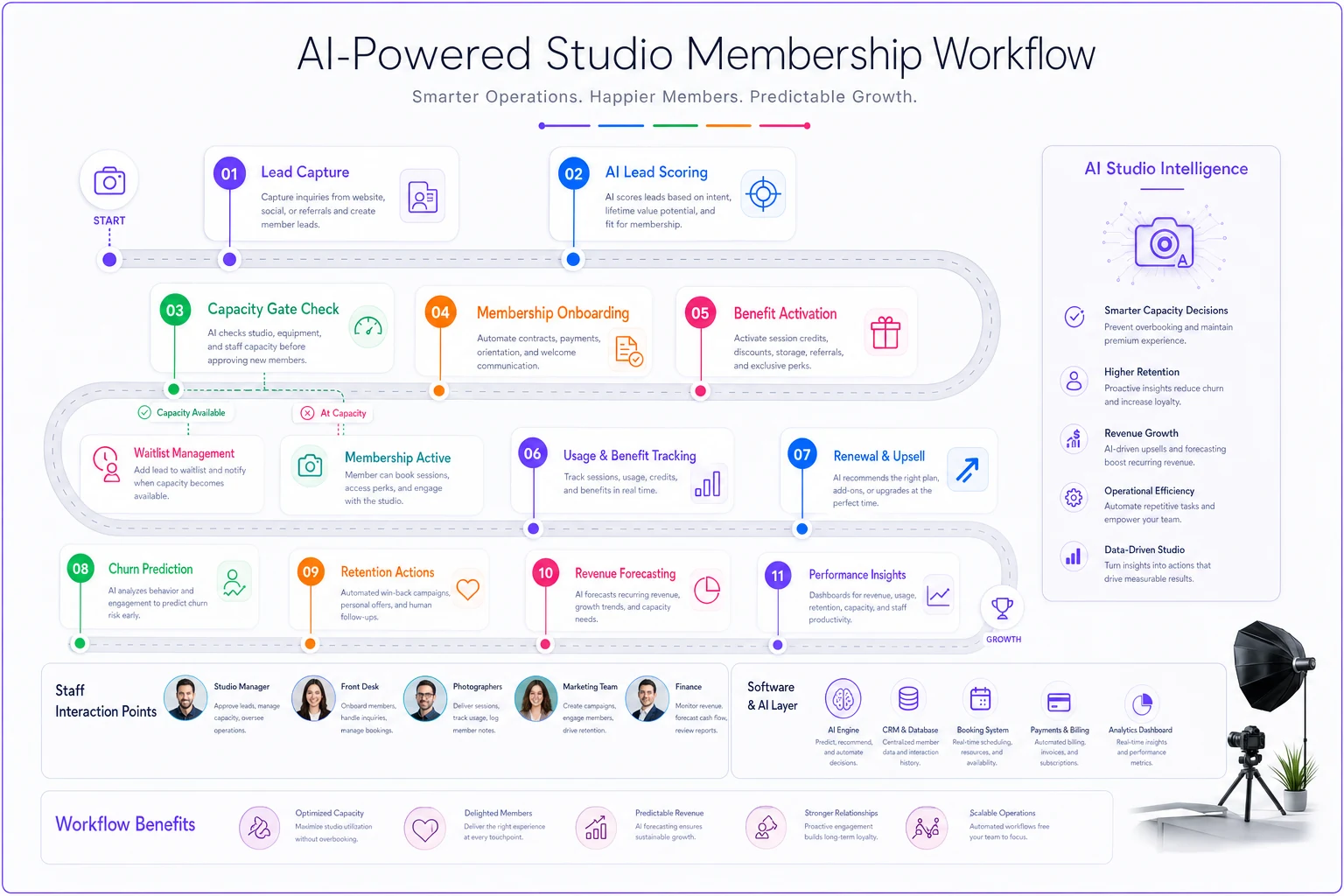
Benefit tracking becomes automatic too. The system monitors print credit usage, flags unusual consumption patterns, and can suggest benefit adjustments based on actual usage data across your member base. Rather than discovering three months later that print costs exceeded projections, you get real-time alerts when consumption trends the wrong direction.
Churn prediction runs continuously in the background. The software analyzes booking patterns, benefit usage, communication engagement, and payment history to score churn risk without anyone manually pulling reports. Your team gets a weekly list of at-risk members with specific outreach suggestions tied to their actual behavior — not a generic follow-up template.
Revenue forecasting also improves when systems track real member behavior rather than generic retention assumptions. The software learns your studio's specific patterns — maybe your members churn more in January after holiday sessions wrap, or renewal rates jump in September when school photos remind parents about professional photography. That kind of pattern recognition takes months to develop manually and is hard to act on consistently without automation.
Capacity optimization benefits too. The system identifies when you're consistently under-allocating member slots during slow periods or over-allocating during rush seasons and suggests adjustments that improve both member satisfaction and overall studio revenue.
The difference between membership programs that scale and those that stall
Studios running successful membership programs share one thing: they treat operations as the foundation, not an afterthought. They build clear rules, monitor actively, and adjust based on data rather than gut feel.
Your membership program lives or dies on execution. Perfect pricing means nothing if members can't book sessions. Beautiful tier names don't matter when benefit costs spiral. Aggressive sales targets become meaningless when churn eats all your growth.
Start with the fundamentals here. Set capacity gates that protect your business while delivering real member value. Track benefit consumption before it becomes a problem. Watch for churn signals early enough to do something about it. Build revenue forecasts that reflect how your members actually behave. Use session-specific workflows to ensure members get consistent experiences regardless of when they book. And if you're managing newborn sessions with complex scheduling requirements, slot length and buffer rules matter more than most studios realize.
The studios doing $30k-50k monthly from memberships didn't get there through marketing. They got there through operational discipline. They know exactly how many members they can support, what benefits actually cost to deliver, and when members start disengaging.
They've also built systems — whether through disciplined manual processes or operational software — that handle complexity without overwhelming their teams. Membership programs fail when operational overhead exceeds the revenue benefit. The successful ones figure this out before it becomes an expensive lesson.
Your idle capacity is real revenue. But only if you can operationally deliver on the membership promise without sacrificing your core business or burning out your team. The frameworks here give you that foundation. Whether you implement them manually or through automation, they're the difference between a membership program that generates consistent recurring revenue and one that quietly creates chaos.
The question isn't whether to offer memberships. It's whether you'll run them professionally or figure out the hard way why the studios that do it well are so deliberate about operations.
Ready to elevate your studio’s workflow?
Join 500+ studios using TryPixly to save time, reduce scheduling conflicts, and deliver exceptional client experiences.