

Most studios don't lose clients because the photos were bad. They lose them in the gap between "that costs more than I expected" and whatever the front desk blurts out next. The script matters, but so does the thing most studios skip: who's allowed to say what, and at what point a conversation stops being a staff decision and becomes a manager one.
This is a working repository. It's segmented by stage, each script has a clear escalation trigger, and every concession is tied to an approval rule so your team isn't quietly handing out 15% off to keep the peace. If you want the scheduling-and-SLA side of this, the operations playbook from inquiry to delivery covers the backbone these scripts sit on top of.
The core problem with handling photography client scripts pricing objections isn't wording. It's authority. A good script with no approval boundary just means your staff improvises discounts under pressure.
Why pricing conversations go sideways at the desk
The usual failure looks like this. A client sees the proofing total, hesitates, and the staff member — who genuinely wants to help — immediately jumps to a solution: "I can probably take 10% off." Now you've trained that client, and every client they talk to, that your prices move if you push a little.
The person fielding the objection usually has no map. They don't know the difference between an objection they're allowed to handle — a payment plan, a package swap — and one that actually needs a manager, like a real price cut below floor. So they default to the only tool that reliably works short-term: giving money away.
The fix is boring and it works. Every concession gets a tier. Tier 1 anyone can offer. Tier 2 needs a shift lead. Tier 3 needs an owner or studio manager with a reason logged. Once that's clear, the scripts become straightforward because the person knows exactly how far they can go before they stop talking and hand it off.
Concession tiers and who approves them
Before the scripts, set the rules. This table is what your staff should have at the desk, because the words only work if the authority behind them is defined.
Never miss a shoot or client detail again.
TryPixly helps you book, confirm, and manage every photography session seamlessly.
- Unified session and client management
- Automated client reminders
- Team calendar & resource scheduling
No credit card required
| Concession | Who can approve | Hard limit | Must be logged? |
|---|---|---|---|
| Package swap (same price tier) | Any staff | N/A | No |
| Payment plan (2–3 installments) | Any staff | Deposit still required | Yes |
| Add-on bonus (extra edit, small print) | Shift lead | Under ~$40 value | Yes |
| Discount 5–10% | Shift lead | Once per client | Yes |
| Discount 10–20% | Studio manager | Documented reason | Yes |
| Free reshoot (studio fault) | Studio manager | Full session only | Yes |
| Free reshoot (client fault) | Owner | Rare, case-by-case | Yes |
| Full/partial refund | Owner | — | Yes |
The logging rule is the quiet hero here. When concessions have to be written down with a reason, the number of "just this once" discounts drops noticeably — because nobody wants to explain a pattern of them in a monthly review.
Stage 1 scripts — Pricing objections during the sale
Pricing objections cluster into three real types, and treating them the same is why they're hard. Someone saying "that's expensive" could mean they can't afford it, they don't see the value, or they're testing whether you'll move. Different problem, different script.
"That's more than I expected." (Usually a value gap.)
> "Totally fair — a lot of people are comparing to a quick-shoot price. What's in this one is [X hours, Y final edited images, the in-person reveal]. If the full collection is more than you want right now, the [mid package] gets you the same quality on the images you love most. Want me to show you the difference side by side?"
No discount offered. You reframe to value or step down a tier. If they still hesitate, move to the payment-plan script — not a price cut.
"Can you do anything on the price?" (A test, or a budget ceiling.)
> "I can't drop the session price — that's what keeps the quality where it is. What I can do is split it into [two/three] payments so it's easier to manage, or move you to [package] which comes in at [price]. Which of those helps more?"
This is where staff want to cave. The script gives them two legitimate things to offer so they're not standing there empty-handed. Both are Tier 1. Neither touches your floor price.
"[Competitor] is cheaper." (Comparison pressure.)
> "They might be! Pricing's all over the place in this area. The thing I'd check is what's actually included — number of final images, editing time, and whether reshoots are covered. We build those in because it's what people come back about. If budget's the deciding factor, I'd rather help you find the right package here than have you disappointed somewhere else."
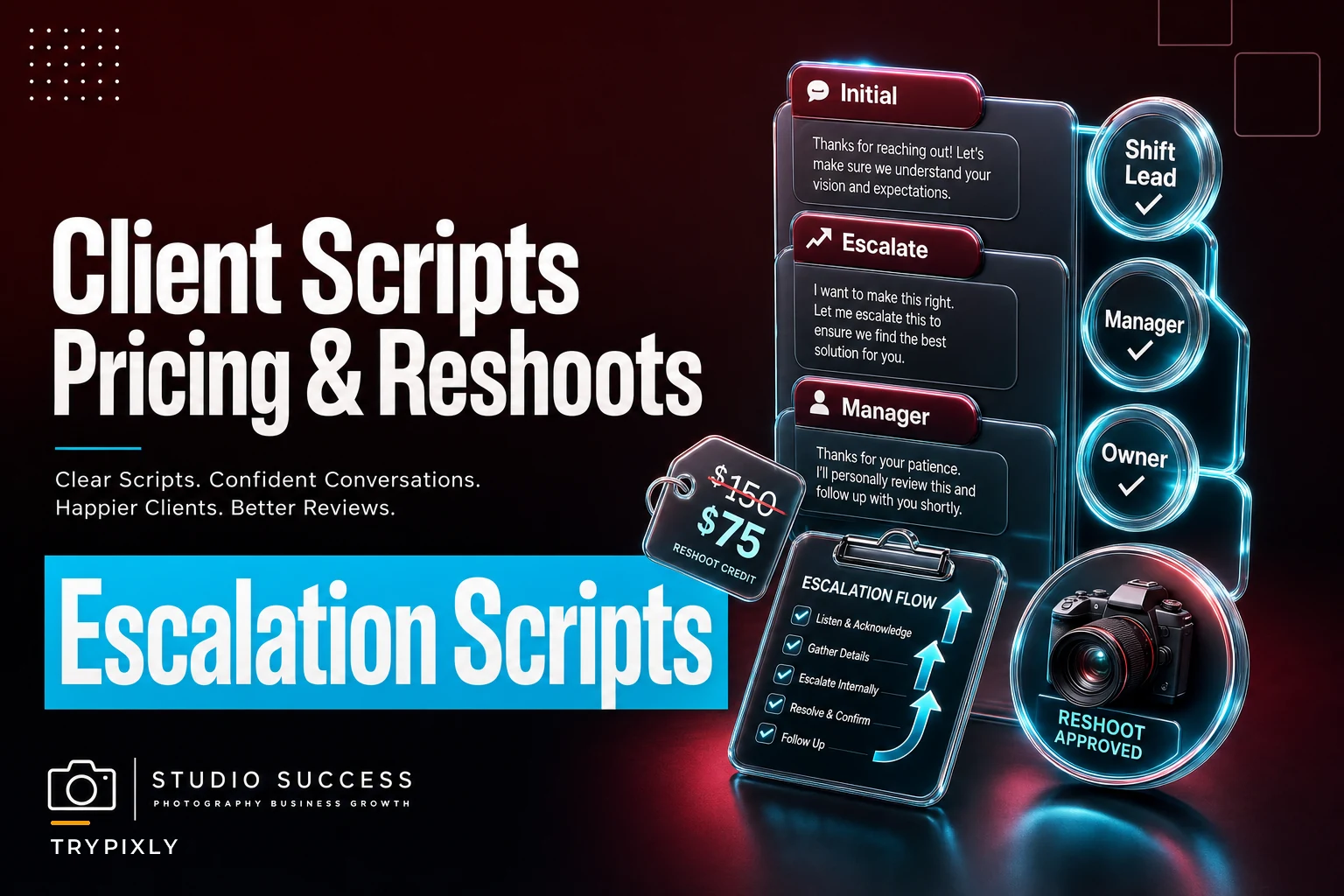
Escalation trigger for Stage 1: if the client asks for a discount beyond a package swap or payment plan, the staff member stops and brings in a shift lead. The handoff line matters as much as the script itself:
> "Let me grab [name] — they can look at a couple of options I can't."
That sentence does two things: it signals the staff genuinely can't just decide, and it gives the client a moment to feel heard without the price moving. A lot of the conversion work happens in the proofing room anyway, and the proofing session runbooks pair well with these objection scripts.
Stage 2 scripts — Reshoot requests
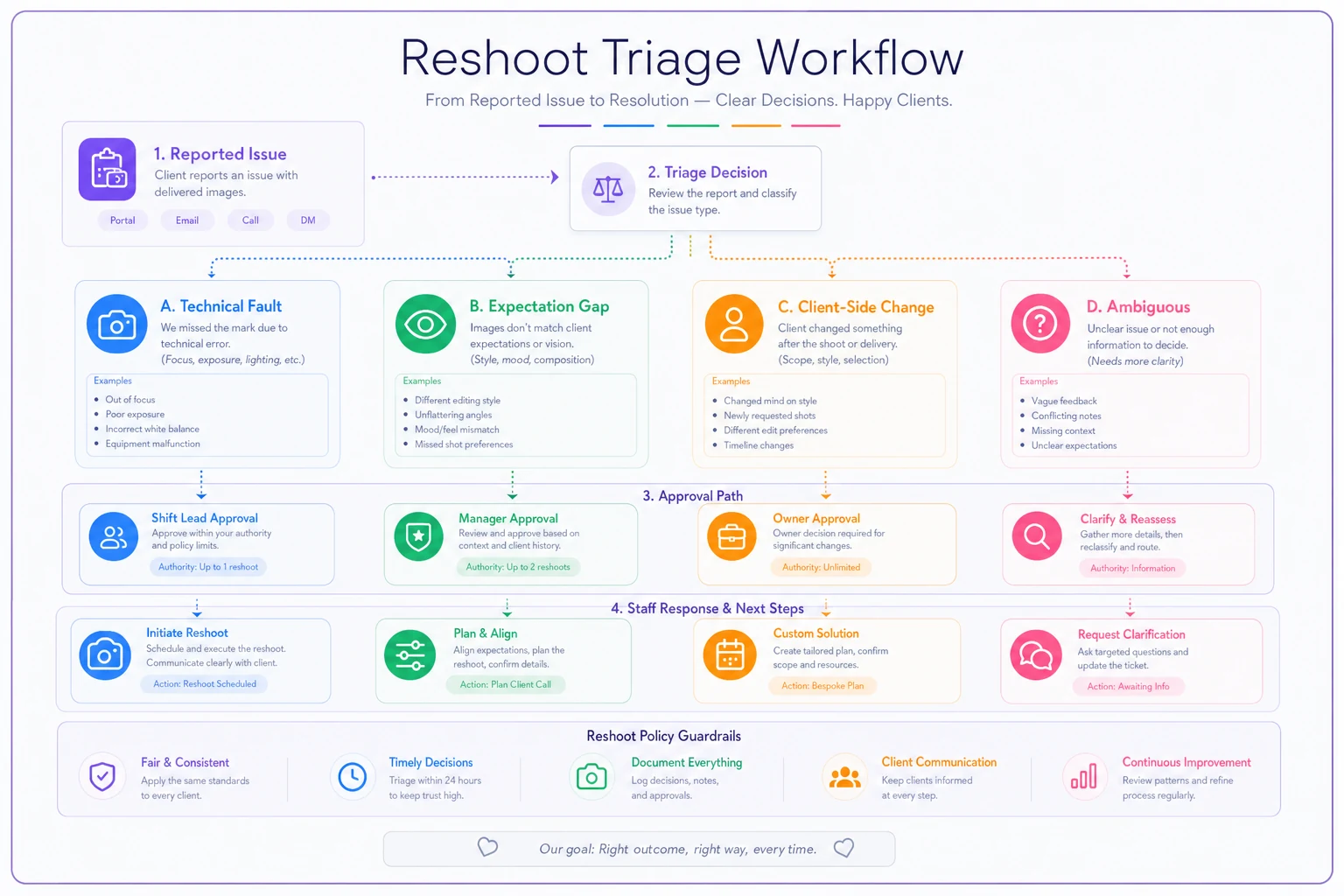
Reshoots are where comp policy and communication collide hardest, because the first question — whose fault was it? — is exactly the question you shouldn't ask out loud to the client. Internally, it determines everything. Externally, you lead with the fix, not the blame.
The internal triage before anyone replies
-
Technical fault on our end (missed focus, lighting failure, corrupt files)? → Free reshoot, manager approves, apologize cleanly, no hedging.
-
Expectation gap (client wanted a style or shot not discussed)? → Offer options; may be partial comp. Shift lead decides.
-
Client-side change (they didn't like their outfit, want a different person, changed their mind)? → Paid reshoot, possibly at a reduced rate. Owner approves any comp.
-
Ambiguous / hard to tell? → Treat as goodwill-leaning, escalate to manager before committing.
The mistake studios make is responding before triage. A staff member, wanting to be helpful, promises a free reshoot by text — and now you've comped a client-fault session you can't walk back without looking worse.
Reshoot scripts by cause
Studio fault:
> "You're right, and I'm sorry — those didn't come out the way they should have. We're going to redo the session at no charge. Let me find you the soonest slot that works. We'll get this right."
Short. No excuses, no "the lighting was tricky." Studio-fault reshoots are relationship-savers only if you own them cleanly. Hedging turns a recoverable moment into a bad review.
Expectation gap:
> "I hear you — those aren't the look you had in mind. Let me check what we captured, because there may be more we can do in editing first. If we can't get you there that way, let's talk about a shorter follow-up session to capture the [specific] shots you're after."
Notice it opens a smaller-scope option before jumping to a full reshoot. A targeted mini-session often satisfies the client at a fraction of your cost.
Client-side change:
> "Absolutely, we can set up another session. Since the first one came out as planned on our end, this would be a [reduced-rate / standard] booking. I can get you in on [date] — want me to hold it?"
Said warmly, this almost never causes conflict, because you're agreeing to help — just not for free. The friction people fear usually comes from an apologetic, mushy delivery that implies the studio might cave if pushed.
A simple triage workflow looks like this.
The mistake studios make is responding before triage. A staff member, wanting to be helpful, promises a free reshoot by text — and now you've comped a client-fault session you can't walk back without looking worse.
Stage 3 scripts — Delayed delivery communication
Delays damage trust less through the delay itself and more through the silence around it. The pattern is predictable: turnaround slips, nobody tells the client, the client emails on day 21 asking where their gallery is, and now you're on defense for something you could've gotten ahead of on day 10.
The rule: the studio contacts the client about a delay before the client contacts the studio. Always. A proactive delay message, even a vague one, reads as competence. A reactive one reads as excuse.
Proactive heads-up (before deadline passes):
> "Quick update on your gallery — we're running a little behind our usual turnaround and I want to keep you posted rather than leave you guessing. We're now expecting it by [date]. Thanks for your patience; I'll let you know the moment it's ready."
Client already asked (you're late):
> "Thanks for checking in, and sorry you had to. Your gallery's in final editing now and I expect it ready by [specific date]. I'll personally follow up to confirm. Appreciate you bearing with us."
Give a real date, not "soon." A missed vague promise is worse than a slightly later firm one. And if you give a date, it goes in whatever system tracks it, with an owner attached — because a second missed delivery promise is where goodwill actually breaks.
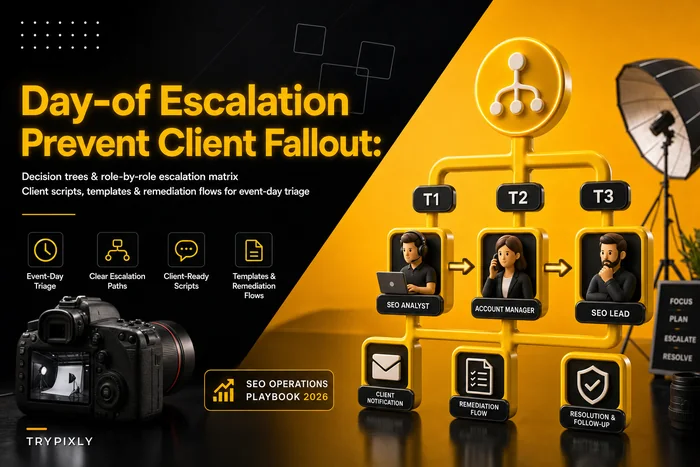
When the delay is significant (over a week past the original promise): this escalates to a manager, and comp enters the picture. A small gesture — a free print, a complimentary edit — tied to a genuine apology does more than another round of "sorry." That's a Tier 2 concession, logged, so you can see if a particular stage of your workflow keeps generating these. For studios dealing with day-of chaos that cascades into delivery delays, the day-of escalation plan with decision trees and role scripts handles the upstream version of this problem.
A real scenario
A two-photographer portrait studio doing around 30–40 sessions a month had a recurring margin leak nobody could pin down. Average order value looked fine, but comped discounts and surprise free reshoots were eating somewhere in the $1,500–$2,000 a month range. When they actually logged concessions for six weeks, the cause was obvious: front-desk staff were offering 10% off to anyone who paused at the total, and promising free reshoots over text before anyone checked whose fault it was.
They didn't change prices. They built the tier table, put the Stage 1 scripts at the desk, and required a two-line internal triage before any reshoot reply went out. Within a couple of months, discretionary discounting dropped to a handful of logged, approved cases, and the reflexive free reshoots mostly stopped — a mini-session or editing fix handled the real expectation gaps instead. Recovered margin landed somewhere in the $1,200–$1,600 a month range. Nothing dramatic. Just money that had been leaking quietly through conversations nobody was tracking.
When to use tight scripts — and when not to
This makes sense when you have more than one person talking to clients, when concessions are happening without anyone actually deciding to make them, or when your team freezes under pricing pressure and defaults to discounts. Scripts plus approval tiers fix the authority gap.
This is overkill when you're a solo owner handling every client yourself. You already know your floor and your comp logic — writing it down for one person is low value, though a reshoot triage habit is still worth keeping.
Who should NOT roll this out rigidly: high-end, relationship-driven studios where a scripted feel would cheapen the experience. Use the escalation tiers and triage logic — those are internal — but let experienced staff speak naturally. The boundary matters more than the exact words.
Making the repository actually get used
A script document that lives in a shared drive dies in a shared drive. The ones that work are short, physically present at the point of decision, and reviewed against real logs.
-
Every concession type has a named approver and a hard limit
-
Stage 1 scripts are at the desk, not buried in a manual
-
Reshoot triage runs before any reply goes out
-
Delay messages go out before the client asks — no exceptions
-
Concessions are logged with a one-line reason
-
Someone reviews the log monthly to spot patterns (a recurring reshoot cause, a stage that always runs late)
-
Scripts get edited when a line consistently falls flat — they're not sacred
That last point gets ignored most. The first draft of any script is a guess. Watch which lines land and which make clients tense up, and rewrite accordingly.
The real win here isn't smoother conversations, though you'll get those. It's that pricing objections, reshoots, and delays stop being improvised one at a time and start running through a system where the words and the authority behind them actually match.
The real win here isn't smoother conversations, though you'll get those. It's that pricing objections, reshoots, and delays stop being improvised one at a time and start running through a system where the words and the authority behind them actually match.
Ready to elevate your studio’s workflow?
Join 500+ studios using TryPixly to save time, reduce scheduling conflicts, and deliver exceptional client experiences.