

A proofing session is where real money gets won or lost, and most studios treat it like an afterthought. The photos are gorgeous, the client is emotional, and then the sale gets fumbled because nobody wrote down what happens between "wow, these are beautiful" and "here's my card."
What shows up across a lot of studios is that proofing conversion isn't a charisma problem. The owner who thinks they're "just not a salesperson" is usually working without a runbook. They improvise every session, close inconsistently, forget to mention the album when the client is clearly in love with three spreads, and let hot leads cool off for two weeks because there's no follow-up cadence.
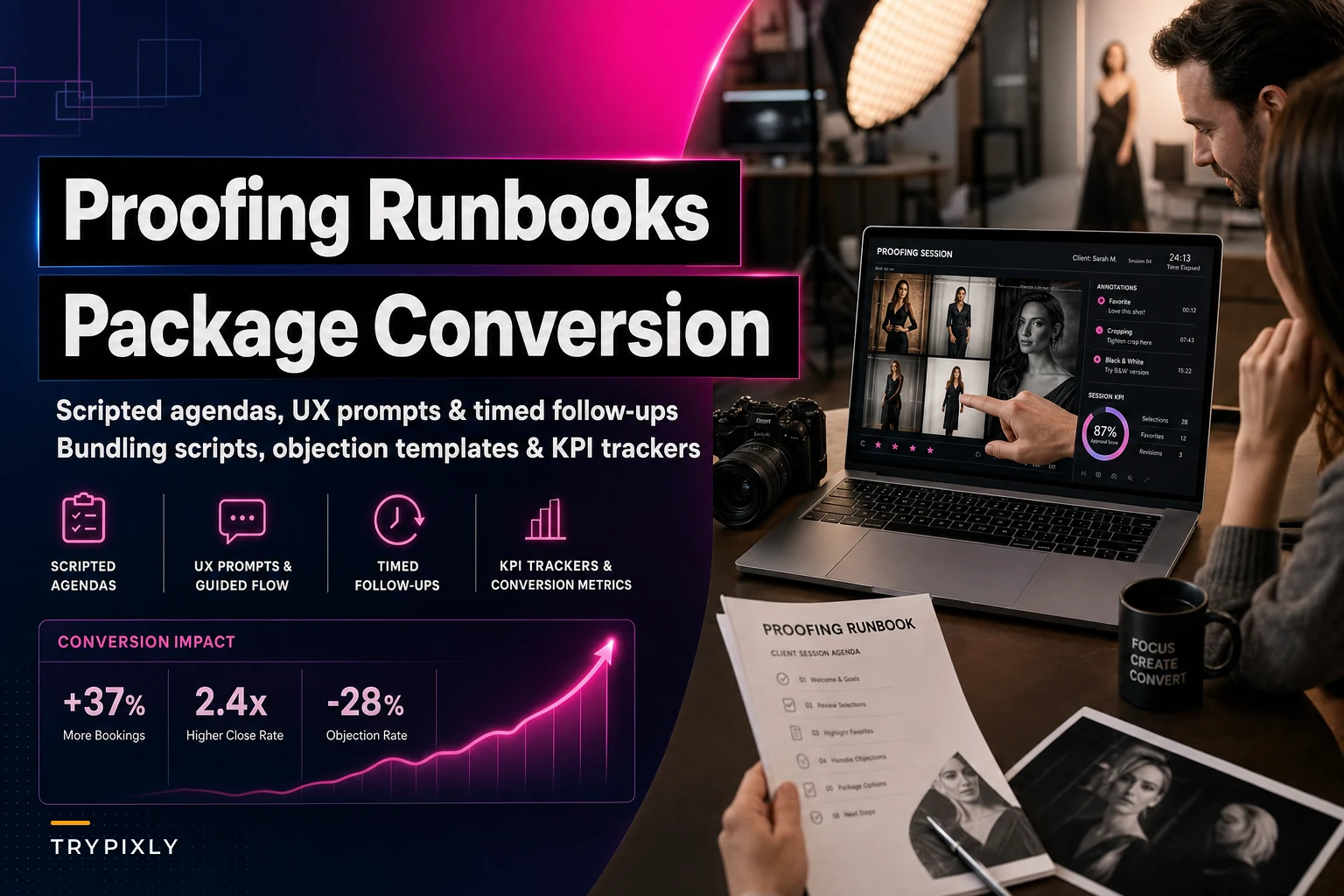
This post is a working photo proofing conversion runbook — the agendas, the on-screen and offline prompts, the follow-up timing, the bundling scripts, the objection responses, and the KPI tables you need to actually measure whether any of it works.
Why unscripted proofing sessions leak money
The leak is rarely dramatic. It's small stuff compounding.
A family books a newborn session. The gallery has 42 images. The client loves them all, which feels like a win — but "loving all of them" with no structure usually ends in a small digital-only order because the photographer never steered toward a product. No album walkthrough, no wall-art prompt, no bundle framing. The client leaves having spent roughly $400 on a session that could've closed at $1,200–$1,800 with a product-led proofing flow.
The pattern underneath that: when a proofing session has no agenda, the client sets the agenda. And a client's default agenda is "show me the cheapest way to get my pictures." Your job in proofing isn't to pressure anyone — it's to control the sequence so value gets presented before price enters the room.
The second leak is timing. A studio runs a beautiful in-person reveal, the client says "let me talk to my husband," and nothing happens for 11 days until someone remembers to send a follow-up. By then the emotional peak is gone. Proofing conversion is extremely time-sensitive, and most studios have no cadence at all.
The proofing session agenda (your core runbook)
The agenda is the spine of the whole thing. Every proofing session — in-person or over a screen-share — should run the same sequence, whether it's a wedding IPS appointment or a 15-minute Zoom for corporate headshots.
Never miss a shoot or client detail again.
TryPixly helps you book, confirm, and manage every photography session seamlessly.
- Unified session and client management
- Automated client reminders
- Team calendar & resource scheduling
No credit card required
-
Reset the emotion (2–3 min). Before showing anything, remind them why they booked. "You wanted something for the living room wall, right?" This anchors the session to a product outcome, not a file dump.
-
Reveal in the right order (5–10 min). Show the slideshow once, uninterrupted, set to music. Do not let them scroll and pixel-peep yet. The first full-sequence reveal is where the emotional buy-in happens.
-
Narrow before you sell (5 min). Help them cut to favorites. People can't buy from 42 images; they can buy from 8. Narrowing is a sales step disguised as a helping step.
-
Present products against their stated goal (10–15 min). Now bring in the album, the wall art, the bundles — tied directly to what they said in step one.
-
Present packages, highest first (5 min). Anchor high. More on this below.
-
Close or schedule the close (5 min). Either they order now, or you book the exact follow-up time before they leave. Never end on "let me know."
The mistake most owners make is collapsing steps 2 through 5 into one messy scroll-through where the client drives. The agenda exists precisely to stop that.
Here's a quick visual of how the session should flow.
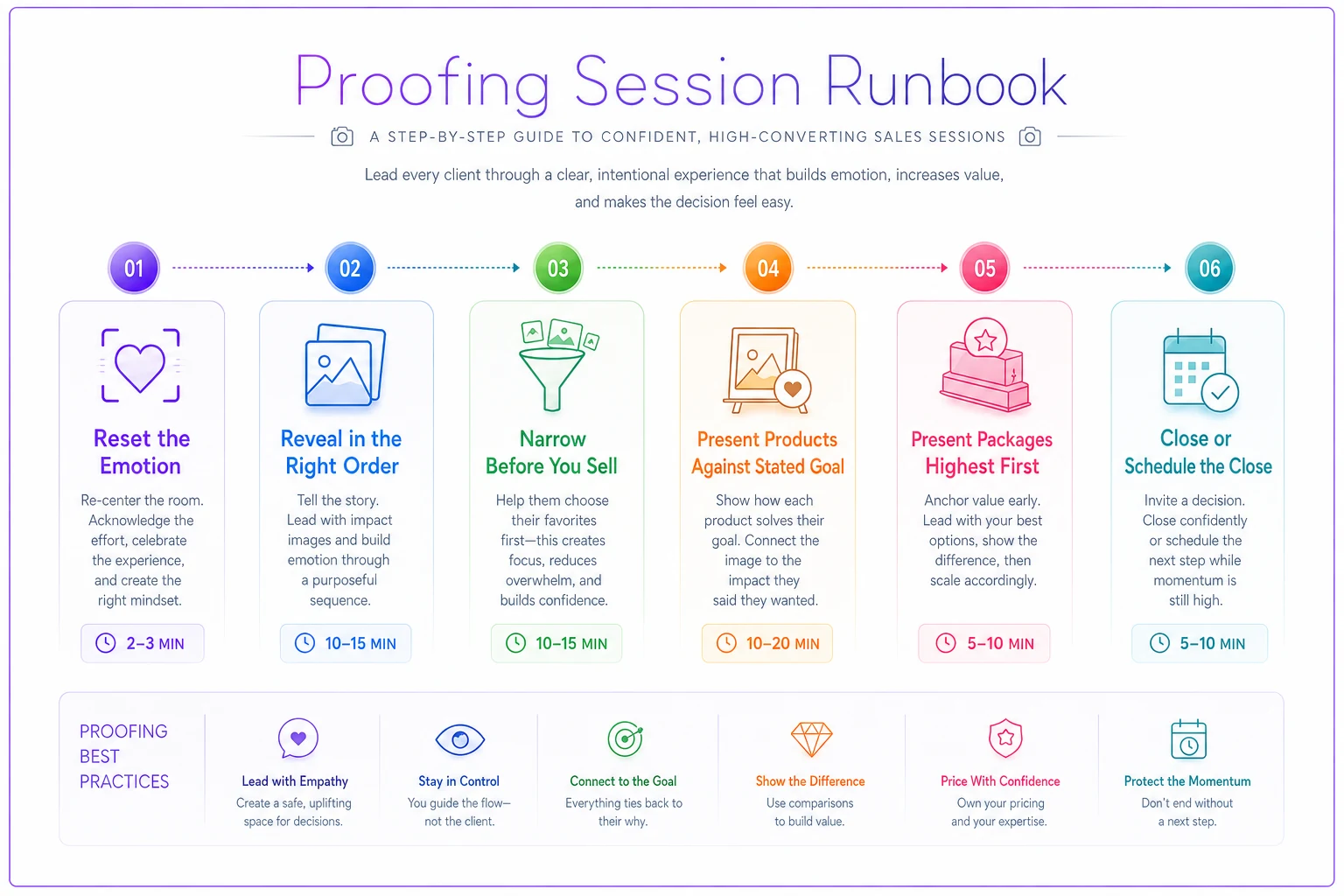
The agenda exists precisely to stop the client from driving the session and to make value appear before price.
On-screen vs. offline UX prompts
Whether your proofing happens on a screen or across a table changes the prompts you use. Here's the practical split:
| Moment | On-screen (remote/gallery) prompt | Offline (in-person) prompt |
|---|---|---|
| Opening the reveal | Full-screen slideshow, autoplay, no price visible | Dim the lights, music on, no product menu on the table yet |
| Narrowing favorites | "Tap the heart on the ones that stop you" | Physical proof prints they can sort into yes/maybe/no piles |
| Introducing product | Side-by-side room mockup with their image on a wall | A sample album open to a spread with their photos if possible |
| Showing price | Reveal package tiers only after favorites are chosen | Printed price menu handed over after the album walkthrough |
| Nudging the decision | "Your favorites are saved for 72 hours" countdown | "I've pulled the album layout already — want to see it built?" |
The single biggest UX miss in online proofing is showing the price list on the same screen as the photos. The moment price and image share a frame, the client's brain switches from "I want this" to "how do I minimize this." Keep them separate as long as you reasonably can.
For in-person, the equivalent miss is handing over the full menu too early. The menu is a step-5 tool, not a greeting.
Timed follow-up cadences
Most of the lost revenue in proofing isn't lost during the session. It's lost in the silence afterward. A follow-up cadence fixes that, and the timing matters more than the wording.
-
Within 1 hour (same day) A short thank-you with the saved-favorites link and the hold expiration. This rides the emotional high.
-
Day 2 A single product-focused nudge — "I mocked up your three favorites as a canvas trio, here's how it'd look." Visual, not pushy.
-
Day 4 Address the likely hesitation directly. If they said "need to check with my partner," this is the message that gives them something to forward.
-
Day 7 The expiration reminder. Favorites hold ends, pricing-as-shown ends. This is where fence-sitters move.
-
Day 10 (final) A soft close — "closing your gallery Friday, want me to keep anything open?"
Prioritize a manual reach-out for clients who open the gallery during days 2–7 to convert warmed leads.
Two things studios consistently get wrong here. First, they front-load too hard and send four messages in 48 hours, which reads as desperate. Second, they give up after one unanswered email. The drop-off between a one-touch and a five-touch cadence is significant — plenty of clients who looked cold convert on day 7 purely because the deadline became real.
Managing this manually across 20–30 open galleries is where it falls apart. This is exactly the kind of timing logic that AI-assisted operational tools handle well — the platform tracks where each client sits in the cadence, triggers the right message at the right interval, and flags the ones who opened but didn't order so a human can step in. The point isn't to automate the relationship; it's to make sure nobody falls through the cracks because someone got busy on a shoot day.
Bundling scripts that lift average order value
Bundling is where package close rates actually move. The script isn't about convincing — it's about framing the comparison so the mid or high tier feels obviously smart.
The anchor-high open: > "Most families in your situation go with the Heirloom collection — that's the full album, the wall piece, and all your digitals. It's the complete set. But let me show you all three so you can see where you land."
Starting high reframes the middle tier as the reasonable choice rather than the expensive one.
The goal-tieback bundle: > "You mentioned the living room wall earlier. The Signature bundle gives you that canvas plus the album, and it actually comes out about $200 less than buying those two separately."
You're not inventing a need — you're connecting their own stated goal to a bundle.
The "complete the story" prompt for albums: > "You picked eight favorites, which is almost exactly a 10-spread album. Want me to show you what it looks like built out? We're basically already there."
This works because the client has already done the emotional selection. The album just finishes what they started.
If you haven't sorted out how your tiers are actually priced and what each bundle costs you to deliver, the scripts won't save you — you'll close more and still bleed margin. It's worth getting your tier structure right first; our breakdown on pricing packages by slot cost, deliverables and perceived value covers that groundwork.
Objection-handling templates
Objections in proofing are predictable. If you've heard them before, you should have a written response ready — not a rehearsed robot line, just a default you can lean on so you don't freeze.
-
"It's more than I expected." "Totally fair. Let me show you the collection that most people pick when they want the album but need to spread the investment — and we do offer a payment plan on anything over $800."
-
"I need to talk to my partner." "Makes sense — this is a joint decision. Let me build the layout now so you both see exactly what we're talking about, and I'll hold tonight's pricing through the weekend so you're not deciding under a clock."
-
"Can I just get the digitals?" "Absolutely, digitals are included in two of the collections. Honestly, people who grab only the files tend to never print them — so if the wall piece mattered to you, the Signature bundle gets you both for not much more."
-
"Let me think about it." "Of course. What's the one thing you're unsure about — the size, the collection, or the timing? Let's solve just that one."
That last one is the most useful template in the set. "Let me think about it" is almost never about thinking — it's a specific unspoken hesitation. Asking which of three things it is surfaces the real objection instead of letting it walk out the door.
KPI tracking tables
You can't improve what you don't measure, and proofing is one of the easiest things in a studio to track consistently. Keep a simple table per month:
| Metric | How to calculate | Healthy range (varies by studio) |
|---|---|---|
| Proofing-to-sale rate | Sessions that resulted in any order ÷ total proofing sessions | 80%+ |
| Average order value (AOV) | Total product revenue ÷ sessions that ordered | Trending up month over month |
| Bundle attach rate | Orders including a bundle ÷ total orders | 40–60% |
| Same-day close rate | Orders closed during the session ÷ total sessions | The higher the better |
| Follow-up conversion | Orders closed days 2–10 ÷ sessions not closed same day | 20–35% |
The number most studios ignore is the follow-up conversion rate, because they don't track which sales happened after the session. If that number is near zero, your cadence is broken — you're leaving the slow-deciders behind entirely. If your same-day rate is low but follow-up conversion is strong, your in-session agenda needs work even though the overall numbers look fine.
A real scenario
A two-person family and newborn studio was running in-person reveals but closing inconsistently — roughly 60% of sessions ordered, and average orders sat around $450, mostly digital-only. No agenda, no written scripts, and follow-up was "whenever someone remembered."
They put in a fixed proofing agenda (reveal-first, narrow, then product), moved the price menu to step five, built three bundles anchored high, and set a five-touch follow-up cadence capped at day 10.
Over the next few months, their proofing-to-sale rate climbed into the low 80s, and AOV moved to somewhere around $780–$850 as the album and canvas bundles started attaching. The biggest surprise was follow-up: nearly a quarter of their non-same-day sessions ended up ordering on day 4 or day 7 — revenue they'd simply been forgetting to chase. No new talent, no new gear. Just a sequence and a cadence someone finally wrote down.
When this runbook makes sense (and when it doesn't)
This level of structure is worth it if product sales are a real part of your revenue — albums, prints, wall art, digital collections. If you run a volume model where clients order through an automated gallery with no human proofing step (schools, large sports days), you don't need the full agenda; you need tight gallery UX and a clean follow-up email sequence instead.
It's also a bad idea to bolt scripts onto a broken product lineup. If your bundles don't actually save the client money or your tiers aren't differentiated, scripts just make the confusion faster. Fix the offer first.
And if your gallery delivery is slow, none of this works. The emotional peak that drives proofing sales fades fast — clients waiting weeks to see images have already mentally moved on. Tightening that is its own project; worth reading our take on a throughput-first post-production workflow and on how a retouching QA and approval loop reduces rework so proofing-ready images actually arrive while the client still cares.
Putting it to work
Pick one session type — newborns, weddings, headshots, whatever you run most — and build the full runbook for just that: the agenda, the on-screen or offline prompts, three bundles, your four objection templates, the five-touch cadence, and the KPI table. Run it for a month before you touch anything else.
Proofing isn't the part of the business where you hope it goes well. It's the part where a written sequence, used consistently, quietly outperforms talent. The studios that close well aren't better at selling. They just stopped improvising.
Proofing isn't the part of the business where you hope it goes well. It's the part where a written sequence, used consistently, quietly outperforms talent. The studios that close well aren't better at selling. They just stopped improvising.
Ready to elevate your studio’s workflow?
Join 500+ studios using TryPixly to save time, reduce scheduling conflicts, and deliver exceptional client experiences.