

Most studios treat local marketing like a lottery. Throw money at Instagram ads, join one networking group, ask a happy client to "tell your friends," and then wait. The problem with waiting is that it's not a system. When a slow month hits — and it always hits — you have nothing built underneath you to catch the fall.
The studios that stay booked through the dead weeks usually have something boring working in the background: a handful of local partners who send people their way, plus a referral mechanic that actually pays attention to who's doing the sending. That's the whole game. Not viral reels. Just a repeatable way to turn other local businesses and past clients into a pipeline.
This is a step-by-step version of that. Built specifically for portrait and product studios, because the partner math is different for each, and most generic "local marketing for photography studios" advice ignores that completely.
Start with partner identification, not outreach
The biggest mistake studios make is rushing to outreach before figuring out who's actually worth partnering with. You end up with twelve lukewarm coffee meetings and no bookings.
The filter that matters: who already has your future client's trust at the exact moment they need you?
For a portrait studio, that's not "other photographers." It's businesses that touch people during a life transition or a milestone:
-
Maternity boutiques and prenatal yoga studios (newborn + maternity pipeline)
-
Wedding planners and florists (but for the portrait side — engagement, anniversary, family)
-
High-end salons and makeup artists (headshots, personal branding)
-
Realtors and mortgage brokers (new-home family sessions, oddly reliable)
-
Private schools and daycares (family and senior portraits)
-
Estate planners and financial advisors (legacy family portraits — underused, very high intent)
For a product studio, the whole list flips:
-
Branding agencies and web designers who need product shots for client sites
-
Packaging designers and print shops
-
Local e-commerce consultants and Shopify freelancers
-
Candle makers, skincare brands, specialty food producers — small DTC makers who can't shoot their own catalog
-
Marketing agencies that outsource photography
A product studio partnering with a wedding planner is a waste of everyone's time. A portrait studio partnering with a Shopify freelancer is the same mistake in reverse. Match the partner to where the buying decision actually happens.
Rank your list before you contact anyone
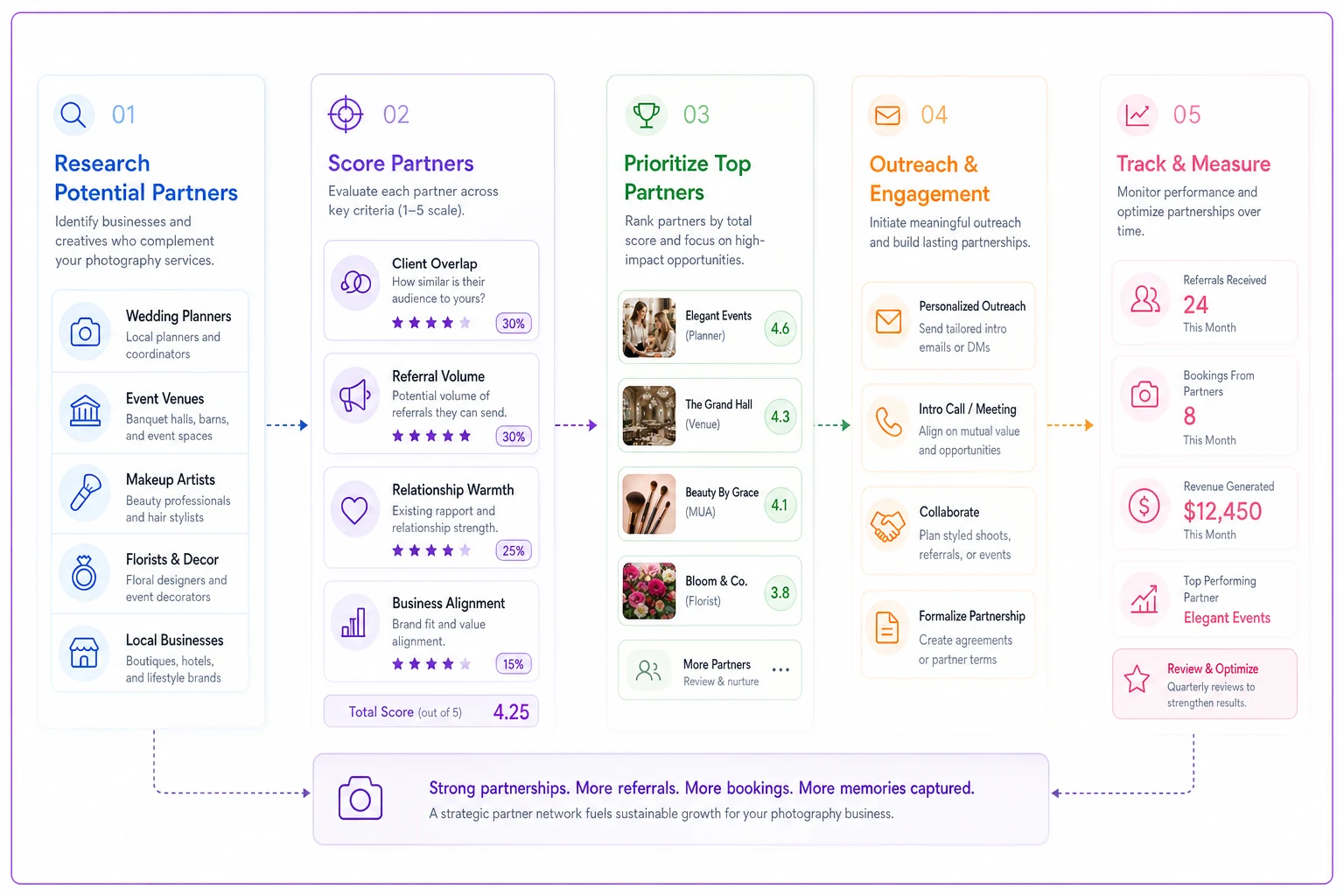
Not all partners are equal. Score each prospect on three things, 1–5:
Here's a quick visual of the partner identification and ranking workflow.
| Factor | What you're measuring | Why it matters |
|---|---|---|
| Client overlap | How closely their customers match your ideal client | A partner with the wrong audience sends you junk leads |
| Referral volume | How many relevant customers they see per month | A boutique seeing 8 pregnant clients/month beats one seeing 2 |
| Relationship warmth | Do you already know them, or cold? | Warm partners convert 3–4x faster to an active agreement |
Add the three numbers. Anything scoring 11 or higher goes to the top of your outreach list. Under 8, skip for now. In practice, a studio only needs 4 to 6 genuinely active partners to change its booking picture — you don't need forty.
Outreach that doesn't sound like every other vendor
Local business owners get pitched constantly. Most studio outreach fails because it leads with your needs ("I'd love to send clients your way, and maybe you could send some to me!"). That's a transaction nobody asked for.
Never miss a shoot or client detail again.
TryPixly helps you book, confirm, and manage every photography session seamlessly.
- Unified session and client management
- Automated client reminders
- Team calendar & resource scheduling
No credit card required
The outreach that works leads with a specific, low-friction offer that helps them first.
Template 1 — Portrait studio to a maternity boutique (warm-ish lead): > Hi [Name] — I run [Studio] a few blocks from you and a lot of my newborn clients mention shopping at your store. I'd love to offer your customers a small perk: a $75 session credit they get just for shopping with you, no cost to you. I'd also feature your shop in the welcome guide every newborn client receives. Could I drop off a few cards this week and see if it's a fit?
Template 2 — Product studio to a branding agency (cold): > Hi [Name] — I saw [Agency]'s recent work for [local brand] and the site looked great. I run a product studio locally and handle the photography piece a lot of agencies prefer to outsource. If you ever have a client who needs clean e-commerce or lifestyle product shots, I'd be glad to be your go-to — fast turnaround, and I keep agencies looped in on timelines. Open to a quick 15-minute call?
Both do the same thing: they name something specific, they put the benefit on the partner's side, and they ask for something small. You're not proposing marriage. You're proposing a first date.
Worth remembering: outreach that references one concrete detail about the partner gets replies at roughly double the rate of generic messages. It takes ninety seconds of looking at their website. Do it.
Co-marketing offers that actually move people
Once a partner says yes, you need an offer that gives their customer a real reason to act. Vague discounts die. "10% off a session" means nothing to someone who wasn't planning to book.
The offers that convert share a shape: specific value, mild urgency, and zero awkwardness for the partner to hand out.
A few that have worked:
-
The bundled perk. The partner's customer gets a $100 print credit and a complimentary styling consult. Feels like a gift, not a coupon.
-
The "with purchase" trigger. Spend over a threshold at the partner's store, get a free mini-session voucher. Strong for product studios partnering with makers — "book a full catalog shoot, get your hero product retouched free."
-
The co-hosted event. A portrait studio runs a one-day "fall family mini" event inside a boutique's space. The boutique gets foot traffic, you get a dozen sessions in a day, and shared promotion costs neither side cash.
Co-hosted events are genuinely underrated. A single Saturday mini-session day at a partner's location can generate 10–15 bookings in six hours, and because the partner promotes it to their own list, your acquisition cost is basically a few printed cards and some retouching hours.
One caution: make the partner's job stupidly easy. Give them a stack of pre-printed cards or a single link to share. If handing out your offer requires them to explain anything, it won't happen. The offer that needs a paragraph of context is dead on arrival.
Designing referral incentives that don't train the wrong behavior
Referrals from past clients are the highest-converting leads a studio gets — someone who already trusts you is vouching for you to someone who trusts them. But most studio referral programs quietly fail because the incentive is either too small to notice or structured so it rewards the wrong thing.
The core design question: do you reward the referrer, the new client, or both?
In most cases, both — but weighted toward the new client. A classic double-sided structure:
-
New client incentive $50 off their first session. This is what actually gets them through the door.
-
Referrer reward a $50 print credit that only unlocks once the referred client completes a paid session. This is the part studios botch.
That conditional trigger matters. If you pay the referrer the instant they drop a name, you'll get a flood of "my cousin might want photos someday" leads. Tie the reward to a completed, paid session and the quality of referrals climbs immediately — people only refer when they genuinely think it'll land.
A few design rules that hold up:
-
Make the reward feel like more of your product, not cash. A print credit or album upgrade keeps the client in your world and costs you less than its face value. Cash leaves and never comes back.
-
Stack a small bonus for repeat referrers. Someone who sends you their third client is gold. A surprise upgrade on their next session turns them into a permanent advocate.
-
Set a clear expiration. "Use within 6 months" prevents open liabilities on your books and creates a gentle nudge to rebook.
If you want the deeper version of turning one happy client into a stream of them, this connects directly to building an operational client lifecycle that turns first inquiry into referrals — the referral program is really just the last stage of that lifecycle working correctly.
When referral programs are a bad idea
Not every studio should run one yet. If your delivery is inconsistent — galleries sometimes run two weeks late, retouching quality wobbles between editors — a referral program will amplify your problems. You'll be paying people to send clients into a flawed experience. Fix the core delivery first. A referral engine pours fuel on whatever already exists, good or bad.
Tracking: the part everyone skips, and why it's the whole point
Studios will spend hours building partner relationships and designing clever incentives, then have no idea which partner or which referrer actually produced revenue. When a slow month comes and you need to cut effort somewhere, you're guessing.
The minimum viable tracking system answers four questions:
-
Where did this lead come from? Capture source at inquiry — a simple "How did you hear about us?" field with partner names as options, not a free-text box.
-
Did it convert to a paid booking? Tie the source to the actual booking, not just the inquiry.
-
What was the booking worth? Including print and album sales, not just the session fee.
-
What did the referral cost you? The incentive value you paid out.
Put those together and you get the one number that matters: revenue per partner, net of incentive cost.
A realistic example. Three partners tracked over a quarter:
| Partner | Referred bookings | Total revenue | Incentives paid | Net |
|---|---|---|---|---|
| Maternity boutique | 9 | ~$6,800 | $450 | ~$6,350 |
| Realtor contact | 2 | ~$900 | $100 | ~$800 |
| Branding agency | 6 | ~$5,200 | $0 (reciprocal) | ~$5,200 |
The picture is obvious. The boutique and the agency are your engine. The realtor isn't worth the quarterly coffee. Without tracking, you'd probably keep all three alive equally and wonder why the partnership program felt vague. With it, you double down on two relationships and quietly let one go dormant.
Tracking also surfaces reciprocity imbalance, which is where partnerships silently rot. If you've sent a wedding planner eleven clients this year and received two, that relationship needs a direct conversation before resentment sets in. You can't have that conversation if you're not counting.
You don't need expensive tooling for this. A shared spreadsheet with source, booking value, and incentive columns beats nothing by a mile. Studios that run intake and booking through a single operational platform have an easier time here — the source field gets captured automatically at inquiry and follows the client through to final sales, so the revenue-per-partner number builds itself instead of requiring a monthly data-entry chore that nobody keeps up with. The format matters less than the discipline. Track something.
Make the "How did you hear about us?" field a required dropdown rather than free text to keep partner attribution consistent.
Track something.
A real scenario
A two-photographer portrait studio in a mid-size suburb was doing fine in spring and fall but bleeding through January and February every year — the usual seasonal trough that quietly eats a studio's annual margin. If that's your pattern, the cross-functional approach to smoothing cashflow is worth reading alongside this.
They picked four partners using the scoring filter: two maternity boutiques, a high-end salon, and a pediatric dental office (that last one was a wildcard — turned out to be the sleeper). Outreach used the perk-first template. The co-marketing offer was a $75 session credit handed out as a physical card, plus the partner featured in the studio's newborn welcome guide. The referral program paid past clients a $50 print credit, unlocked only on a completed session.
Over the first two quarters, roughly 28 bookings traced back to the four partners and the referral mechanic combined. The dental office alone drove about a third of them — new parents sitting in a waiting room with nothing to do are a surprisingly captive audience. Net of incentives, it added somewhere in the $18k–$22k range they wouldn't have had otherwise, and a meaningful chunk landed in the slow winter window because the boutiques were actively handing out cards in December.
The part that made it stick wasn't the offers. It was that they tracked source from day one, saw the dental office outperforming, and gave that partner extra attention — a framed print for their waiting room, first access to a holiday mini event. The relationship compounded because they were paying attention to the numbers instead of their assumptions.
Keep it small, keep it counted
The whole thing fits on one page:
-
Build a partner list scored on client overlap, volume, and warmth — aim for 4 to 6 active, not forty.
-
Lead outreach with a specific perk for them, referencing one real detail about their business.
-
Design co-marketing offers that are concrete and effortless for the partner to hand out.
-
Make referral rewards conditional on a completed paid session, and pay in product credit over cash.
-
Track source, conversion, revenue, and incentive cost for every single lead — no exceptions.
Local marketing for photography studios doesn't reward the cleverest campaign. It rewards the studio that built four solid relationships, measured which ones worked, and quietly kept watering them while everyone else was still waiting on their next viral post. If you're thinking about running this across more than one location down the line, the discipline here is the foundation — scaling partnerships without tracking is exactly how multi-location launches fall apart.
Pick your four partners this week. Score them before you email anyone. And whatever you build, count it from the first lead.
Ready to elevate your studio’s workflow?
Join 500+ studios using TryPixly to save time, reduce scheduling conflicts, and deliver exceptional client experiences.