

Most studio owners who open a second location assume the hard part is the buildout — the lease, the lighting, the vibe. That part is stressful but finite. What quietly kills multi-location growth is governance: who decides what, where the standards live, and what happens when location #2 starts making different calls than location #1 without anyone noticing until a client complains.
A photography multi-location operating model isn't a bigger version of your current setup. It's a different animal. The moment you're not physically in the room, every undocumented decision you used to make on instinct becomes a gap someone else fills — usually badly, usually without telling you. Retouching standards drift. Sales scripts mutate. Pricing gets "adjusted" for a walk-in. And by the time you catch it, three months of clients have already been served under a version of your brand you never approved.
This is a blueprint for the first 12 months across multiple locations. Not a pep talk — an actual framework for what stays central, what goes local, where the checkpoints sit, and how to replicate a location without reinventing your studio each time.
The core tension: central control vs local autonomy
Every multi-location business lives on a spectrum between two failure modes.
Lock everything down centrally and your new location becomes a helpless branch office. The manager can't approve a $40 reprint without a phone call. Local clients get treated like they're in a different city (they are), and the manager burns out because they have zero authority but full accountability.
Push everything local and you get five studios wearing the same logo but delivering five different experiences. The second failure mode is far more common — owners over-delegate because they're exhausted, then spend the next year firefighting inconsistency.
The answer isn't picking a side. It's deciding, deliberately and in writing, which category every operational decision falls into. That's what a responsibility matrix does.
The central vs local responsibility matrix
Here's a starting framework. Adjust the lines based on how mature your SOPs are, but don't skip categories.
| Function | Central (HQ owns) | Local (Location owns) | Notes |
|---|---|---|---|
| Brand & visual standards | Editing style, delivery specs, gallery presentation | Nothing | This is your product. Never local. |
| Pricing & packages | Base package structure, floor prices | Limited add-on bundling, local promos within a ceiling | Local can flex up, rarely down |
| Sales process | Consult-to-book script, objection framework | Local rapport, scheduling flexibility | Script is central, delivery is human |
| Hiring | Role definitions, pay bands, calibration standards | Interviewing, day-to-day scheduling | See staffing note below |
| Scheduling & capacity | Slot logic, buffer rules | Filling the calendar, local blackout dates | Capacity math stays central |
| Vendor/lab relationships | Approved labs, print specs, SLAs | Local courier, local props | Quality-critical vendors = central |
| Client escalations | Refund policy, escalation ceiling | First-line resolution under threshold | Give locals a dollar ceiling |
| Marketing | Brand assets, campaign templates | Local partnerships, community events | Templates central, execution local |
| Finance | Chart of accounts, margin targets, reporting cadence | Petty cash, local vendor payments | Reporting format never varies |
The single most useful column here is "Notes," because the real decisions live in the gray areas. A local manager running a fall mini-session promo is fine. A local manager quietly discounting your premium package to hit a monthly number is a margin problem that spreads. The matrix exists to make those distinctions before the pressure hits, not during.
One pattern worth flagging: the functions that get miscategorized most often are pricing floors and editing standards. Owners assume everyone "knows" the standard, so they never write it down — and those are exactly the two things that erode fastest with distance.
The 0–12 month timeline: what governance looks like at each phase
You don't roll out full governance on day one. You phase it. Trying to enforce a 40-page ops manual on a location that's been open six days just teaches everyone to ignore the manual.
Never miss a shoot or client detail again.
TryPixly helps you book, confirm, and manage every photography session seamlessly.
- Unified session and client management
- Automated client reminders
- Team calendar & resource scheduling
No credit card required
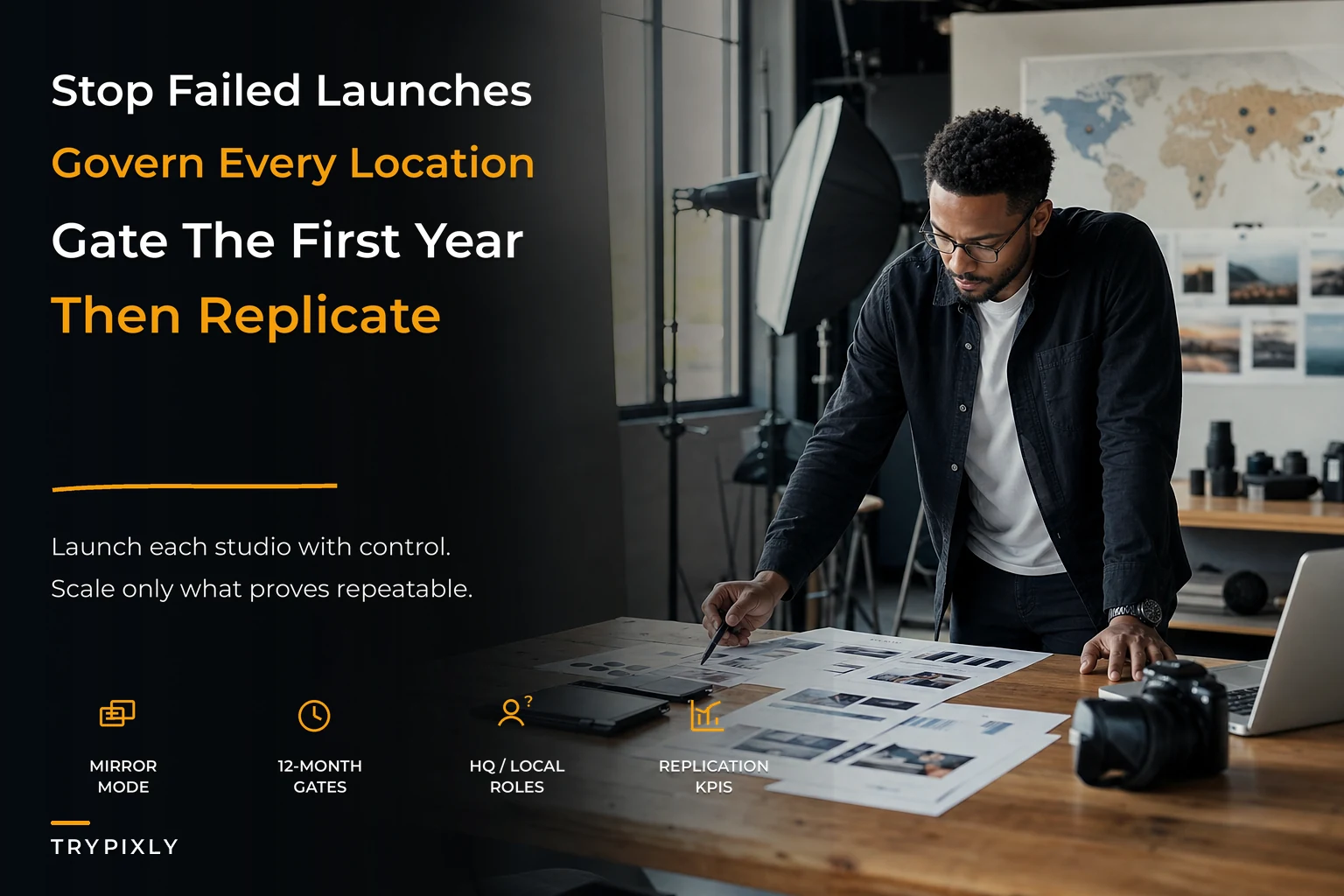
Months 0–2: Mirror mode. The new location runs as a near-exact clone of your flagship. No local pricing decisions. No process changes. The goal is to prove the replication works before anyone starts "improving" it. This is when your SOP library earns its keep — if your standards aren't already documented, you're not ready to open, full stop.
Months 3–5: Calibration. Now you start measuring drift. Are galleries coming out consistent? Are consult-to-book rates comparable? This is where calibration sessions matter enormously, and the same logic behind role matrices and calibration for multi-photographer studios applies at the location level. You're not just calibrating photographers now — you're calibrating whole locations against a standard.
Months 6–8: Controlled autonomy. Once a location hits consistency gates (more on those below), you grant specific local authority — a promo budget, an escalation ceiling, some scheduling flexibility. Autonomy is earned by hitting metrics, not granted by tenure.
Months 9–12: Systematize the pattern. By now you should be able to describe exactly what a "healthy" location looks like numerically and operationally. That description becomes your replication checklist for location #3, #4, #5.
The mistake here is compressing this timeline because a location "feels ready." Feelings aren't a gate. Metrics are.
Here's a simple visualization of that phased rollout.
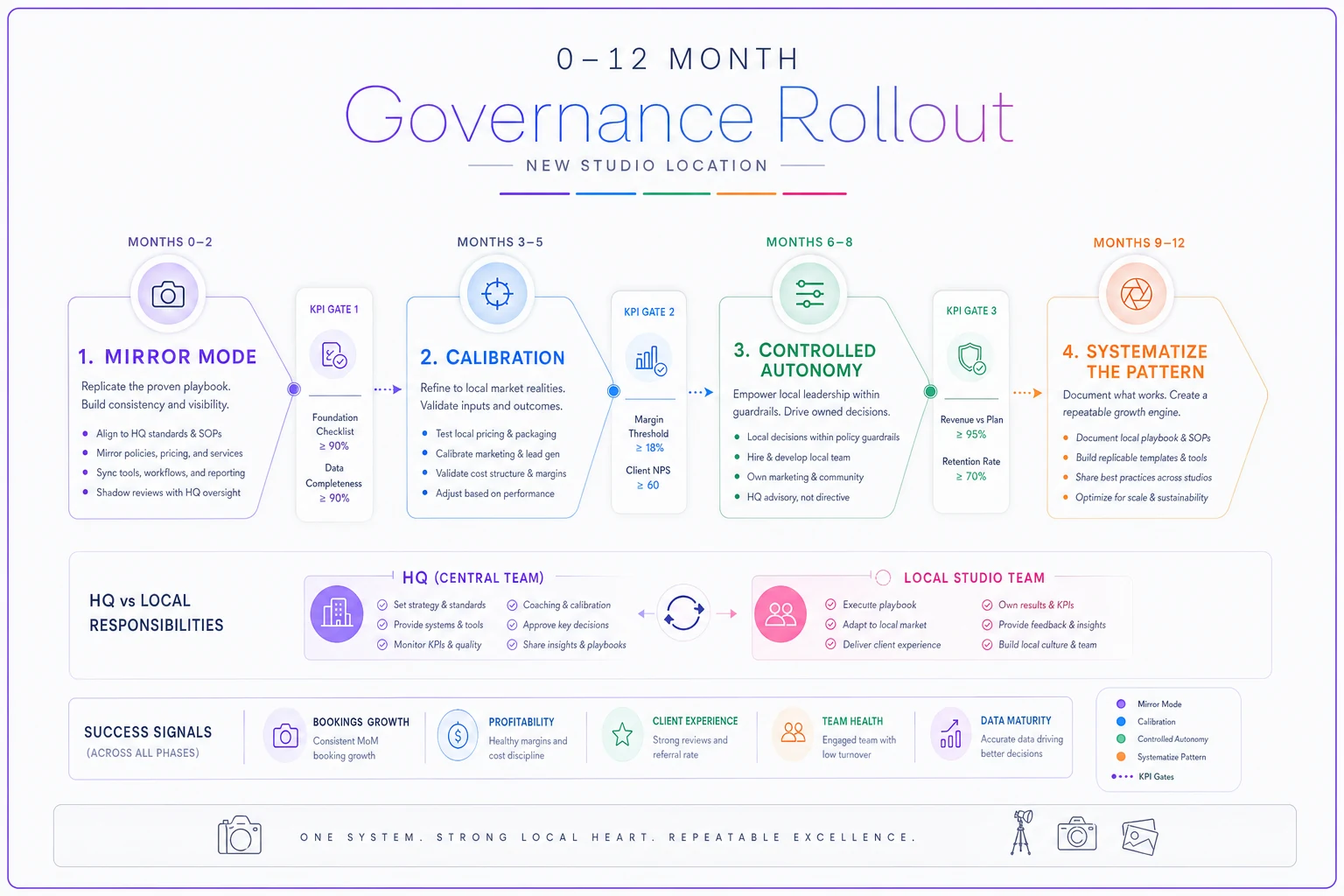
This maps phases to KPI gates and the HQ/local handoffs so everyone understands when autonomy is earned.
KPI gates: the checkpoints that decide when a location earns more freedom
A KPI gate is a specific threshold a location must hit before moving to the next governance phase. No gate, no promotion to more autonomy. This is the mechanism that keeps you from handing pricing authority to a location that's still botching delivery.
The metrics themselves should tie directly back to profitability — if you haven't built the underlying math, the studio profitability system linking cost-per-slot, package mix, and post-production is the foundation these gates sit on top of. Gates without margin logic just measure activity.
-
Consistency gate (before month 3) Gallery output from the new location is indistinguishable from flagship in a blind review. If a client couldn't tell which location shot their session, you pass.
-
Throughput gate (before month 5) Turnaround times are within roughly 15% of flagship. A new location will be slower at first — that's fine — but a location stuck at double the turnaround has a workflow problem, not a ramp problem.
-
Conversion gate (before month 6) Consult-to-book rate lands in a comparable band to your other locations. If flagship books around 55–60% of consults and the new spot is sitting at 30%, autonomy is the wrong reward — coaching is.
-
Margin gate (before month 8) Contribution margin per session is within target range. This is the gate that decides whether a location gets pricing flexibility.
-
Stability gate (before month 12) Staff retention and rebooking rates are holding. A location that hits every financial number but churns staff every two months isn't stable — it's borrowing against next year.
Notice these gates get harder to fake as they go. Anyone can hit a throughput number by cutting corners. Almost nobody can hit a stability gate without a genuinely functioning operation underneath.
The replication checklist: opening location #3 without starting from scratch
The whole point of governance is that your third location should be easier to open than your second, and your fifth easier than your third. If each launch feels like the first one all over again, you don't have a system — you have a series of heroic efforts.
-
Documented SOP package transferred and version-controlled (editing specs, delivery specs, consult scripts, escalation rules)
-
Role definitions and pay bands pre-set, not negotiated fresh each time — the hiring approach in an end-to-end staffing and talent system is what keeps location #4 from inventing its own comp structure
-
Approved vendor and lab list with pre-negotiated specs and SLAs
-
Gear standard — the exact kit list so every location shoots to the same baseline
-
Calibration shoot completed and reviewed against flagship before opening to clients
-
Scheduling template loaded with correct slot lengths and buffers
-
KPI dashboard connected and reporting from day one, not bolted on at month four
-
Named escalation path — every local manager knows exactly who they call and for what
-
Local decision ceiling documented (refund limits, promo authority, discount floors)
-
30/60/90 review dates already on the calendar before the doors open
Keep a named owner for the SOP package so it gets updated after each launch.
The checklist is boring on purpose. Boring is what scales. The exciting, improvised launches are the ones that produce inconsistency you'll be untangling a year later.
Central service samples: what HQ should actually deliver to locations
A common failure: HQ sets rules but provides no services. Local managers get a rulebook and no support, which trains them to route around HQ entirely. Governance only works when central is genuinely useful to locations, not just a compliance office.
-
Centralized editing or QC review so gallery standards stay locked regardless of where the session happened
-
Shared booking and capacity visibility across locations, so an overbooked studio can route overflow to a nearby one instead of turning clients away
-
A single client record that follows the client across locations — nothing erodes a "premium" brand faster than a returning client re-explaining their preferences at a different branch
-
Consolidated vendor and lab management so locations get volume pricing they'd never negotiate alone
-
Reporting and margin dashboards delivered to each location, not extracted from them
That cross-location visibility is where the operational layer matters most. When bookings, client history, capacity, and quality reviews all live in fragmented spreadsheets per location, HQ is flying blind and every gate becomes a guessing game. Studios that manage this well tend to centralize these workflows in a shared operational platform — the value isn't the software itself, it's that everyone's looking at the same numbers and the same client history at the same time. AI-assisted routing and quality flagging can help catch drift early (a location's turnaround creeping up, editing style diverging), but the underlying win is simple: one source of truth instead of five.
A real scenario: the third location that almost didn't work
A portrait and family studio expanded from one location to three over about 18 months. Flagship was excellent. Location two, opened with a documented SOP package and a mirror-mode launch, ramped cleanly and hit its consistency gate by month three.
Location three was the problem. The owner, feeling confident, skipped mirror mode — the local manager was experienced, so why slow them down? Within four months, that location's consult-to-book rate was sitting around 34% against a network average near 55%, and turnaround had drifted to roughly double the flagship's. The manager had quietly rewritten the consult flow and started discounting the mid-tier package to close deals, which torched contribution margin per session.
The fix wasn't dramatic. They pulled location three back to mirror mode for about six weeks, re-ran the calibration shoot, reinstated the central consult script, and locked the pricing floor. Consult-to-book climbed back into the high-40s within two months and settled near the network average by month six. The margin recovered once the discounting stopped.
The lesson wasn't "the manager was bad." The manager was good — which was exactly the problem. A capable person with no gates and no governance will build their own system, and their system won't match yours. Governance isn't distrust. It's the thing that lets talented people succeed inside your standard instead of drifting outside it.
When a formal operating model makes sense — and when it doesn't
When it makes sense: You're at two locations and planning a third, or you're opening your second and already know you won't stop there. If replication is the goal, build the governance layer before you need it — retrofitting standards onto locations that already run their own way is brutal.
When it's premature: You have one location and a vague idea of expanding "someday." Building a full central-vs-local matrix for a single studio is over-engineering. Document your SOPs well, yes — but don't build a corporate governance structure for a business that doesn't have branches yet.
Who should NOT do this: Owners who are expanding to escape problems at their current location. A second location doesn't fix a broken first one — it multiplies the break. If your flagship isn't hitting consistent quality, turnaround, and margin, governance won't save the expansion, because there's no working standard to replicate. Fix the one before you clone it.
Bringing it together
The studios that scale past two locations aren't the ones with the best photographers or the nicest spaces. They're the ones that decided, on purpose and in writing, what belongs to HQ and what belongs to the floor — and then built gates so autonomy gets earned instead of assumed.
Start with the responsibility matrix. Phase your first year instead of dumping everything at once. Set KPI gates that get harder to fake as they go. Make your replication checklist boring and repeatable. And make sure central actually delivers services worth having, so local managers pull toward HQ instead of routing around it.
Do that, and location #3 becomes a process instead of a gamble. Skip it, and you'll spend your growth year discovering all the decisions you never realized you were making — one client complaint at a time.
Ready to elevate your studio’s workflow?
Join 500+ studios using TryPixly to save time, reduce scheduling conflicts, and deliver exceptional client experiences.