

Most studios build their release process around a world that no longer exists — one where the person in front of the camera was either a paid model booked through an agency or a private client who'd never dream of reposting. That gap is where studios get burned now. The subject is an influencer. The usage isn't "personal." And the single-page release you've been reusing since 2017 says nothing about whether the brand can boost the content on Meta for eighteen months across three markets.
This is specifically about influencer model release photography — the messy middle where the person photographed also has commercial leverage, the content has resale and ad value, and the paperwork has to survive a legal review two years later when nobody remembers what was agreed.
If your releases are built for either agency talent or private clients but not for creators who sit between both, this is the playbook to fix that.
Why the standard release breaks the moment an influencer is involved
A normal model release assumes a one-directional grant: the subject gives the photographer (or the client) rights to use the images. Clean. Simple.
Influencers break that in three ways at once.
First, they often have their own usage rights baked into their deal with the brand — they want to post the content too, sometimes before the brand does, sometimes with their own captions and tags. Your release has to acknowledge a shared-usage reality, not a transfer.
Second, their likeness has independent commercial value, which means "flat day rate, all rights assigned" doesn't fly. There's negotiation over territory, duration, channel, and whether paid amplification is included. A creator will happily shoot for a usage fee but gets twitchy when "in perpetuity, all media" shows up in clause four.
Third — and this is the one that bites studios directly — the brand client assumes you handled the rights cleanly, and when a dispute surfaces, they come to the studio, not the influencer. You're the one holding the signed document, so you're the one explaining why it doesn't cover what everyone's now doing with the images.
What tends to happen across studios juggling both commercial and creator work is that the release becomes an afterthought handled by whoever's free on shoot day, using whatever template lives in a shared Google Drive folder. That works until a brand's legal team asks for proof that the influencer consented to a specific paid-ad usage, and you're scrolling through DMs trying to reconstruct consent after the fact.
A template library instead of one master release
The fix isn't a better single template. It's a small library of release variants where you pick the right one based on the shoot, and each variant has a locked structure so the only things that change are the negotiated variables.
Never miss a shoot or client detail again.
TryPixly helps you book, confirm, and manage every photography session seamlessly.
- Unified session and client management
- Automated client reminders
- Team calendar & resource scheduling
No credit card required
Here's the core set worth building.
| Release variant | When to use it | Key clauses that differ |
|---|---|---|
| Standard talent release | Paid model, no personal brand, rights fully licensed to client | Duration, territory, exclusivity window |
| Influencer co-usage release | Creator who will also post the content themselves | Subject's own posting rights, embargo timing, tagging requirements |
| Influencer licensed-usage release | Creator licensing likeness for a defined campaign | Channel list, paid-amplification flag, renewal terms |
| Hybrid/UGC release | Creator producing content on the brand's behalf | Who owns raw files, edit approval, whitelisting/Spark Ads rights |
| Minor/guardian release | Any subject under 18 | Guardian signature, narrower usage scope, shorter duration default |
The point of variants is that you stop improvising. The shoot coordinator asks two questions — Is the subject also distributing the content? and Is paid advertising involved? — and the answer routes to one of five documents, not a blank page.
Template the hybrid/UGC release first since it's the one studios skip and causes the worst surprises.
One pattern worth flagging: the hybrid/UGC release is the one studios skip most often, and it's the one causing the worst surprises. When a creator shoots content that the brand then runs as paid ads from the brand's own account (whitelisting / Spark Ads), the standard influencer release doesn't cover it. The creator agreed to post — not to have their face run as a brand ad they don't control. If your library doesn't have a variant that names this explicitly, you will eventually have a creator demanding the ads come down mid-campaign.
A decision matrix for pricing adders
Studios tend to price the shoot and treat usage as an afterthought, which is exactly backwards for influencer work. The usage is the product. Here's a workable way to structure adders so you're not guessing or undercharging.
-
Base production fee — your actual cost to shoot and deliver, priced the way you'd price any commercial session.
-
Usage duration adder — short campaign (up to 3 months), standard (up to 12 months), extended (12+ months). Each tier steps up meaningfully, not by a flat 10%.
-
Channel breadth adder — organic social only vs. social + web vs. social + web + OOH/print. The more channels, the higher.
-
Paid amplification adder — this is the big one. The moment content gets ad spend behind it, value jumps. Price a distinct adder for paid, and a higher one if the brand wants whitelisting through the creator's handle.
-
Exclusivity adder — if the brand wants the creator locked out of competitor work in the same category for a window, that's a real cost to the creator and should be a real line on your invoice.
-
Renewal/extension adder — pre-negotiated so an extension doesn't become a renegotiation.
The mistake studios make is quoting usage as a single number instead of a matrix. When you quote one number, every change becomes a fight. When you quote it as adders, a client who wants to extend from 6 to 12 months already knows the cost — it's defined in the agreement, not invented later.
A realistic example: a studio shooting a skincare brand's creator campaign quoted a flat "$2,500, you can use it however" and then the brand decided to run paid ads across two markets for a year. The studio had no adder structure, so they either ate the under-pricing or went back to the creator — who now had leverage — to renegotiate. Done right, the paid-amplification and multi-market adders would've already been priced, turning a tense renegotiation into a one-line approval. The thinking here overlaps heavily with how studios should already be handling releases, usage pricing and secure storage — influencer work just raises the stakes because the subject has their own rights to protect.
DAM tracking: connecting the release to the actual files
A signed release that isn't connected to the specific files it covers is almost useless under pressure. This is the operational failure that quietly costs studios the most.
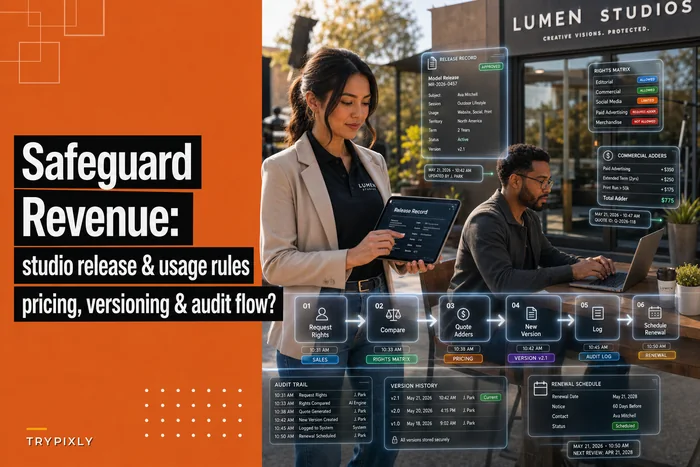
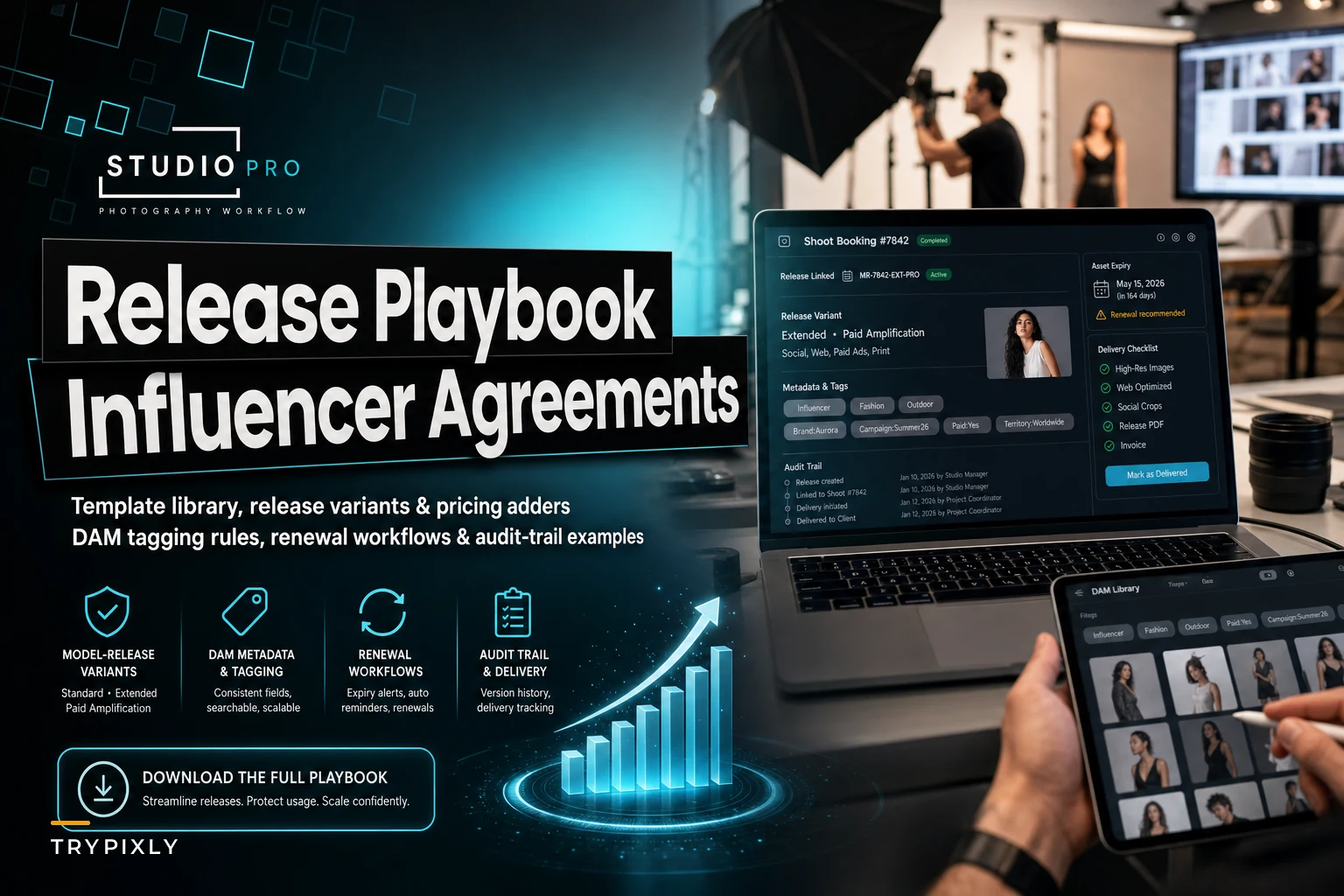
The workflow that actually holds up: the moment a shoot is booked, the release variant and its negotiated terms get attached to the project record — before anyone picks up a camera. When files are ingested, they inherit metadata tied to that release: subject name, usage scope, duration, paid-amplification flag, expiry date, and a link to the signed PDF.
-
At booking release variant selected, pricing adders logged, terms captured as structured fields (not buried in a contract nobody will re-read).
-
At ingest files tagged with the release ID so every asset carries its own permission profile.
-
At delivery the usage scope travels with the files to the client, so there's no ambiguity about what they're allowed to do.
-
On an ongoing basis expiry dates are visible, so you know which campaigns are approaching the end of their licensed window.
The common breakdown is that the release lives in a signing tool, the files live in the DAM, and nothing connects them. Six months later a brand asks "can we keep running this?" and nobody can answer without a manual archaeology dig. If your DAM already has governance discipline, this is an extension of it — the release becomes just another piece of asset metadata rather than a document floating in a separate system.
A small but important detail: tag the paid-amplification flag as its own searchable field. When a creator's rights expire, you want to instantly pull every asset that was running as a paid ad under that creator's likeness, because those are the assets that create legal exposure if they keep running. You can't do that if "paid: yes/no" is buried in clause seven of a PDF.
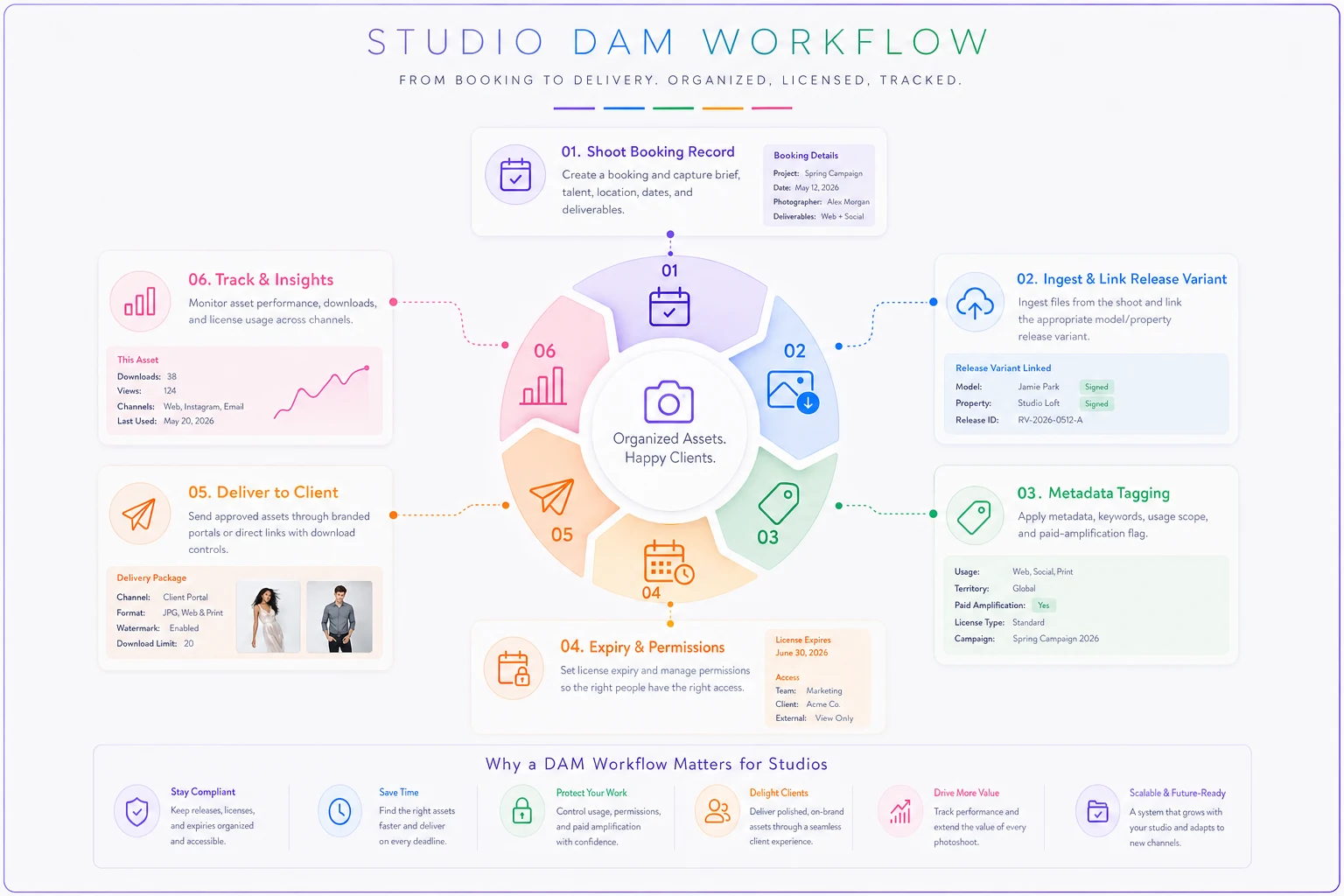
This diagram shows the DAM workflow for connecting releases to files.
Renewal and extension rules that prevent the awkward re-negotiation
Licenses expire. Campaigns don't always stop when they expire. That gap is where studios get dragged into disputes they didn't create.
-
Pre-priced extensions. The cost to extend a 6-month usage to 12 is defined at signing. No surprise renegotiation.
-
Notice windows. The brand must notify you (and the creator) a set number of days before expiry if they want to renew. Silence = usage must stop.
-
Expiry triggers a review, not an auto-renewal. Default to off. Auto-renewing influencer usage is how you end up with a creator's face running in ads two years after they moved on, and a very unhappy phone call.
-
Rate-step on renewal. A renewal isn't the original rate forever — the creator's following and value may have changed, and the agreement should allow a defined step rather than locking in year-one pricing indefinitely.
The decision rule is simple: if a license is approaching expiry and no renewal has been signed, the content comes down. Your DAM expiry dates make that enforceable instead of aspirational.
When this level of rigor actually makes sense
If you shoot one or two creator campaigns a year, a single well-written influencer release plus a calendar reminder for expiry dates is probably enough. Don't build a five-variant library and a metadata schema for volume you don't have.
When it's a bad idea
If your work is almost entirely private clients and traditional agency talent, forcing influencer-specific variants into every workflow just adds friction. And if you're shooting purely organic, no-paid-ad creator content for small brands, the heavy paid-amplification and whitelisting clauses will make simple deals feel adversarial. Match the paperwork to the actual risk.
The audit trail: proving what was agreed, when, and by whom
When a dispute lands, the question is never "did you have a release?" It's "can you prove this specific person consented to this specific usage on this specific date?" That's an audit-trail problem.
-
Timestamped signature on the correct release variant.
-
The negotiated terms as structured data, not just prose, so it's clear what duration/channel/paid scope was agreed.
-
Version history — if terms were amended mid-negotiation, you can show which version was actually signed.
-
A link from the signed document to the delivered assets, so you can prove these files fall under this release.
-
A record of renewals or extensions, each with its own timestamp and approval.
Here's a realistic audit scenario. A brand runs a creator's content as a paid ad past the licensed window. The creator complains publicly. The brand's legal team calls the studio asking for proof of what was licensed. With a clean trail, the studio produces: the signed licensed-usage release dated March, showing 6-month organic + 6-month paid usage, expiring in September, with no renewal on file. That instantly clarifies that the brand overran its license — the studio did its job, and the exposure sits where it belongs. Without that trail, the studio looks negligent by default, because they're the one who ran the shoot.
This is the same governance instinct that protects you on post-sale delivery and account disputes with bigger clients — the difference is that with influencers you're documenting a living person's consent, which raises the bar considerably.
A real scenario
A mid-sized commercial studio was doing roughly 15–20 creator campaigns a year for a handful of DTC brands. Their process: one reused model release, signed on shoot day, stored in a shared drive by date.
The problem surfaced when a skincare brand extended a campaign and started running a creator's content as paid ads in a second market. The creator objected — she'd understood it was organic, single-market. The brand pointed at the studio. The release said nothing specific about paid amplification or territory. The studio spent close to two weeks reconstructing the agreement from emails and ended up offering a discount on the next project to smooth things over — a few thousand dollars of margin gone, plus a bruised client relationship.
After that, they built a four-variant library, added usage adders to every creator quote, and started attaching each release's terms to the project record with an expiry date. The shift wasn't dramatic in effort — the coordinator now spends maybe ten extra minutes per shoot routing to the right variant and logging terms. But over the next year they stopped having a single consent dispute, and two brands actually extended spend because the extension pricing was already defined and painless to approve. The usage adders alone pulled in noticeably more per campaign than their old flat-fee quotes did, because they were finally charging for the paid-amplification value they'd been giving away.
Handoff discipline matters as much as the release itself
One last operational point that gets overlooked: the release only protects you if the people downstream respect it.
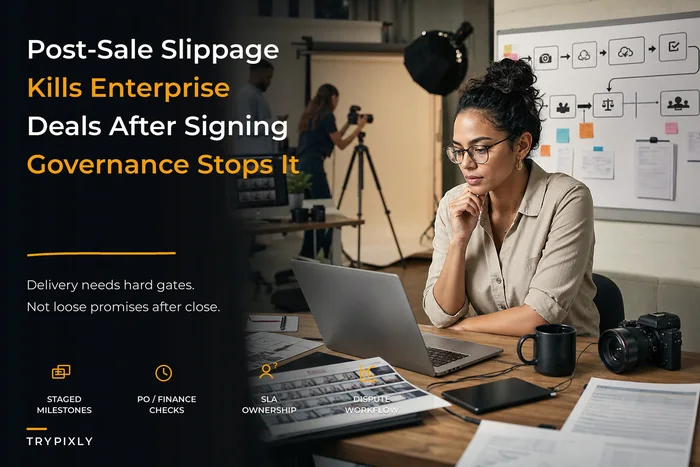
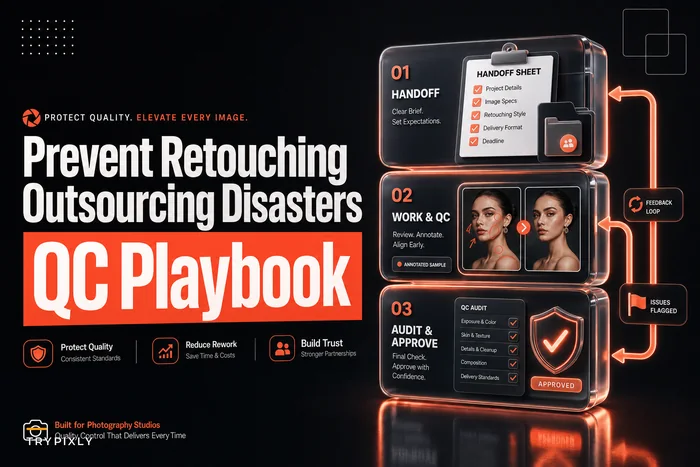
If your retoucher delivers a cut that's technically out of the licensed scope, or your delivery process hands a client more than they paid for, the paperwork upstream doesn't save you. The same handoff discipline that keeps outsourced retouching from turning into a disaster applies here — usage scope has to travel with the files all the way to final delivery, not stop at the signature.
Where to start
You don't need to build the whole system this week. Start with the two highest-risk gaps:
-
Create the influencer licensed-usage and hybrid/UGC variants. These are the two most studios are missing, and they're the ones creating the worst surprises.
-
Add a paid-amplification flag and an expiry date to how you track every creator asset. Even a spreadsheet column beats a PDF nobody re-reads.
From there, add pricing adders to your quotes so usage stops being free, and build the audit trail so you can always answer who consented to what, when. The studios that get dragged into influencer disputes aren't the ones with bad photographers — they're the ones whose paperwork was built for a client who no longer exists.
From there, add pricing adders to your quotes so usage stops being free, and build the audit trail so you can always answer who consented to what, when. The studios that get dragged into influencer disputes aren't the ones with bad photographers — they're the ones whose paperwork was built for a client who no longer exists.
Ready to elevate your studio’s workflow?
Join 500+ studios using TryPixly to save time, reduce scheduling conflicts, and deliver exceptional client experiences.