
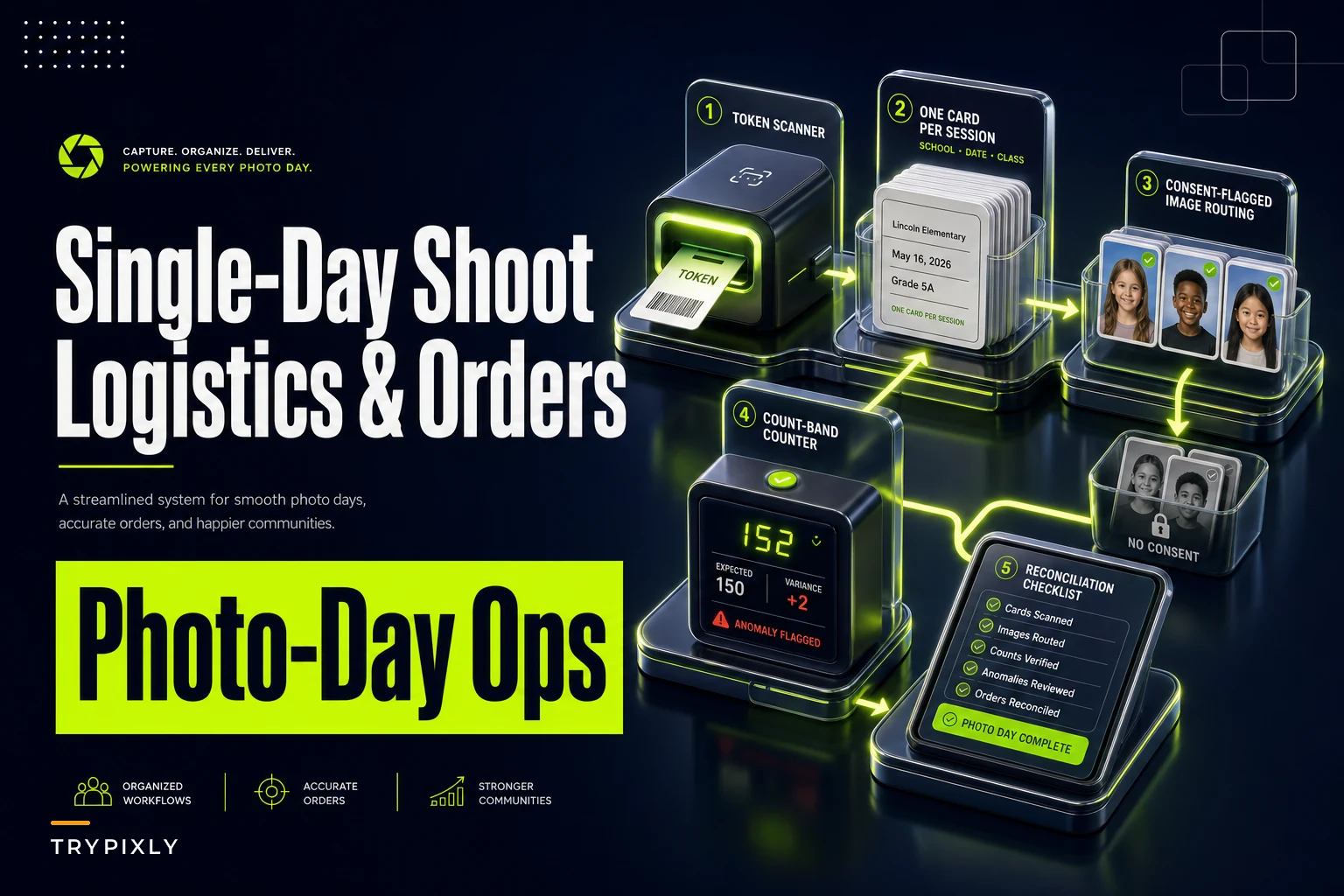

School picture day and sports day photography lives or dies in about six hours. You show up, you shoot 400–900 kids, and then everything you captured has to survive the chaos of matching faces to names, orders to students, and prints to the right classroom envelope weeks later. The photography part is almost the easy part. The operations part is where studios quietly bleed margin.
Most studios that struggle with school photography logistics don't fail because their photographers are slow. They fail because the data fell apart on-site — a consent form went missing, an order slip got separated from a kid, or a batch of files got ingested with the wrong grade tag. And you don't find out until you're three days into fulfillment and someone's mom is emailing about why her son's package shows a different child.
This post is narrow on purpose. It's about the flow of paper, consent, orders, and files on a single high-volume day, and how to reconcile all of it afterward without a spreadsheet nightmare.
The single point of failure nobody plans for: identity matching
What breaks first on a high-volume day isn't the camera, the lighting, or the backdrop. It's the link between this photo and this specific child, with this specific order attached.
On a family session you have one client and plenty of time. On school day you have a line of 30 kids per class, teachers rotating them through in under a minute each, and a photographer who never learns a single name. The identity chain looks like this:
Student → order form (parent filled out, or not) → session capture → file → gallery access → fulfillment envelope.
Break any one of those links and the whole order becomes an orphan. A typical example: a kindergartner walks up without a form because it's crumpled in their backpack. Photographer shoots anyway — correctly, you never skip a kid. Now you have images with no order attached and no reliable name. Multiply that by 40–60 kids across a mid-size school and you've got an afternoon of detective work.
The studios that get this right treat identity capture as the primary job of the day, not an afterthought. Every kid gets a scannable token — a printed card, a barcode sticker, a numbered clip — that ties their frames to a record before they sit down.
Permission capture flows: consent before the shutter, not after
School and sports work has a consent layer that portrait studios usually don't deal with. Parents have to opt in for photos, and increasingly they have to separately opt in for how images get used — internal yearbook only, sold to families, or usable in your marketing.
Never miss a shoot or client detail again.
TryPixly helps you book, confirm, and manage every photography session seamlessly.
- Unified session and client management
- Automated client reminders
- Team calendar & resource scheduling
No credit card required
The mistake studios make is treating consent as a single yes/no box collected at the school office. In reality you're dealing with three separate permissions that don't always move together:
-
Permission to photograph the child at all
-
Permission for the family to purchase/receive images
-
Permission for image use beyond the family (yearbook, team composite, studio promotion)
A parent might say yes to the first two and no to the third. If your capture flow doesn't record that distinction at the moment of capture, you'll either withhold images you were allowed to sell, or worse, use a child's face in an ad you had no right to.
A workable permission flow for the day
-
School distributes a digital consent form 2–3 weeks ahead, tied to each student's ID.
-
On-site, the check-in station pulls up consent status by scanning the student token.
-
If consent is missing, the student still gets photographed, but their record is flagged "hold — no consent on file."
-
Held records never enter the sales gallery or marketing pool until consent clears.
-
A same-day export gives the school office a list of missing-consent students so they can chase parents while it still matters.
The flag-and-hold approach matters because skipping unconsented kids creates its own disaster. A child who missed picture day because of a paperwork gap becomes an angry-parent phone call and a costly re-shoot. Shoot everyone, gate the release, not the capture.
If you handle image usage rights across your work, the same discipline around releases and secure storage applies here — the studio decision rules for releases, usage pricing and secure storage mindset carries directly into school consent handling, where the stakes are higher because the subjects are minors.
On-site order capture: templates that survive a folding table
The order slip is the most fragile object of the entire day. It's paper, it's near kids, it's near juice boxes, and it has to travel with the child's identity through the whole pipeline.
What works consistently on high-volume days is a template built around three constraints: fillable in under 30 seconds, carrying the identity token, and photographable so a paper copy never becomes the only copy.
A good on-site order slip includes:
-
Pre-printed student token / barcode (matched to the check-in record)
-
Student name, grade, teacher — pre-filled where possible
-
Package selection as checkboxes, not write-ins
-
Sibling linking field (huge for family reconciliation later)
-
Consent status confirmation checkbox
-
A visible "photographed at [time]" stamp added at the station
| Capture model | Speed on-site | Order loss risk | Reconciliation effort | Best for |
|---|---|---|---|---|
| Pure paper slips | Fast | High (paper walks off) | Heavy manual matching | Very small schools |
| Pure digital-only | Slower per kid | Low | Light | Schools with strong pre-registration |
| Hybrid (token + photographed slip) | Fast | Low | Moderate | Most one-day high-volume shoots |
The hybrid model — physical token scanned at check-in, order slip photographed and linked immediately — is what holds up when a class of 28 comes through in 20 minutes. The paper can still get lost. The record can't.
The sibling problem
Siblings at different grade levels are where order matching quietly falls apart. A family orders one combined package but the kids get photographed 90 minutes apart in different classes. If your slip doesn't have an explicit sibling-link field captured at the table, you end up with two half-orders that neither reconcile nor ship correctly. Ask the sibling question at check-in, every time.
Ask the sibling question at check-in, every time.
Ask the sibling question at check-in, every time.
Batch ingestion rules: the moment files hit your system
Ingestion is where a clean day gets ruined by lazy rules. You come back with 3,000–7,000 frames from one school and dump them onto a drive. If folder structure and tagging aren't enforced at ingestion, you're guessing which frames belong to which class weeks later.
Set ingestion rules before the day, not after. The non-negotiables:
A quick visual of the ingestion workflow:
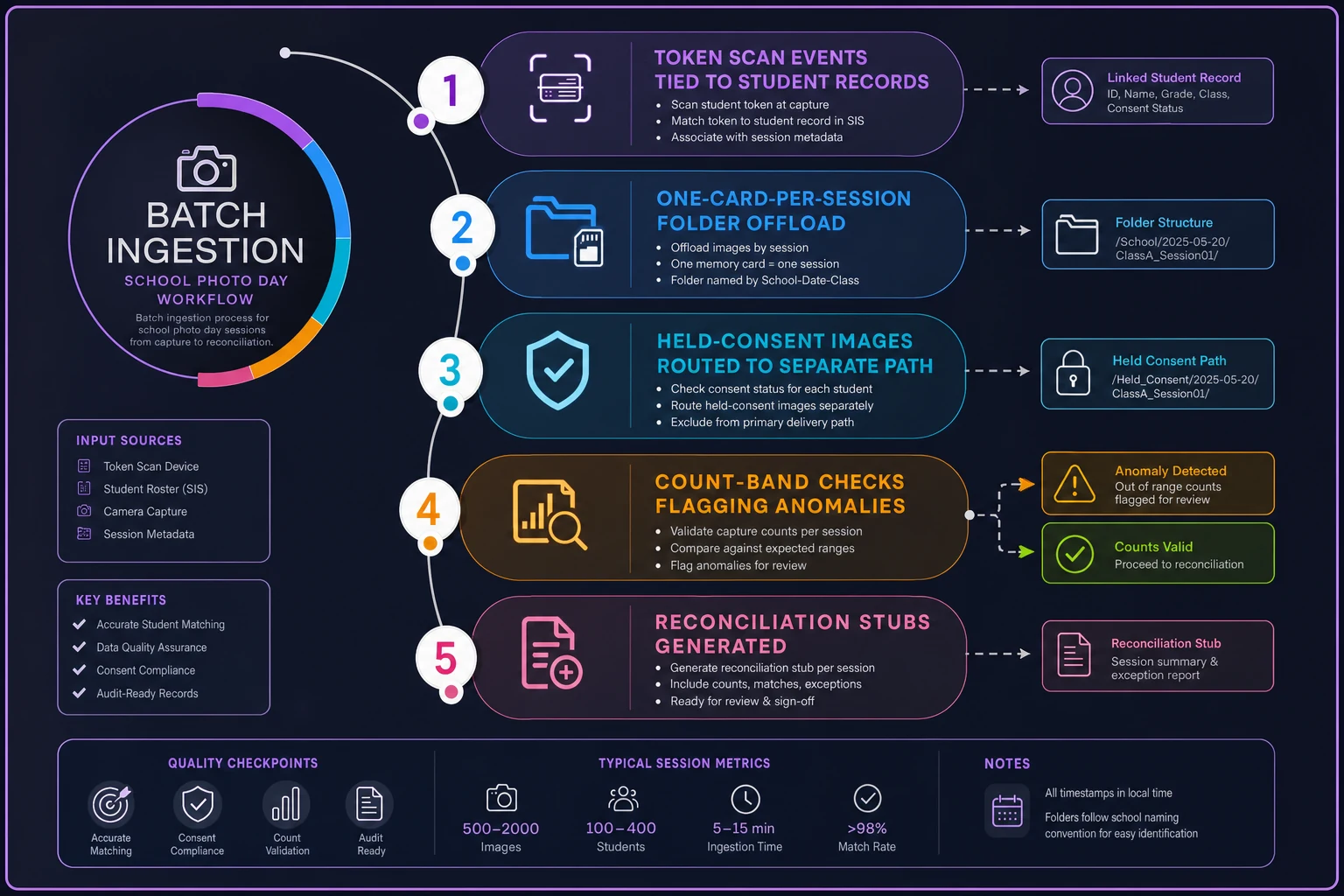
This diagram highlights the checkpoints you'll enforce at offload.
-
One card = one session block = one folder, named by school-date-class. No mixed cards.
-
Token scan events get timestamped so files can be aligned to students by capture time even if a slip is missing.
-
Reject frames outside the expected count band. If a class of 28 produced 3 frames or 400, something's wrong — flag it before it goes downstream.
-
Held-consent students get a separate ingestion path so their images physically cannot land in the sales gallery by accident.
-
Every batch gets a reconciliation stub — an expected-vs-actual count sheet generated at ingestion.
The most common ingestion failure is silent: nobody notices that Ms. Patel's third-grade class is missing entirely because the photographer's second card wasn't offloaded. You only find out when 26 families can't find their kids in the gallery. The count-band check and the per-class expected count catch this on day one instead of day fourteen.
This is also where studios shooting high volume for institutions start thinking about margin the same way they would on any big account. The discipline in a studio profitability system that ties cost-per-slot, package mix and post-production into decision rules applies here — a school day isn't priced per session, it's priced per throughput, and ingestion errors are pure margin leak.
Vendor routing: getting the right files to the right lab
Once files are ingested and matched, they split. Yearbook composites go one place, family print orders go another, team collages and sports "memory mates" often route to a specialized product vendor. This fan-out is where high-volume studios lose track of what shipped where.
The routing logic needs to be rule-based, not decided file-by-file:
-
Family retail orders → your standard print lab, batched by school and shipped to the school for classroom distribution (or split-shipped to homes).
-
Yearbook / school administrative set → separate export at required resolution and naming convention the school's yearbook software expects.
-
Sports composites and team products → specialty vendor, which usually needs the team roster and individual crops together.
-
Held-consent students → nowhere until cleared.
The pattern that bites studios: sending the same export to every vendor. Yearbook software wants specific filenames and dimensions. Print labs want a different structure. Sports composite vendors want grouped roster data. One generic export means at least one vendor kicks the whole batch back, and now you're re-exporting under deadline pressure.
Build a routing table per school before you shoot, listing every downstream vendor, their file spec, their deadline, and their contact. Treat it like the account governance you'd apply to any large institutional client — the same rigor from the B2B ops playbook for corporate and high-volume clients keeps a school district from becoming an unprofitable account.
Post-event reconciliation: the checklist that catches problems before parents do
Reconciliation is the step everyone under-invests in, and it's the single best predictor of whether a school day was profitable or a slow-motion refund event. The goal is simple: confirm that every consented student who was photographed has matched files, a matched order (if they ordered), and a clear routing destination — before anything ships.
Run this within 48 hours of the shoot, while memory is fresh and the school can still help:
-
[ ] Total students on roster vs. total students photographed — investigate every gap
-
[ ] Every photographed student has at least one usable frame linked to their record
-
[ ] Every order slip is linked to a student record (no orphan orders)
-
[ ] Every ordering student has files that pass the sales-gallery check
-
[ ] Held-consent list reconciled against final consent status
-
[ ] Sibling links verified across grade levels
-
[ ] Per-class frame counts within expected band
-
[ ] Each downstream vendor batch matches its expected count
-
[ ] Missing-student list sent to school for re-shoot scheduling
-
[ ] Refund/hold list generated for unresolved orders
If you're finding orphan orders during reconciliation, you'll find more of them after shipping when parents complain. Reconciliation isn't paperwork. It's your last chance to catch mismatches while they're cheap to fix.
A worked example: mid-size elementary school day
Business type: a two-photographer studio doing about a dozen school and sports days each spring.
The school: roughly 480 students across 19 classes, one shooting day.
Before they tightened the flow: They ran pure paper slips, ingested files into date folders with no per-class rules, and reconciled "as orders came in." On a school of this size they'd end up with 25–40 orphaned orders and missing-file situations, each taking 15–30 minutes to resolve. Two of those per year escalated into re-shoots. Fulfillment stretched close to five weeks, and they were writing off a handful of orders entirely because they simply couldn't match them.
After moving to token-based check-in, photographed slips, and enforced ingestion rules: Orphan orders on a comparable school dropped to low single digits. The count-band check caught a fully-missed class on ingestion day instead of after gallery launch, turning a potential 26-family disaster into a same-week fix. Reconciliation went from an open-ended slog to a focused half-day. Turnaround tightened to around three weeks, and the near-total elimination of unmatched write-offs mattered more to margin than any pricing change they made that year.
Nothing about their gear or their shooting changed. What changed was that identity, consent, and orders were locked together at the moment of capture, so reconciliation became a verification step instead of an investigation.
When this level of process makes sense — and when it doesn't
Do this if: you're regularly shooting schools or sports leagues of 200+ subjects, routing to multiple vendors, or handling consent for minors. At that scale, the cost of orphaned orders and re-shoots dwarfs the setup effort.
You can run lighter if: you're doing a single small daycare of 30 kids with one product option and one lab. Full token infrastructure is overkill — a well-designed paper slip with photographed backups is fine.
Who should not bolt this on mid-season: a studio that's about to shoot its biggest school of the year next week. Rolling out a new capture flow untested on a high-stakes day is how you invent brand-new failure modes. Pilot it on a small school first, break it there, then scale it.
The through-line
Single-day high-volume school and sports work rewards preparation in a way portrait work never does, because you get exactly one pass at each child and no chance to redo the data later. The photography is repeatable. The identity chain — consent to token to order to file to vendor — is not.
Build the token flow, gate consent at release, enforce ingestion rules on the drive before anything moves downstream, and give each vendor its own spec. Do that, and the six hours of chaos on picture day turn into a pipeline you can actually trust weeks later when the orders come due.
Ready to elevate your studio’s workflow?
Join 500+ studios using TryPixly to save time, reduce scheduling conflicts, and deliver exceptional client experiences.