

Most studios operate like nothing will ever go wrong. Then a client slips on a cable run during a newborn session, a rented lens gets dropped on a commercial shoot, a hard drive dies with three unarchived weddings on it, or a second shooter's car gets broken into with $9k of gear inside. Suddenly the question isn't "did we get the shot" — it's "who's liable, what does our policy actually cover, and how long until we see the money back."
The gap most owners discover too late is that incident response and insurance aren't two separate things. They're one workflow. The quality of your response in the first hour determines whether your insurer pays, whether the client sues, and how badly the whole thing dents your cashflow. And that workflow almost always breaks in the same places — not because owners are careless, but because the pieces live in different heads, different folders, and different inboxes.
This is the playbook for tying it all together: the policies you actually need, the scripts your team follows when something goes wrong, the waivers that hold up, the vendor insurance checks that stop you absorbing someone else's mistake, and a claims reconciliation process mapped to what each incident does to your money. Photography studio insurance and incident response isn't glamorous, but it's the difference between a bad week and a closed business.
Why the system breaks (and it's rarely the policy itself)
The studios that get burned usually have insurance. What they don't have is the connective tissue between the moment something happens and the moment a claim gets filed correctly.
A typical breakdown looks like this. An incident occurs on-site. The photographer handles it emotionally and well — calms the client, apologizes, maybe offers a free reshoot on the spot. That generous verbal promise, made before anyone looked at the policy, becomes a problem three weeks later when the insurer wants to subrogate and the client has already been told "don't worry, we'll make it right." Nobody wrote down what happened. No photos of the scene. No timestamps. The waiver the client signed was a 2019 template that never mentioned the specific risk. By the time the claim gets filed, half the useful evidence is gone and the story has three versions.
What tends to happen across a lot of small operations is that the failure isn't a single missing document. Incident response, documentation, client communication, and insurance filing are each owned by different people — or nobody — and they only collide when it's already too late to coordinate them.
This gets exponentially worse as you scale. A solo shooter can hold the whole thing in their head. A five-photographer studio running weddings, commercial, and school days simultaneously cannot. The second shooter at a Saturday wedding has no idea what your insurance covers or what to say when a guest trips over a light stand. If you haven't built the response into a repeatable system, every incident is handled by whoever happens to be standing there, with whatever judgment they've got that day.
The five policies you actually need to have decided in advance
Before any script or checklist matters, someone has to make decisions about coverage and liability. Most studios carry general liability and call it done. That's a thin layer. Here's how the pieces map to the real risks studios face.
Never miss a shoot or client detail again.
TryPixly helps you book, confirm, and manage every photography session seamlessly.
- Unified session and client management
- Automated client reminders
- Team calendar & resource scheduling
No credit card required
| Policy / Coverage | What it actually protects | Where studios get caught |
|---|---|---|
| General liability | Third-party bodily injury & property damage (guest trips, client's property damaged) | Assuming it covers your own gear — it doesn't |
| Inland marine / equipment | Your cameras, lenses, lighting — including off-premises and rented gear | Rented gear often needs to be scheduled or specifically endorsed |
| Professional liability (E&O) | Failure to deliver — corrupted files, missed moments, lost wedding | Often excluded or needs separate rider; this is the one that saves weddings |
| Cyber / data | Breach of client images, stored galleries, PII | Growing exposure as studios store more client data online |
| Workers' comp / contractor coverage | Injury to your staff and, in some states, your 1099 shooters | Treating contractors as uncovered when state law disagrees |
The decision you need to make isn't just "do we have these." It's defining the thresholds and the owner for each. Who confirms rented gear is scheduled before a shoot? What's the deductible on equipment, and does that change what's worth claiming versus eating? If a wedding's files are unrecoverable, does your E&O cover the reshoot, the refund, or neither? Those answers should exist on paper before an incident, not get discovered during one.
One thing worth flagging: studios often buy coverage based on current operations and never revisit it. If you added commercial work, started storing galleries in the cloud, or began using 1099 shooters, your old policy almost certainly has gaps you're not aware of. Review coverage any time the shape of the business changes, not just at renewal.
Incident-response scripts: the first 60 minutes
The emotional instinct in a crisis is to over-promise to keep the client happy. The operational discipline is to respond warmly without admitting fault or committing to remedies you haven't scoped. Those two things can coexist, but only if your team has words to use.
-
Ensure safety first. Stop the shoot if needed, attend to the person, call medical help if there's any doubt. Nothing else matters until this is handled.
-
Say the right thing. Something like
"I'm so sorry this happened — let's make sure you're okay first. I'm going to document everything so we take care of it properly." Note what's missing: no "it's our fault," no "we'll pay for that," no promises.
-
Document the scene immediately. Photos from multiple angles, timestamps, what the conditions were, who witnessed it. Your phone is already in your hand — use it.
-
Capture the account while it's fresh. What happened, in sequence, in writing. Memory degrades within hours.
-
Escalate to the owner/manager before making any commitment. The person on-site is not the person who decides the remedy.
-
Log it into a single record so the claims process starts from complete information, not a reconstruction.
For a gear or data incident — dropped rented lens, dead drive, corrupted cards — the sequence shifts toward preservation and chain of custody. Don't reformat the card. Don't try DIY recovery on a failing drive before documenting its state. Note the serial number of damaged rented equipment and photograph the damage before it moves.
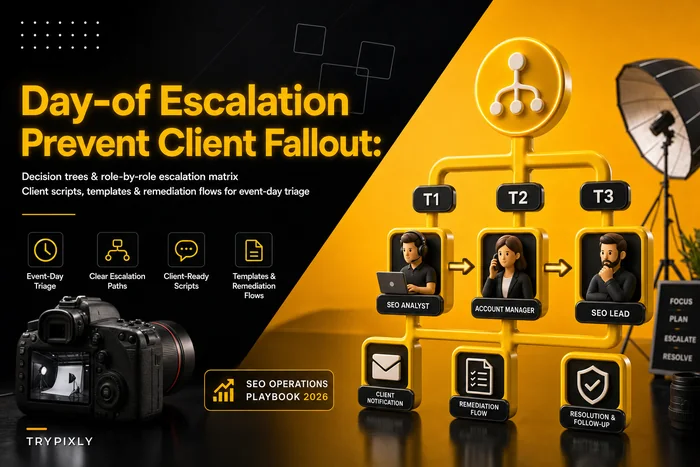
The connection to your event-day structure matters here. If you've already built a day-of escalation plan with decision trees and role scripts, the incident-response scripts should plug directly into it — same escalation ladder, same owner-of-decision, so your team isn't learning a second system under stress.
Client waivers that actually hold up
A waiver that was downloaded once and never updated is barely better than nothing. The common failure is generic language that doesn't name the specific risks of the session type. A newborn session, a boudoir shoot, an on-location family session near water, and a corporate headshot day carry completely different risk profiles, and a one-size waiver covers none of them well.
Waivers do two jobs. First, they establish informed consent — the client acknowledged the real risks of this activity. Second, they set expectations about deliverables and limits, which is where E&O-type disputes get defused before they start. A line clarifying that the studio isn't liable for consequential damages beyond the session fee changes the ceiling on a "you ruined my wedding" claim considerably.
-
Session-specific risk language — name the real hazards of the specific shoot type
-
Delivery and file-loss terms — what happens if images are lost, delayed, or partially unusable
-
Liability caps — explicit limits tied to the session value where legally permissible
-
Model/property releases where relevant, kept separate from the liability waiver
-
Minors and guardianship — who signs for newborn and child sessions
-
Signature capture and storage — signed, dated, timestamped, and findable later
-
Jurisdiction review — a lawyer in your state has actually looked at it
That last point gets skipped constantly. Waiver enforceability varies by state, and template language written for one jurisdiction can be partially void in another. The cost of a single legal review is trivial against what an unenforceable waiver costs during a real claim.
Vendor insurance checks: stop absorbing other people's risk
As studios grow, they lean on outside parties — second shooters, retouchers, rental houses, venue partners, print labs, assistants. Every one of those relationships is a place where someone else's failure can land on your policy and your reputation.
The core discipline is a certificate of insurance (COI) requirement for anyone whose mistake could hurt you, verified before the engagement and tracked for expiration. In real operations, this breaks because COIs get requested informally, collected inconsistently, and then nobody notices when they lapse. A contractor you used last year is still on your roster with a policy that expired four months ago, and you only find out when something goes wrong on their shoot.
The patterns worth building into your vendor management approach include naming your studio as additional insured where appropriate, setting minimum coverage amounts by vendor type, and holding a live record of every COI with its expiration date. A rental house's coverage is irrelevant to the lens you dropped — that's on your inland marine — but a venue's liability coverage is very relevant when a guest is injured at their property during your shoot.
-
Always 1099 photographers and second shooters, assistants handling gear, anyone on a commercial set
-
Usually venues (verify theirs), rental equipment houses, delivery vendors for high-value albums
-
Depends retouchers (lower physical risk, but data/confidentiality terms matter more than a COI)
Keep a single spreadsheet of COIs and set calendar reminders for expirations so lapses don't live in email threads.
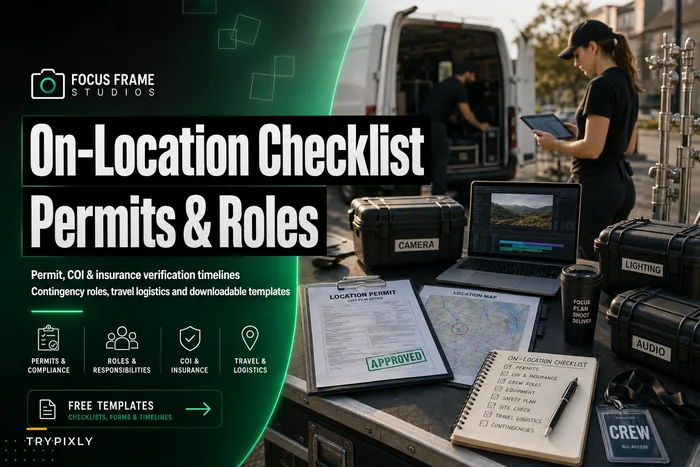
The same on-site rigor you apply to location permits, timelines, and contingency roles should extend to confirming insurance status before anyone sets foot on a job. It's the same instinct — don't discover a gap in the field.
Claims reconciliation mapped to cashflow impact
Almost nobody builds this part: the bridge between an incident and your actual money. Filing a claim isn't the finish line. There's a lag — sometimes weeks, sometimes months — between the incident, the claim, the adjuster's decision, and the deposit hitting your account. During that lag, you may be out of pocket for the reshoot, the refund, the replacement gear, or the client goodwill credit. If you don't track that, incidents quietly erode cashflow in ways that never show up as a line item.
The fix is a reconciliation checklist that treats every incident as a mini financial event with a before-and-after on your cash position.
-
Incident logged with date, type, parties, and full documentation
-
Immediate out-of-pocket costs estimated (reshoot, replacement, refund, comp)
-
Claim filed with reference number and date
-
Deductible amount recorded (this is yours regardless)
-
Expected reimbursement amount and estimated payout date
-
Gap tracked
what you've spent vs. what you'll recover vs. when
-
Client resolution logged and closed
-
Post-incident review
what control would have prevented this
Mapping that to cashflow-impact templates means categorizing incidents by how they hit you:
| Incident type | Typical immediate cash hit | Recoverable? | Cashflow lag risk |
|---|---|---|---|
| Guest injury (GL claim) | Low upfront; legal exposure later | Via GL, after adjustment | Medium-high (long tail) |
| Owned gear damage | High (replacement to keep working) | Via inland marine, minus deductible | Medium |
| Rented gear damage | Immediate liability to rental house | Depends on endorsement | High if uninsured |
| Lost/corrupted client files | Reshoot cost + possible refund | Only if E&O covers it | Medium |
| Data breach | Variable; notification + remediation | Via cyber policy | High |
One thing worth defining in advance: your deductible is a guaranteed cost on every claim, so for smaller incidents it's sometimes cheaper to self-pay and not claim at all — keeping your loss history clean so premiums don't jump. Making that call case-by-case under stress leads to inconsistent, often expensive choices. Set a threshold beforehand. Below it, absorb it. Above it, claim it.
A real scenario
A four-photographer studio running weddings and commercial work had a second shooter's bag stolen from a vehicle during a reception — roughly $8k of bodies and lenses, some of it the studio's, some the shooter's own. The immediate problem was replacing gear fast enough to not miss the next weekend's bookings, which meant close to $5k out of pocket on short notice.
The claim itself was straightforward, but the money took about seven weeks to come back. In the meantime, they'd also quietly covered a reshoot for a corporate client whose headshot files had a card error the same month — another few hundred dollars and a scramble. Neither event was catastrophic on its own, but stacked together they created a cashflow pinch the owner didn't see coming because nothing tracked the lag between spending and recovery.
After building a simple reconciliation log — incident, out-of-pocket, claim status, expected payout date — the change wasn't dramatic revenue; it was visibility. They started self-paying anything under their deductible without filing, keeping their loss history clean, and they could see the "money owed back to us by insurers" number at a glance instead of being surprised by it. The bad months became more predictable, which is almost as good as avoiding them.
When to build this out — and when it's overkill
Build the full system when: you're running multiple photographers or regular 1099 shooters, doing commercial or event work with third parties present, storing client galleries online at scale, or handling enough volume that incidents are a when, not an if. At that point the connective tissue between response, documentation, waivers, and claims is doing real work every month.
Keep it light when: you're solo or near-solo, low-risk session types, no outside crew. You still need proper coverage and decent waivers — don't skip those — but you don't need a formal reconciliation dashboard for two incidents a year.
Who should not over-engineer this: newer studios still finding product-market fit. Spend your energy getting the policies right and a basic incident log in place. The elaborate vendor-tracking and cashflow-template machinery can wait until you have the volume to justify it.
Pulling it together
The reason incident response and insurance get treated as separate problems is that they feel like separate problems — until the day they collide and you realize they were always one workflow. The script your second shooter uses in the first ten minutes affects whether your insurer pays. The waiver you updated (or didn't) affects your liability ceiling. The COI you forgot to re-verify affects whose policy absorbs the hit. And all of it eventually shows up in your cash position, with a lag that catches owners off guard.
The following visual maps the workflow from incident to cashflow reconciliation.
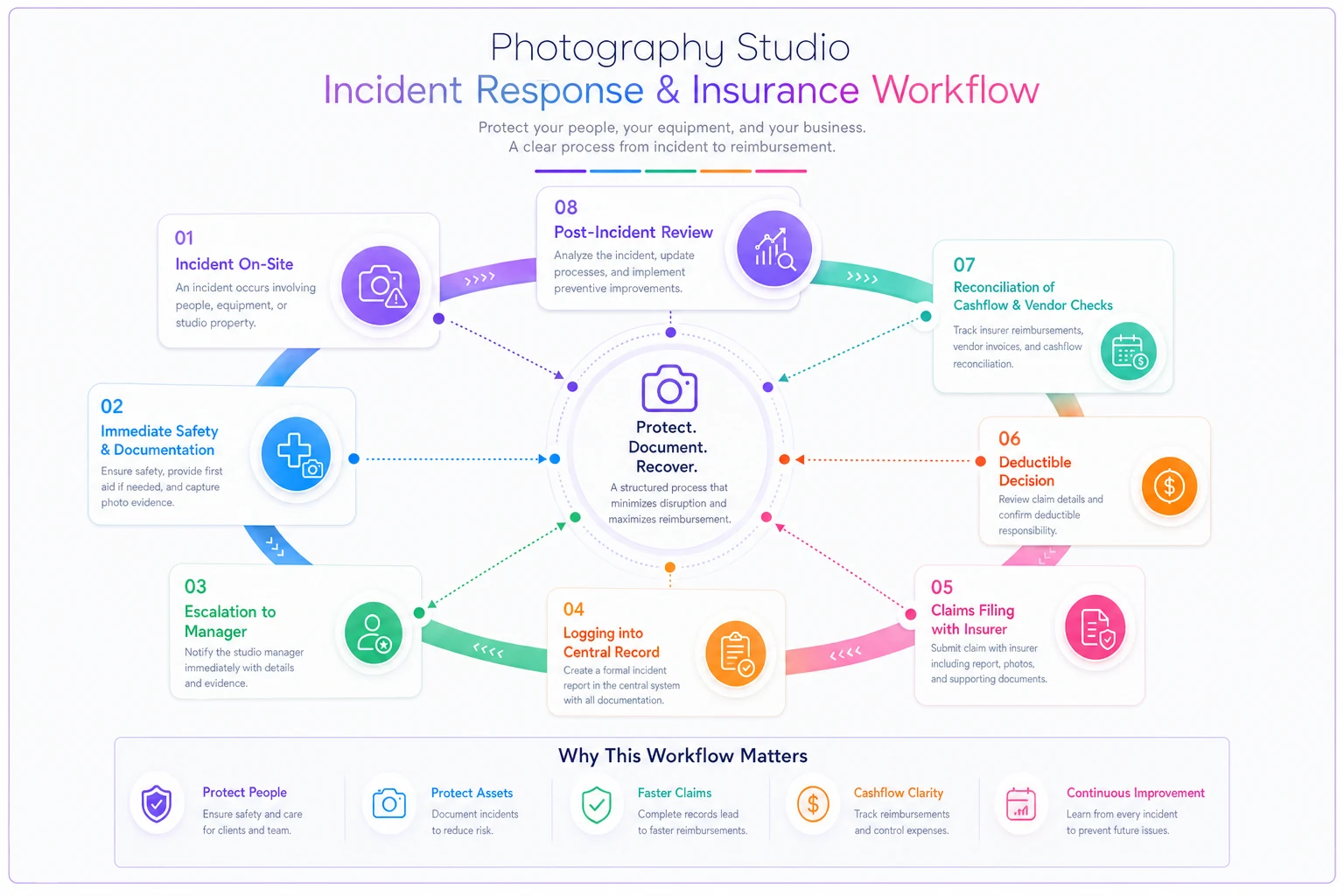
You don't need to build all of this at once. Start with the coverage decisions and the first-hour scripts, because those protect you during the incidents most likely to actually happen. Add waivers that name real risks. Layer in vendor checks as you bring on outside crew. And once incidents become routine enough to pinch your cashflow, build the reconciliation layer so you're never surprised by money you're owed. The studios that handle their worst days well aren't luckier — they just decided what to do before the bad day arrived.
The studios that handle their worst days well aren't luckier — they just decided what to do before the bad day arrived.
Ready to elevate your studio’s workflow?
Join 500+ studios using TryPixly to save time, reduce scheduling conflicts, and deliver exceptional client experiences.