


Most studios don't have a vendor problem until they suddenly have five of them at once. A print lab misses a wedding album deadline, your go-to retoucher goes dark for ten days, the MUA you booked for a corporate headshot day cancels the morning of, and the rental house you've used for three years swaps your reserved body for "an equivalent model" that isn't equivalent at all. None of these are catastrophic on their own. Together, in the same month, they tell you something about how your studio actually runs behind the scenes.
Your vendors are part of your production line whether you treat them that way or not. A studio that runs tight internal operations but loose external ones is only as reliable as its weakest outside partner. And because those partners live outside your walls, their failures tend to surface late — usually at the client-facing end, where they do the most damage.
This is a playbook for treating that external ecosystem as a managed system: qualifying vendors properly, writing SLAs that actually fit each vendor type, scoring performance, building escalation paths that don't depend on you personally texting someone at 11pm, running calibration meetings, and keeping a live contingency bench for the roles that can sink a shoot.
Why vendor ecosystems break the way they do
The pattern is almost always the same. A studio finds a vendor through a referral or a lucky first job, the relationship works, and then it just... continues. No contract beyond an email thread, no defined turnaround in writing, no backup if that person disappears. The whole thing runs on goodwill and habit.
That works fine at low volume. When you're doing eight sessions a month and one wedding a quarter, a single retoucher and a single print lab is a reasonable setup. Problems are rare enough that you absorb them personally — stay up late fixing files, make the apology call, eat the cost.
What breaks at scale isn't the vendor. It's the concentration. As volume climbs, every vendor you depend on becomes a single point of failure with no redundancy. A pretty typical example: a studio grows from roughly 10 to 35 shoots a month over two years but still uses the one retoucher they started with. That retoucher is now a bottleneck on every delivery, and the studio has no leverage, no backup, and no documented standard — so quality drifts and nobody notices until a client complains.
The second failure mode is that nobody owns the relationship. In solo studios the owner handles everything. As you add staff, vendor communication gets scattered across whoever happened to email the lab last. Specs live in people's heads. When the person who "knew how to talk to the lab" leaves or goes on vacation, institutional knowledge walks out with them.
The real problem isn't finding good vendors. It's building a structure that survives growth, staff turnover, and the inevitable bad month.
Vendor qualification: stop hiring on vibes
Most studios qualify vendors backwards. They give a vendor the real, high-stakes job first — a paying client's wedding album, a retouching batch due tomorrow — and find out whether the vendor is good by whether that job blows up. That's an expensive way to run a tryout.
Never miss a shoot or client detail again.
TryPixly helps you book, confirm, and manage every photography session seamlessly.
- Unified session and client management
- Automated client reminders
- Team calendar & resource scheduling
No credit card required
-
Printers / labs Order a paid test print run of the exact products you sell — the album, the 16x24, the fine-art paper, the packaging. Judge color accuracy against your calibrated proofs, physical build quality, and how they pack for shipping. A lab that prints beautifully but packs carelessly will cost you reprints.
-
Retouchers Send a small paid batch (5–10 images) that includes your hardest cases — mixed lighting, heavy skin work, a group shot with uneven exposure. You're not testing whether they can retouch an easy image. You're testing their judgment on the ones that usually cause revision rounds.
-
MUAs Do a paid calibration session or trial. Watch timing, hygiene, how they handle a range of skin tones, and whether they communicate naturally with the subject. An MUA who's slow throws off your whole shoot schedule even if the work is gorgeous.
-
Rental houses Place a small real rental first. Check gear condition, whether reservations are actually honored, how substitutions are handled, and what their late-return and damage policies say in writing.
The insight most studios miss: qualification isn't a one-time gate. A vendor who passed two years ago isn't automatically still qualified. Labs change ownership, retouchers get busy and start outsourcing your work without telling you, MUAs raise rates and lower effort. Re-qualification should happen on a schedule, not only after something breaks.
SLA templates by vendor type
A single generic SLA for all vendors is close to useless, because what can go wrong is completely different per role. A retouching SLA obsessed with turnaround says nothing useful to a rental house. Build a short template per vendor type, and keep each one to the handful of metrics that actually predict a failure.
| Vendor type | Core SLA metrics | Typical standard | Main failure mode it prevents |
|---|---|---|---|
| Printer / lab | Color accuracy, production turnaround, defect/reprint rate, packaging quality | 5–10 business days; reprint rate under ~2% | Late albums, color mismatches, damaged-in-transit prints |
| Retoucher | Turnaround per batch, revision rate, spec adherence, file-naming compliance | Agreed per batch; first-pass acceptance above ~85% | Rework loops, blown delivery dates, inconsistent style |
| MUA | On-time arrival, time-per-face, kit hygiene standards, cancellation notice | On-site 30 min early; defined notice window | Shoot-day delays, last-minute cancellations |
| Rental house | Reservation guarantee, substitution policy, gear condition, damage/late terms | Written hold; no silent swaps | Missing bodies/lenses on shoot day |
A few things that make SLAs real instead of decorative. First, put consequences in writing — not necessarily penalties, but at minimum what happens when the standard is missed (reprint at their cost, priority on the next job, a documented strike). Second, define the notice window for cancellations and delays explicitly, because "as soon as possible" is not a window. Third, spell out handoff specs in the SLA itself rather than re-explaining them every job.
That last point is where retouching SLAs live or die. If you want the full breakdown of handoff specifications and QC gates for outsourced editing, the deeper piece on preventing outsourced retouching disasters is worth reading — the file-spec and three-gate logic there plugs directly into the retoucher SLA above.
Scorecards: making vendor quality visible
The reason bad vendor relationships drag on is that nobody's keeping score. Problems feel like isolated incidents — "the lab was just slow that one time" — because there's no record showing it's actually the third time this quarter. Memory is forgiving; a scorecard isn't.
-
On-time rate — percentage of jobs delivered within the SLA window.
-
Quality / first-pass rate — how often the work was accepted without rework or reprint.
-
Revision or defect rate — how much back-and-forth each job generates.
-
Responsiveness — how fast they reply when you need an answer.
-
Issue count — logged incidents, even small ones.
The number that reveals the most is usually the trend, not the absolute. A retoucher sitting at a 90% first-pass rate who's been slipping a couple points a quarter is telling you something before it becomes a crisis. A lab whose reprint rate crept from near-zero to around 4% is heading somewhere you don't want to go. Scorecards turn "I have a bad feeling about this vendor" into a conversation you can actually have with evidence.
One practical pattern worth adopting: tie the scorecard to your fulfillment records so print and packaging failures get logged automatically rather than depending on someone remembering to note them. The operational side of that — catching defects before they reach the client — connects directly to how you run album, print and packaging operations, where the QC checkpoints double as data points for the lab's scorecard.
Escalation paths that don't depend on you
Something that plays out more often than it should: a retoucher misses a deadline, a staff member notices, and then nothing happens for a day because they don't know whether it's their job to chase it, who to tell, or what counts as "late enough to escalate." The delay inside your own studio often costs more than the vendor's delay.
An escalation path fixes this by defining, in advance, what happens at each stage of a problem and who owns it. It should be boring and mechanical on purpose.
A workable structure: Level 1 is the routine nudge — the vendor missed a soft checkpoint, so the assigned coordinator sends a standard follow-up and logs it. Level 2 triggers when the SLA window is actually breached: the coordinator contacts the vendor directly, gets a committed recovery time, and flags the affected client job. Level 3 is when recovery isn't credible or the client delivery is now at risk — the contingency bench gets activated and the studio owner or production lead is pulled in to make the call. Moving from Level 1 to Level 3 shouldn't require anyone to improvise.
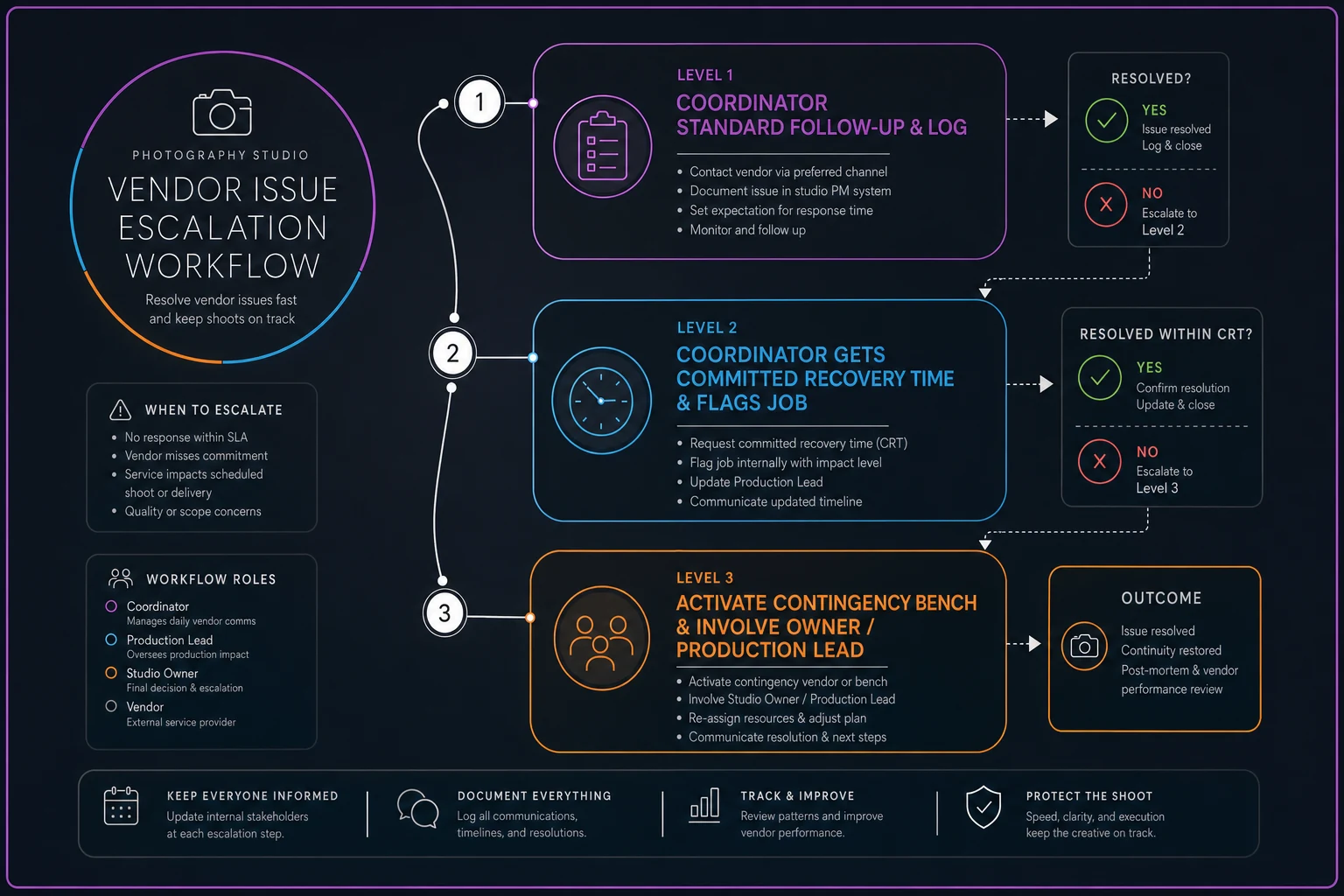
The mistake studios make is treating escalation as a personality trait — the owner is the escalation path. That doesn't scale and it doesn't survive you being on a shoot, on a plane, or asleep. Write down the triggers and the owner for each level, and the whole thing runs without heroics.
Calibration meetings: aligning before drift sets in
Quality drift with external vendors is sneaky because you only ever see the output, not the process. A retoucher slowly shifts their skin-tone handling toward something you wouldn't choose. A lab's new printer runs slightly cool. An MUA starts doing the same look on everyone to save time. None of these announce themselves.
Calibration meetings catch drift before it becomes a reshoot. These aren't status updates — they're alignment sessions. Twice a year with your core vendors is usually enough, more often if you're onboarding someone or if the scorecard is trending down. For retouchers and labs, bring real recent examples: images where your taste and their output diverged, side by side. For MUAs, review a shoot's worth of results and talk through what worked. For rental houses, it's more of a relationship conversation — what gear they're adding, what's hard to reserve during peak season.
The underrated benefit of calibration meetings is that they build the relationship capital you'll need during a crunch. The vendor who meets with you twice a year and feels like a partner is the one who'll squeeze your rush job in ahead of someone they've never talked to. Transactional vendors treat you transactionally.
Contingency partner lists: the bench nobody builds until it's too late
Every critical vendor role needs a backup you've already qualified — not a name you'll Google in a panic. The contingency list is the single highest-leverage, least-done part of vendor management, because building it requires work during calm periods to prevent disasters during busy ones, and that's exactly the kind of thing that never feels urgent.
-
Printers at least one secondary lab you've run a real test order through, ideally one that can handle rush jobs even if their standard pricing is higher.
-
Retouchers one or two backups already onboarded to your file specs and style guide, so activating them doesn't require a week of calibration.
-
MUAs a short list of artists who've worked your style, geographically sensible, with known rates and availability patterns.
-
Rental houses a second supplier for your most-used bodies and lenses, because "sold out during wedding season" is not a hypothetical.
Qualify backups with a real test order and occasional small jobs so they can be activated fast.
The critical detail: a contingency vendor is only real if they can be activated fast. A backup retoucher who's never seen your file-naming conventions or your style guide isn't a backup — they're a future emergency onboarding project. Qualify the bench the same way you qualify primaries, keep their specs current, and send them an occasional small job so the relationship stays warm. This is the external mirror of keeping your internal editing pipeline resilient; the same substitution thinking that keeps a distributed editing operation predictable applies to the vendors feeding it.
A real scenario
A mid-sized portrait and wedding studio — roughly 30–40 shoots a month across three photographers — ran everything through one retoucher and one print lab for years. During one spring the retoucher took on another big client and her turnaround quietly stretched from about a week to nearly three. Because there was no scorecard, nobody caught the trend until two wedding galleries were late and a client posted about it.
The fix wasn't dramatic. They wrote a one-page SLA with a turnaround window and a first-pass acceptance target, started logging every batch's turnaround and revision count on a simple scorecard, and spent two slow weeks qualifying a second retoucher and getting her onto their file specs. They also set a plain escalation rule: if a batch is two days past the window, the studio manager — not the owner — contacts the vendor and, if there's no credible recovery, routes the job to the backup.
Over the following few months, late deliveries essentially stopped. The original retoucher, now aware her turnaround was being tracked and that she wasn't the only option, tightened back up. Revision rounds dropped noticeably because the SLA forced the specs to be written down. The studio didn't spend more money — they just stopped running a critical function on hope.
When this level of structure makes sense — and when it doesn't
If you're a solo shooter doing a handful of sessions a month with one reliable retoucher and a lab you trust, a full scorecard-and-escalation system is overkill. You'll feel problems immediately and fix them yourself. Keep a written spec sheet and know one backup for each role — that's enough.
This playbook starts paying off when you cross the point where you can't personally watch every vendor interaction. Usually that's when you've added staff who deal with vendors, when a single vendor failure can hit multiple client jobs at once, or when you're running enough volume that a 5% defect rate is a real monthly cost rather than a rounding error. Multi-photographer studios, high-volume portrait operations, and anyone doing weddings at scale should treat this as core infrastructure.
Who should not do this: a studio still trying to find product-market fit on their session types, or one so small that maintaining scorecards and calibration meetings costs more than the occasional vendor hiccup. Don't build a vendor ops system to manage three relationships you could run from memory.
Pulling it together
The studios that get burned by vendors aren't the ones with bad partners — they're the ones with no system around good partners. A single retoucher, a single lab, a single MUA, held together by email threads and goodwill, works right up until the month it doesn't. And by then the failure is already sitting in a client's inbox.
Treating your vendor ecosystem like a managed system just means applying outward the same discipline you already apply inside your studio: qualify before you commit, write down the standard, keep score, define what happens when things slip, talk regularly, and always have a bench. None of it is glamorous. All of it is the difference between a vendor problem being a minor logged incident and it being the reason a client never books again. Build the structure while things are calm — because the whole point is that it's already there when they aren't.
Treating your vendor ecosystem like a managed system just means applying outward the same discipline you already apply inside your studio: qualify before you commit, write down the standard, keep score, define what happens when things slip, talk regularly, and always have a bench. None of it is glamorous. All of it is the difference between a vendor problem being a minor logged incident and it being the reason a client never books again. Build the structure while things are calm — because the whole point is that it's already there when they aren't.
Ready to elevate your studio’s workflow?
Join 500+ studios using TryPixly to save time, reduce scheduling conflicts, and deliver exceptional client experiences.