


Most studio owners don't think about integration architecture until something silently fails. A deposit gets charged but the calendar doesn't block the slot. A gallery goes live but the album vendor never received the export. A client pays their balance and the download stays locked because two systems disagreed about whether the invoice was "paid" or "partially paid."
None of these are dramatic failures. That's the problem. They're quiet. And by the time you notice, you've already double-booked a newborn session or a client has emailed you three times asking where their photos are.
Studios don't run on one tool anymore. You've got a booking platform, a digital asset manager or gallery host, a payment processor, and a handful of vendor APIs for albums, prints, retouching handoffs, and licensing. Each one works fine on its own. The failures live in the gaps between them — and those gaps get wider as you grow.
This is about how those pieces connect, where they break, and how to design something that doesn't collapse the first time a webhook times out.
Why the wiring breaks — and why it breaks worse as you scale
When a studio is doing 10–15 sessions a month, integration gaps are survivable. You manually check that deposits matched bookings. You forward gallery links by hand. You remember which orders went to the album lab. The owner is the integration layer.
That human glue doesn't scale, and it fails in a specific pattern. The breakdown doesn't happen gradually — it happens the month you cross into volume you can't personally babysit. Somewhere around 30–40 sessions a month, the mental reconciliation you were doing becomes impossible, and cracks that were always there start leaking money.
A typical example: a studio uses a booking tool that "integrates" with their payment processor. It does — for the initial deposit. But the balance payment happens through a different flow (an invoice link, say), and that event never writes back to the booking record. So the booking still shows "deposit only" internally. The team, trusting the system, chases a client who already paid in full. Now multiply that by a busy season.
The pattern underneath all of these failures: most integrations are one-directional and event-fragile. They fire once, on one trigger, and assume nothing goes wrong. Real operations are full of things going wrong — refunds, reschedules, partial payments, cancelled orders, retries. An integration architecture that only handles the happy path is basically decorative.
The four systems and what they're actually responsible for
Before you can fix the wiring, you have to be honest about which system owns which piece of truth. Most studio chaos comes from two systems both thinking they're the source of truth for the same fact.
Never miss a shoot or client detail again.
TryPixly helps you book, confirm, and manage every photography session seamlessly.
- Unified session and client management
- Automated client reminders
- Team calendar & resource scheduling
No credit card required
| System | Owns the truth about | Common overlap conflict |
|---|---|---|
| Booking / scheduling | Slot availability, session type, client contact, date/time | Thinks it owns payment status too, but often only sees the deposit |
| Payments | What was actually charged, refunded, disputed | Booking assumes "invoice sent" = "paid" |
| DAM / gallery | Which assets exist, delivery status, download rights | Doesn't know whether the balance is paid, so gates the wrong galleries |
| Vendor APIs (albums, prints, retouching, licensing) | Order status, production stage, ship date | Rarely writes status back, so your system shows "ordered" forever |
The single most useful decision you can make is picking one system as the master record for each fact and forcing the others to defer to it. Payments own payment status. The booking system owns scheduling. The DAM owns asset and delivery state. When two systems disagree, you need a rule for who wins — not a judgment call in the moment.
This sounds obvious written down. In practice, almost nobody defines it, which is why a paid client sits behind a locked gallery.
A sample data flow that actually holds together
Abstract architecture advice doesn't help much, so here's what a resilient flow looks like end to end — a single session moving through the pipeline:
-
Client books. The booking system holds the slot and records session type (newborn, which has its own buffer and prep rules). It generates a unique booking ID that every other system will reference. This ID is the spine of everything — without a shared identifier, reconciliation is guesswork.
-
Deposit is charged. The payment processor confirms the charge and sends an event back containing the booking ID. The booking record updates to "deposit paid." If that event fails to arrive, a scheduled job re-checks payment status within a few minutes instead of assuming success.
-
Session happens, assets ingested. The DAM receives the files and tags them with the same booking ID. Now the gallery and the booking are linked by a shared key, not by someone remembering to connect them.
-
Balance is paid. The payment event updates the booking to "paid in full," and the DAM listens for that same status to unlock downloads. Both react to one source of truth — payments — not to each other.
-
Vendor order placed. When an album is ordered, the vendor API returns an order ID, which gets stored against the booking ID. Now you can trace a physical album back to a session in one lookup.
-
Vendor status writes back. As the album moves to production and ships, status updates flow back and update the fulfillment record. If the vendor doesn't push updates, you poll their API on a schedule.
What's holding it together: a shared booking ID, payments as the payment-truth master, and a fallback check whenever an event might have been missed. That third thing — the fallback — is what separates a system that survives a bad Tuesday from one that doesn't.
A quick visual of this flow:
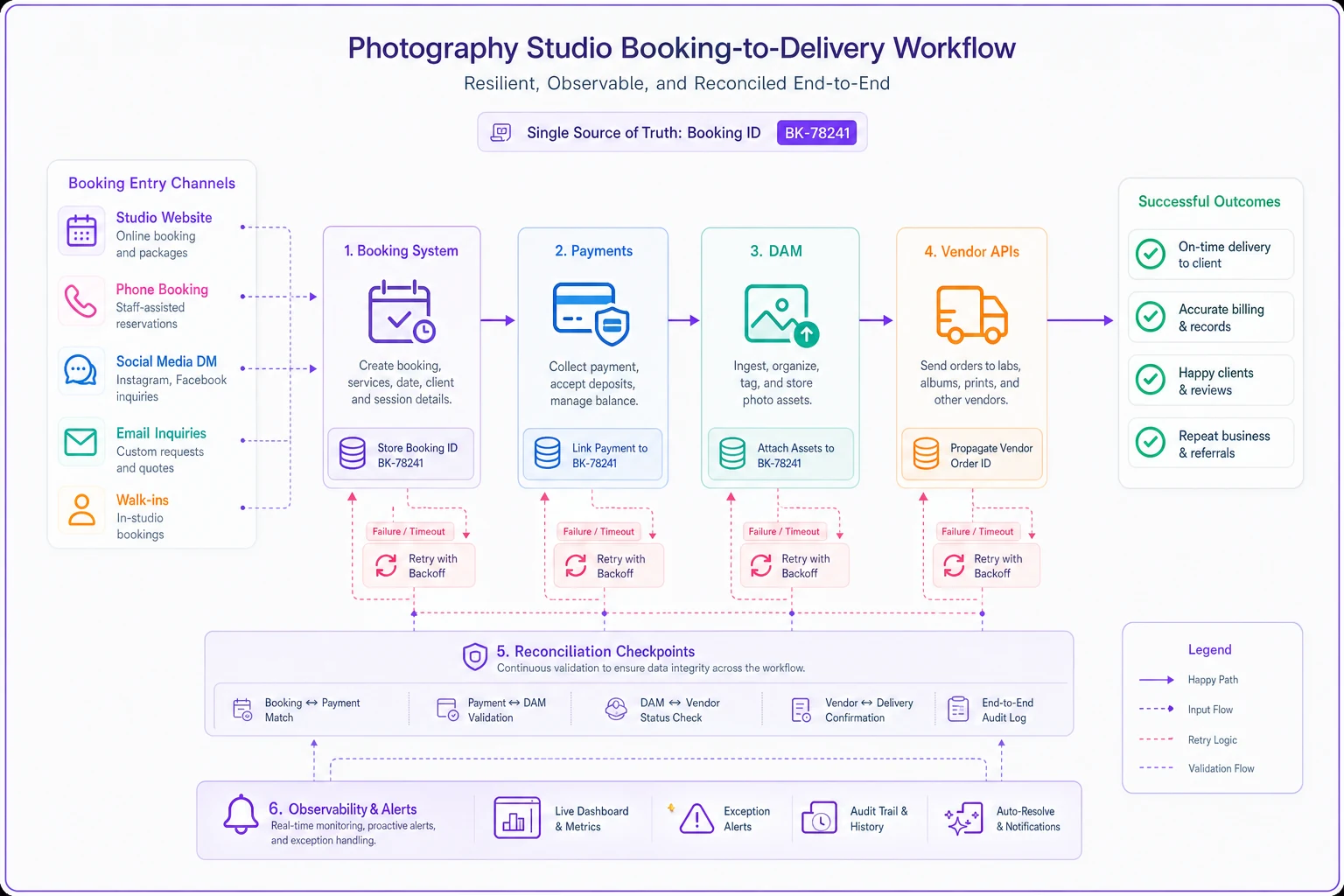
This kind of clean handoff between stages matters even more once you're coordinating outside vendors, which is exactly why disciplined handoff specs and QC gates for outsourced retouching pay off — the integration layer is only as reliable as the specs each stage agrees to.
Error handling: the part everyone skips
Happy-path integrations are easy to build and easy to demo. The reason they fail in production is that nobody designs the guardrails. A real error-handling layer needs to cover:
-
Retries with backoff. When a webhook fails, retry a few times with increasing delays before giving up. A payment processor being briefly unreachable shouldn't permanently break a booking.
-
Idempotency. If the same event arrives twice (it will), the system must not charge twice or duplicate an order. Every action keyed to an event ID, checked before executing.
-
Dead-letter handling. When something genuinely can't be processed, it should land in a visible queue a human can review — not vanish. A silent failure is worse than a loud one.
-
Reconciliation jobs. Once a day, compare payment records against booking statuses and flag mismatches. This catches the events that slipped through everything else.
-
Alerting thresholds. If more than a handful of events fail in an hour, someone gets notified. Not an email nobody reads — an actual alert.
Surface dead-letter queue items to a human-facing dashboard so operations can triage quickly.
The mistake most studios make is treating errors as rare exceptions instead of a normal operating condition. In real operations, a small percentage of events always fail. If your architecture assumes zero failures, your architecture is lying to you.
Build vs. buy: the decision most studios get backwards
The instinct at a certain size is to build custom integrations because off-the-shelf tools "don't do exactly what we need." Sometimes that's right. Usually it's expensive and fragile.
Buy (or use existing integrations) when:
-
The workflow is standard — booking, deposit, gallery delivery, common album labs
-
You don't have technical staff to maintain custom code
-
The vendor already has a maintained connector that covers 80% of your need
-
Downtime on that integration would hurt but not sink you
Build (or commission custom work) when:
-
You have a genuinely unusual workflow that off-the-shelf tools can't model — unusual licensing flows, multi-studio routing, custom vendor relationships
-
The integration touches money or delivery in a way where a generic tool's assumptions are actively wrong
-
You have (or can hire) someone to maintain it, because custom code is a pet, not a purchase
-
The manual workaround is costing you real, measurable hours every week
Who should not build: a two-person studio with no developer, gluing tools together with fragile scripts, will spend more time babysitting the integration than the integration saves. If you're spending your creative energy debugging webhooks, you built the wrong thing.
A middle path that works for a lot of studios is buying a workflow platform that centralizes the booking–payment–delivery record and only commissioning custom connectors for the one or two vendors that genuinely need it. Maintained integrations for the common stuff, custom work only where it earns its keep.
When this makes sense vs. when it's overkill
Not every studio needs a formal architecture. If you're doing 8 sessions a month and you personally touch every one, a spreadsheet and manual checks are fine. Building integration infrastructure at that stage is solving a problem you don't have yet.
The signal that you do need this: you've started making mistakes that come from systems disagreeing, not from people being careless. Double-bookings after a reschedule. Galleries locked for paid clients. Album orders you can't trace back to a session. Those are architecture symptoms, and no amount of "being more careful" fixes them — because the whole point is that you've outgrown being the human integration layer.
This connects directly to how your intake works. Studios that use structured, session-specific onboarding flows tend to feed cleaner data into every downstream system, which means fewer mismatches to reconcile later. Garbage in at booking becomes a reconciliation headache three steps down the line.
A real scenario
A family and newborn studio running roughly 45–55 sessions a month was leaking in two spots. Balance payments through their invoicing tool weren't syncing back to bookings, so staff were locking galleries for clients who'd already paid — a few times a week. Album orders went to two different labs with no unified tracking, so "where's my album?" emails required digging through vendor portals one by one.
They didn't rebuild everything. They picked payments as the single source of payment truth, wired the gallery to unlock strictly off that status, and stored every vendor order ID against the booking ID so any album could be traced in one lookup. They added a daily reconciliation check to flag mismatches.
The result wasn't dramatic. The locked-gallery incidents basically stopped. Album status questions went from a daily annoyance to something the front desk answered in a few seconds. Staff stopped spending an hour or two each week playing detective across portals. Nothing about the sessions changed — the wiring just stopped fighting itself.
That fulfillment-side visibility matters more than people expect. A lot of margin quietly disappears in album, print, and packaging operations precisely because orders lose their thread once they leave your system.
The mindset shift
The core insight is simple and most studios resist it: you are not supposed to be the integration layer. For a while it works, because you're smart and you remember things. But your memory doesn't retry a failed webhook, doesn't reconcile payment records at midnight, and doesn't scale past the point where you can personally verify every booking.
A resilient photography studio integration architecture isn't about buying more software. It's about deciding which system owns which fact, connecting them with a shared identifier, and assuming — correctly — that things will sometimes fail, so you build the guardrails before they do.
Get that foundation right and the failures that used to reach your clients get caught internally, quietly, before anyone notices. Which is exactly how good infrastructure is supposed to feel: invisible, until you remember how bad it was without it.
Ready to elevate your studio’s workflow?
Join 500+ studios using TryPixly to save time, reduce scheduling conflicts, and deliver exceptional client experiences.